Surge Protector vs UPS: 6 Key Differences You Need to Know
A surge protector and a UPS solve two completely different problems, and mixing them up is an expensive mistake — an unprotected UPS rectifier can be destroyed by the very first major surge event. This guide gives you the IEC-standard differences, the correct installation order, and two scenarios (generator switching, UPS output transients) most articles skip entirely.
Quick Answer: Surge Protector vs UPS
A surge protector (SPD) clamps voltage spikes in under 25 nanoseconds — certified to IEC 61643-11 with a rated Imax (kA) and VPL (kV).
A UPS supplies battery power during outages. It is not a certified SPD — no rated Imax, no rated VPL, does not meet IEC 61643-11.
Install rule: SPD upstream, UPS downstream — always. One direct lightning strike destroys an unprotected UPS rectifier regardless of topology.
The surge protector vs UPS confusion costs industrial facilities real money — not because engineers don't understand either device, but because marketing language blurs the line. "UPS with built-in surge protection." "Battery backup surge protector." These claims are not false, but they are dangerously incomplete.
This ups vs surge protector comparison gives you the IEC-standard technical distinctions, the correct installation sequence most competitors contradict each other on, and two industrial scenarios — generator ATS switching and UPS output-side transients — that most other articles skip.
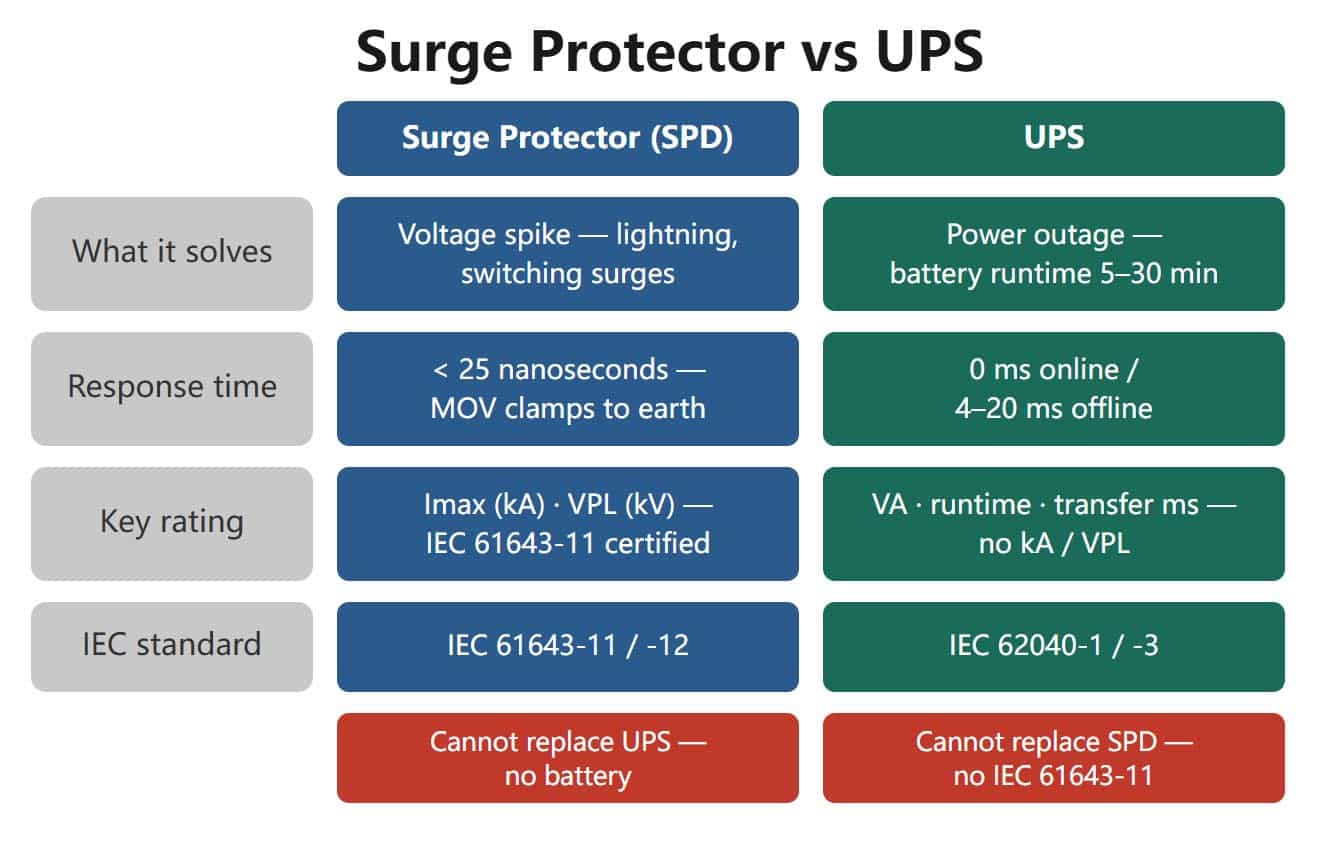
1. Surge Protector vs UPS: The 6 Core Differences
Surge protector vs UPS comes down to six parameters, and each one directly affects how you specify and design the system. An SPD stops a voltage spike from ever reaching your equipment; a UPS keeps your equipment running when the power cuts out completely — one is about spikes, the other is about outages, and you usually need both.
| Parameter | Surge Protector (SPD) | UPS |
|---|---|---|
| What it solves | Transient overvoltage — lightning, switching surges, utility spikes (1–500 µs duration) | Power interruption — complete loss of mains supply (seconds to hours) |
| Response time | <25 ns (MOV clamping) | 0 ms (online double-conversion) / 4–20 ms (offline / line-interactive) |
| Governing standard | IEC 61643-11 (product) · IEC 61643-12 (application) | IEC 62040-1 (safety) · IEC 62040-3 (performance) — not IEC 61643-11 |
| Key ratings | Imax in kA (discharge current) · VPL in kV (clamping voltage) · Type 1/2/3 classification | VA/kW (load capacity) · runtime (minutes) · transfer time (ms) — no kA, no VPL |
| Connection mode | Parallel (shunt) — electrically invisible to the load during normal operation; diverts surges to earth | Series — all load current flows through the UPS continuously |
| Can it replace the other? | No — no battery, load goes dark during an outage | No — no IEC 61643-11 rating, the rectifier is itself surge-vulnerable |
Table 1: Surge Protector (SPD) vs UPS — 6 Core Differences
kA vs Joules — the spec confusion that kills B2B procurement: IEC 61643-11 rates panel SPDs by Imax in kA — peak discharge current, 8/20 µs waveform, tested 15 times. UL 1449 consumer strips use Joules — cumulative energy absorbed. These measure different things. A "1,000 J" power strip and a "40 kA Type 2 SPD" are not equivalent. For any industrial or UPS-upstream application, specify by IEC kA — see Section 5 for the full comparison.
2. Does a UPS Protect Against Power Surges? By Topology
No matter which UPS topology is in use, the answer is the same — the UPS may protect the load from a power surge, but nothing protects the UPS itself unless an SPD is added upstream of it. In the surge protector vs UPS decision, topology changes the details but not the bottom line: no UPS meets IEC 61643-11, and the UPS rectifier is always exposed to incoming surge energy.
| UPS Topology | What happens during a surge | What is NOT protected |
|---|---|---|
| Offline / Standby | Load stays on mains during normal operation. The surge passes straight through. Transfer to inverter takes 4–12 ms — the surge is already gone and the damage is done. | Both load and UPS input electronics. Worst topology for surge exposure. |
| Line-Interactive | AVR transformer handles sustained over/undervoltage. Some MOV input filtering. Response is still milliseconds — far too slow for a 1–50 µs lightning transient. | UPS rectifier and input capacitors absorb residual surge energy and degrade over time. |
| Online Double-Conversion | Load powered continuously from the inverter — fully isolated from mains transients. Load is protected. | The UPS rectifier itself. IGBTs/MOSFETs rated ~1,200 V face a 4–10 kV mains surge directly. Rectifier repair = 40–60% of unit cost. |
Table 2: Does a UPS Protect Against Power Surges? — By Topology
Several widely-cited articles claim a double-conversion UPS "eliminates the need for surge protection" because the load is isolated on the inverter output. This ignores the rectifier — the most expensive component in the UPS. The isolation protects the load. Without an upstream SPD, the UPS itself is destroyed by the first major surge event. In fact, independent testing confirms traditional AC UPS units do not provide certified surge protection on their own — see FAQ 7.5.
The "built-in surge protection" claim on UPS datasheets — a key ups vs surge protector misconception — refers to un-rated MOV components on the input: no Imax specified, no certified VPL, no IEC 61643-11 end-of-life thermal disconnector. It degrades silently and is not a substitute for a Type 2 SPD. See also: when to replace a surge protector — the same silent-degradation risk applies to any un-monitored MOV device.
3. Surge Protector Before or After UPS? IEC 61643-12 Is Unambiguous
SPD before UPS. Always. This is where most competitor articles either contradict each other or go silent — and it is the single most consequential surge protector vs UPS installation decision.
The installation order is governed by IEC 61643-12 §5.1, which establishes the protection zone sequence from the service entrance inward. Every piece of equipment downstream of a Lightning Protection Zone (LPZ) boundary — including UPS systems — requires coordinated upstream SPD protection. The UPS is not an SPD. It is equipment that needs protection like everything else on that circuit.
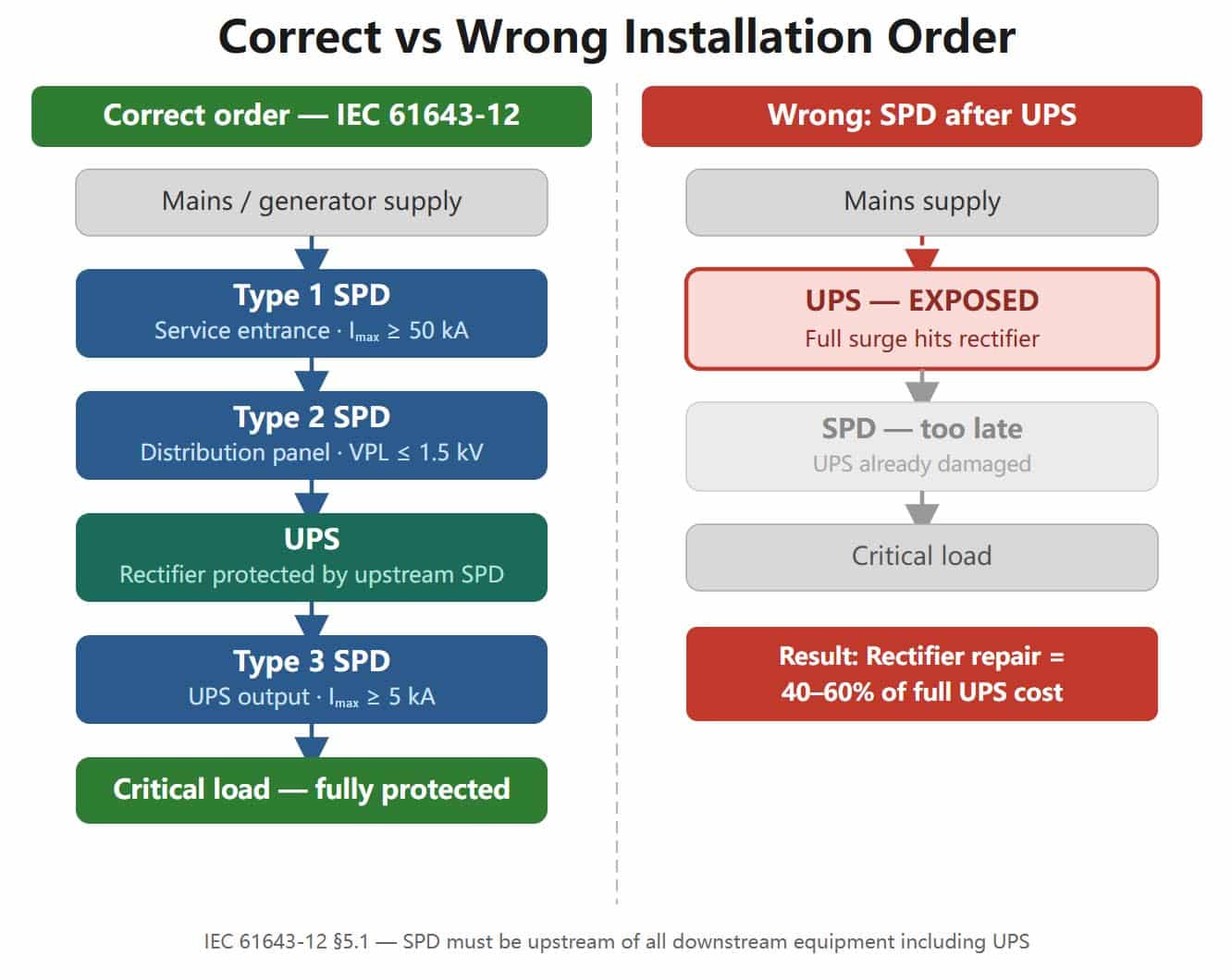
3.1 Complete Installation Sequence
| Order | Correct sequence | What happens if reversed |
|---|---|---|
| 1 | Service entrance: Type 1 SPD (Imax ≥ 50 kA, 10/350 µs) — required where overhead lines or an LPS exist | SPD placed after the UPS leaves the rectifier fully exposed. Full surge energy hits IGBTs/MOSFETs rated ~1,200 V. Result: rectifier destroyed, repair cost 40–60% of unit price. During UPS bypass mode, the load also sits on mains with zero SPD coverage. |
| 2 | Distribution panel: Type 2 SPD (Imax ≥ 20 kA, VPL ≤ 1.5 kV) — upstream of the UPS feed | |
| 3 | UPS: receives clamped voltage — rectifier protected | |
| 4 | UPS output: Type 3 SPD (Imax ≥ 5 kA) — load-side transient protection |
Table 3: Complete Installation Sequence — Correct Order vs Consequence of Reversal
Three sources generate transients on the UPS output bus that make a Type 3 SPD on the output necessary too: load-switching from motors or compressors on the same bus, inverter commutation notches, and bypass mode — when the UPS transfers the load directly to mains for overload or maintenance. A Type 3 SPD on the output bus provides protection independent of UPS operating mode. See our SPD installation guide for full wiring and MCB sizing guidance.
4. Generator + UPS: The Hidden Surge Threat
Every generator transfer sends a switching surge through the system, and repeated over years without protection, this quietly wears out a UPS years ahead of schedule. In any facility with a standby generator, ATS switching surges are repetitive, predictable, and cumulative — degrading UPS rectifiers to a 3–4 year MTBF instead of the designed 10–12 years.
4.1 What Happens at Every Generator Transfer
When the ATS switches between mains and generator, the event generates a transient per IEC 61000-4-5 Combination Wave: up to 6 kV / 3 kA on a 230V system. This hits the UPS rectifier directly if no SPD is installed upstream of the UPS feed.
The failure is cumulative, not catastrophic. Each ATS operation causes micro-thermal stress on the rectifier capacitor banks. In facilities running weekly generator tests — standard for Tier II+ data centers, hospitals, and industrial plants — that is 52 surge events per year. After 3–4 years, the rectifier fails under load at the worst possible moment.
Field data: UPS rectifier MTBF in industrial facilities with weekly generator cycles — without upstream SPD: 3–4 years. With a Type 1+2 combined SPD at the ATS output plus a Type 2 SPD on the UPS feed: 8–10 years. The protection cost is a fraction of one rectifier replacement.
On top of the switching surge risk, generator output also carries 15–25% THD (versus <5% from utility mains). Sustained harmonic stress degrades UPS rectifier capacitors and battery charger circuits independently of surge events — another reason panel-level SPD at the generator feed is essential, not optional.
4.2 Correct Architecture for Generator + UPS Installations
| Location | Device | Spec | Purpose |
|---|---|---|---|
| ATS output / generator feed | Type 1+2 combined SPD | Iimp ≥ 12.5 kA (10/350 µs) · Imax ≥ 40 kA (8/20 µs) | Intercepts generator switching surges before they reach the distribution system |
| UPS feed circuit (distribution panel) | Type 2 SPD | Imax ≥ 20 kA · VPL ≤ 1.5 kV | Final clamping stage immediately before the UPS rectifier input |
| UPS output / load distribution | Type 3 SPD | Imax ≥ 5 kA · VPL ≤ 1.0 kV | Protects critical load from output-bus transients and bypass mode exposure |
Table 4: Correct Architecture for Generator + UPS Installations
5. IEC vs UL: Why kA and Joules Are Not Interchangeable
A consumer power strip's "Joules" rating and an industrial SPD's "kA" rating are not the same kind of number and cannot be converted from one to the other — this is the specification confusion that most damages surge protector vs UPS procurement decisions. Almost no competitor explains it correctly.
| Parameter | IEC 61643-11 (industrial / global) | UL 1449 (consumer / North America) |
|---|---|---|
| Primary surge rating | Imax in kA — peak discharge current, 8/20 µs waveform, tested 15 times at full rating | Joules — cumulative energy absorption across multiple events |
| Clamping voltage | VPL in kV — tested and certified at rated Imax | Clamping voltage in V — tested at lower, less standardized current levels |
| Applicable products | Panel-mount Type 1/2/3 industrial SPDs — UPS upstream protection, ATS installations, data centers | Consumer power strips, desktop surge protectors |
Table 5: IEC 61643-11 vs UL 1449 — Rating Systems Compared
Procurement rule: for any panel-mount SPD installed upstream of a UPS, specify by Imax (kA) and VPL (kV) per IEC 61643-11. Any datasheet that only lists Joules is a consumer product, not an industrial SPD. See our IEC 61643-11 standards guide for a full breakdown of how to read SPD datasheets and Type classifications.
6. Conclusion: Both Devices, Correct Order
Surge protector vs UPS isn't really an either-or question for any facility that can't tolerate downtime or equipment loss — it's a "both, in the right order" question. The SPD stops the surge from ever reaching your equipment, including the UPS itself. The UPS keeps your critical load running through an outage. Skip the SPD, and the UPS rectifier becomes the single point of failure in a system that was supposed to protect you.
Explore TrilPeak's IEC 61643-11 certified SPD range for UPS and generator protection: Type 1 SPD · Type 2 SPD · Type 1+2 Combined SPD · Type 3 SPD.
7. FAQ: Surge Protector vs UPS
7.1 Does a UPS protect against power surges?
Partially — but not to IEC 61643-11 standard. Every UPS contains MOV components on the input, but no UPS carries IEC 61643-11 certification or specifies a rated Imax or VPL. In an online double-conversion UPS the load is isolated from mains transients, but the UPS rectifier absorbs the full surge and fails. Only a certified Type 2 SPD upstream of the UPS protects both the load and the UPS itself.
7.2 Do I need a surge protector with a UPS?
Yes. IEC 61643-12 requires coordinated SPD protection at every Lightning Protection Zone boundary — which includes the feed circuit to any UPS. The SPD protects the UPS from surge damage. The UPS protects the load from outages. Removing either breaks the protection chain.
7.3 Surge protector before or after UPS?
Before — always. The SPD must sit between the distribution panel and the UPS input. An SPD installed after the UPS only protects the load from output-side transients; it does nothing for the UPS rectifier, which is directly exposed to mains surge energy. Per IEC 61643-12: service entrance → Type 1 SPD → distribution panel → Type 2 SPD → UPS → Type 3 SPD → critical load.
7.4 Can a UPS replace a surge protector?
No. A UPS has no IEC 61643-11 rating, no specified Imax, no certified VPL, and no mandatory end-of-life thermal disconnector for its internal MOV components. It cannot substitute for any Type 1, 2, or 3 SPD in an IEC 61643-12 protection design. The UPS is equipment that needs surge protection — it does not provide it.
7.5 Do traditional AC UPS units provide surge protection?
Not to a certified standard. Traditional offline and line-interactive AC UPS units include basic MOV components on the input for cosmetic protection, but these are not tested or rated to IEC 61643-11 — no defined Imax, no certified VPL, no end-of-life disconnection mechanism. They offer some incidental protection against small transients but provide no guaranteed clamping performance against a real lightning-induced surge. A dedicated, certified SPD upstream of the UPS is required for real protection.
7.6 Does a double-conversion UPS eliminate the need for an SPD?
No. The double-conversion topology isolates the load from mains transients via the rectifier–battery–inverter chain. But the rectifier itself — IGBTs and MOSFETs rated ~1,200 V — is directly exposed to mains surge energy of 4–10 kV. Without an upstream SPD the rectifier is destroyed. Repair cost is typically 40–60% of unit price.
7.7 What generator surge risk exists for UPS systems?
Every ATS transfer generates a switching transient up to 6 kV / 3 kA (IEC 61000-4-5 Combination Wave). In facilities with weekly generator tests, that is 52 surge events per year hitting the UPS rectifier. Without upstream SPD protection, rectifier MTBF drops to 3–4 years versus the designed 10–12 years. Install a Type 1+2 combined SPD at the ATS output and a Type 2 SPD on the UPS feed circuit.
7.8 What does "UPS with built-in surge protection" mean?
It means the UPS contains MOV components on the input — not a rated, certified SPD. No specified Imax, no certified VPL, no IEC 61643-11 end-of-life disconnection mechanism. These components degrade silently under repetitive surge stress and offer no guaranteed protection level. The claim does not mean the UPS can replace an upstream Type 2 SPD.
7.9 What is the difference between kA (IEC) and Joules (UL) surge ratings?
IEC 61643-11 rates panel SPDs by Imax in kA — peak discharge current at 8/20 µs, tested 15 times at full rating. UL 1449 consumer devices use Joules — cumulative energy absorption. These measure different things and cannot be converted. For any UPS-upstream or panel-mounted SPD application, always specify by IEC kA ratings. Joule-rated products are consumer devices, not suitable for industrial or UPS protection applications.
Related Resources & Standards
Specifying SPDs for a UPS or generator installation?
Send our engineering team your single-line diagram — we'll confirm the correct Type 1/2/3 SPD placement and ratings for your UPS feed, ATS output, and load distribution, usually within 24 hours.