Surge Protection for BESS: DC, AC, and Signal Line Selection Guide
Battery energy storage systems present a more demanding surge protection for BESS brief than most electrical installations. The DC bus voltage is high — 1000 V or 1500 V in most utility and commercial-scale systems. The system operates continuously, with no planned downtime window for remedial work. The consequences of an unprotected surge event extend beyond equipment damage: a transient that triggers the Battery Management System's (BMS's) protection logic can take the entire storage unit offline, with direct impact on grid services or behind-the-meter energy commitments.
Surge protection for BESS needs to be specified at the system level — DC side, AC side, and communication lines — rather than component by component. This guide covers the selection logic for each layer, the installation positions that matter, and the standard compliance requirements that apply. Get surge protection for BESS right at every one of these positions, and the system stays online through the switching and lightning events it will inevitably encounter.
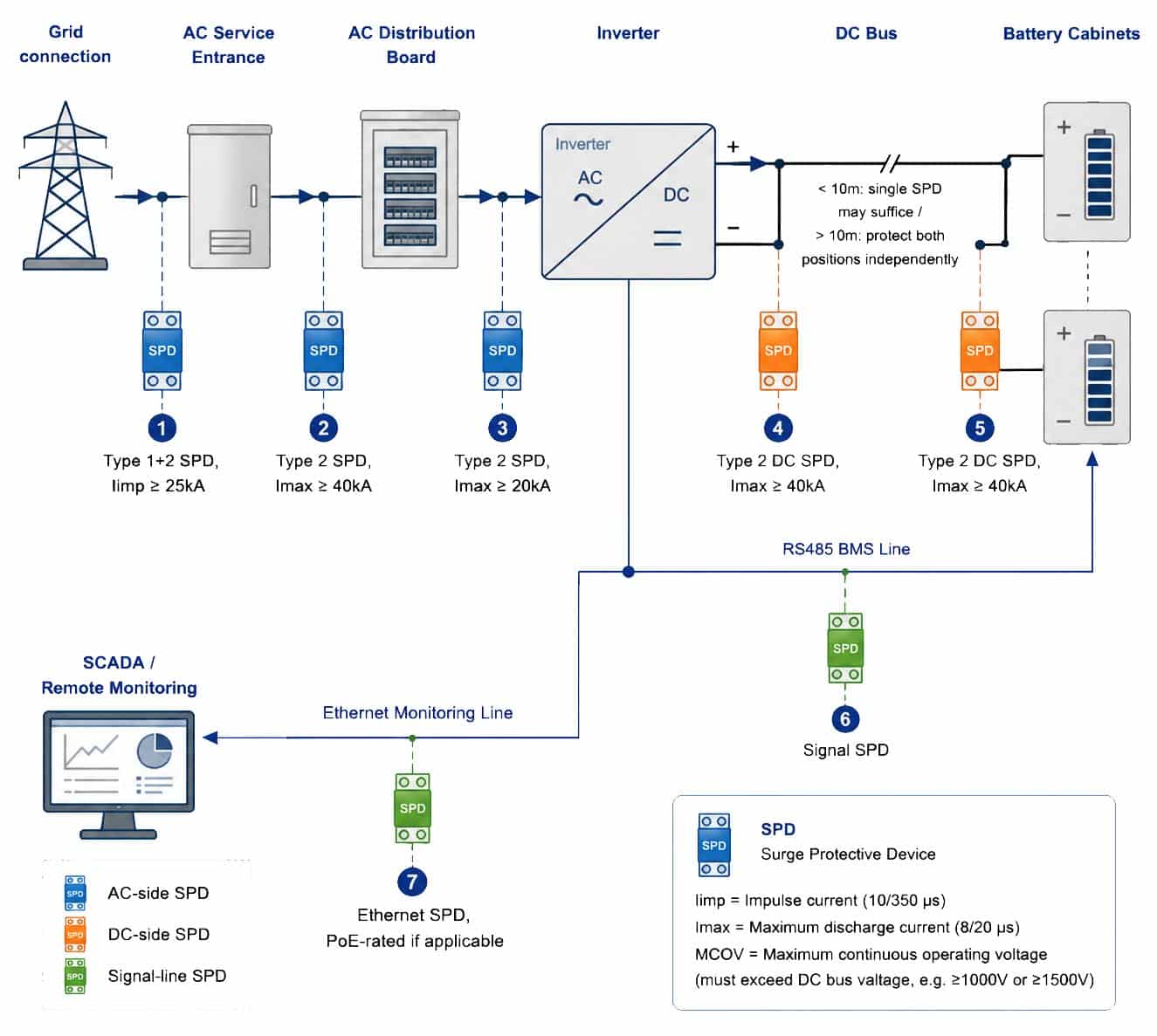
1. Where Surge Risk Originates in a BESS Installation
Four distinct risk sources determine where surge protection for BESS is needed and at what energy level. Understanding each source determines the specification for that position.
Direct and indirect lightning is the primary concern for ground-mounted and rooftop utility-scale installations. Large footprint sites have significant exposure area, and the DC wiring between battery cabinets and inverters acts as an antenna for induced transients. A nearby strike — even one that does not directly contact the installation — can induce several kiloamperes of transient current in unprotected DC cables.
Grid-side switching transients arrive through the AC connection point. Utility grid switching operations, transformer energisation, and capacitor bank switching all generate fast-rise transients that propagate into the inverter's AC terminals. Type 1 protection at the service entrance is the first barrier; without it, these transients reach the inverter unattenuated.
Internal DC switching is specific to BESS and often overlooked. BMS contactors, DC circuit breakers, and charge/discharge switching all generate transients within the DC bus. These are typically lower energy than lightning-induced events but occur far more frequently — potentially thousands of times over the system's operational life — and cause cumulative degradation to unprotected electronics.
Communication line coupling affects BMS communication networks, remote monitoring links, and SCADA connections. Long cable runs between battery cabinets, inverters, and control rooms act as coupling paths for common-mode transients. A surge on the communication lines that reaches the BMS can trigger a false fault condition and cause a protective shutdown even when the power equipment is undamaged.
2. DC-Side SPD Selection
DC-side surge protection for BESS hinges on three parameters — voltage rating, connection mode, and discharge current — and getting any one wrong causes either immediate failure or inadequate protection.
2.1 Voltage Rating: 1000 V vs 1500 V Systems
The most critical parameter for DC-side SPD selection is the Maximum Continuous Operating Voltage (MCOV), which must exceed the maximum DC bus voltage under all operating conditions including charge and temperature variation.
For 1000 V DC systems: MCOV ≥ 1000 V DC. Standard selection: SPDs with MCOV of 1000–1100 V DC and varistor voltage V₁mA in the range of 1400–1500 V.
For 1500 V DC systems: MCOV ≥ 1500 V DC. This is a distinct product requirement — SPDs rated for 1000 V DC systems cannot be used. Confirm explicitly that the SPD datasheet states a 1500 V DC MCOV rating, not a 1000 V rating with a safety margin claimed by the installer.
2.2 Connection Mode and System Grounding
The correct connection mode depends on the system's DC grounding arrangement:
- Floating DC bus (ungrounded): SPDs connected positive-to-ground and negative-to-ground, with appropriate surge current sharing between both poles.
- Negative grounded system: SPD connected positive-to-ground only; the negative rail is already at ground reference.
- IT system (isolated): SPDs connected between each pole and ground, with the ground reference established through the system's isolation monitoring device.
Confirm the grounding arrangement from the system design documentation before specifying the SPD connection mode. An incorrectly connected SPD in a grounded DC system will be permanently forward-biased and will fail immediately on energisation.
2.3 Discharge Current Rating
For utility-scale BESS installations in areas of moderate-to-high lightning exposure, Imax ≥ 40 kA (8/20 μs) per pole is the appropriate starting point for Type 2 DC SPDs. For installations at high-exposure sites — hilltop, coastal, or regions with keraunic level above 40 — or where the DC cable run between battery cabinets and inverters exceeds 30 metres, Type 1+2 combined protection at the DC distribution point should be considered.
2.4 Installation Positions
Two DC-side installation positions are recommended for complete protection:
Position 1 — Battery cabinet DC output terminals: Protects the battery cells and BMS electronics from externally induced transients entering through the DC cable. Install as close to the cabinet terminals as practicable, before any DC overcurrent protection device on the output side.
Position 2 — Inverter DC input terminals: Protects the inverter's power electronics from transients originating in the DC cable run or arriving from the battery side. Many inverter manufacturers specify an SPD at this position as a warranty condition — check the inverter installation manual before finalising the specification.
Where the DC cable run between battery cabinet and inverter is short (under 10 metres), a single SPD at the inverter DC input may provide sufficient protection for both positions. For longer cable runs, both positions should be protected independently.
3. AC-Side SPD Selection
AC-side surge protection for BESS follows a standard three-stage cascade — service entrance, distribution board, and inverter output — coordinated by cable separation distance.
3.1 Service Entrance: Type 1+2 Combined Protection
At the AC connection point — the point of common coupling with the grid — a Type 1+2 combined SPD provides both lightning current handling (10/350 μs waveform, Type 1) and switching transient protection (8/20 μs waveform, Type 2) in a single device. This is the appropriate specification where the BESS has a direct overhead line connection or where the grid operator's network includes overhead sections within the zone of influence.
For installations connected exclusively via underground cable with no overhead sections in the vicinity, a Type 2 SPD at the service entrance may be sufficient — but confirm this with the site's lightning protection risk assessment under IEC 62305-2 before downgrading from Type 1+2.
3.2 Distribution Board: Type 2
At the low-voltage distribution board serving the inverter's auxiliary circuits, control panels, and monitoring equipment, a Type 2 SPD with Imax ≥ 40 kA provides the second protection level. The separation impedance between the service entrance SPD and the distribution board SPD — the cable impedance and any transformers between them — provides the coordination required for the two-stage system to function correctly.
3.3 Inverter AC Output: Type 2 or Type 3
At the inverter's AC output terminals, the appropriate protection level depends on the distance from the service entrance SPD. IEC 61643-12 provides the coordination distance guidance: if the cable distance between the service entrance SPD and the inverter AC terminals exceeds approximately 10 metres, a Type 2 SPD at the inverter AC output is warranted. For shorter distances, the Type 2 at the distribution board provides adequate protection to the inverter AC terminals.
For BESS systems with Power Conditioning Units (PCUs) or auxiliary transformers between the inverter and grid connection, each transformer secondary should be treated as a new protection zone with its own SPD at the distribution board level.
4. Communication and Signal Line Protection
Signal-line surge protection for BESS is frequently the weakest link, since a single unprotected communication cable can trigger a protective shutdown even when all power equipment is undamaged.
4.1 BMS Communication Lines (RS485)
Battery management system communication typically runs on RS485 differential signal lines between individual battery modules, the BMS master, and the inverter or energy management system. These lines are particularly vulnerable to common-mode transients because they span multiple cabinet enclosures, often with cable runs of 10–50 metres.
RS485 signal SPDs must be selected to match the signal voltage level (typically 5 V or 3.3 V logic) and the data rate of the BMS communication protocol. An SPD with too high a clamping voltage will not protect the BMS interface; an SPD with too high a line capacitance will distort high-speed signals and cause communication errors. Confirm the maximum line capacitance specification against the BMS communication protocol's requirements before selection.
4.2 Remote Monitoring and SCADA Lines (Ethernet)
Ethernet connections between the BESS inverter, energy management system, and remote monitoring infrastructure should be protected with Ethernet SPDs at each end of any cable run that exits a building or transitions between separately earthed structures. Power over Ethernet (PoE) circuits require SPDs rated for the PoE power level in addition to the signal protection requirement.
4.3 Alarm and Control Lines
Low-voltage signal lines for remote alarm outputs, digital I/O, and auxiliary control functions should be protected with signal SPDs matched to the operating voltage and current of each circuit. The protection level (Up) of the signal SPD must be below the input protection voltage of the connected control equipment.
5. IEC 62109 and IEC 61643 Compliance
Three IEC standards govern surge protection for BESS installations, and confirming DC-side SPDs meet the correct one is a common specification gap. IEC 62109 (Safety of power converters for use in photovoltaic power systems, Parts 1 and 2) is the primary safety standard for BESS inverters and power conversion equipment. It does not specify SPD requirements directly, but it defines the overvoltage withstand categories for inverter input and output terminals — which in turn determine the minimum protection level (Up) required from the SPDs protecting those terminals.
The SPDs themselves must comply with IEC 61643-11 (AC systems) and IEC 61643-31 (DC SPDs for photovoltaic applications, which is also applicable to BESS DC circuits). For system integrators and EPC contractors specifying BESS installations, confirming that DC-side SPDs carry IEC 61643-31 test reports — not only IEC 61643-11 — is important: the DC standard includes specific tests for reverse polarity tolerance and DC follow current interruption that the AC standard does not cover.
6. Surge Protection for BESS: Specification Summary by Position
| Position | SPD Type | Standard | Recommended Imax | Notes |
|---|---|---|---|---|
| DC battery cabinet output | Type 2 DC | IEC 61643-31 | ≥ 40 kA | MCOV matched to DC bus voltage |
| DC inverter input | Type 2 DC | IEC 61643-31 | ≥ 40 kA | Check inverter warranty requirement |
| AC service entrance | Type 1+2 | IEC 61643-11 | ≥ 25 kA (Iimp) | Type 1 if overhead line connection |
| AC distribution board | Type 2 | IEC 61643-11 | ≥ 40 kA | Auxiliary circuits and control panels |
| AC inverter output | Type 2 | IEC 61643-11 | ≥ 20 kA | If > 10 m from service entrance SPD |
| RS485 BMS lines | Signal SPD | IEC 61643-21 | — | Match signal voltage and data rate |
| Ethernet monitoring | Ethernet SPD | IEC 61643-21 | — | PoE-rated if applicable |
This is the reference table for specifying surge protection for BESS across every position in the system — from grid connection to the individual battery cabinet.
7. Frequently Asked Questions
7.1 Can I use a 1000 V DC SPD on a 1500 V DC BESS system?
No. When specifying surge protection for BESS, the SPD's maximum continuous operating voltage (MCOV) must exceed the maximum DC bus voltage under all operating conditions. A 1000 V DC rated SPD cannot be used on a 1500 V DC system. Confirm explicitly that the SPD datasheet states a 1500 V DC MCOV rating — do not rely on a claimed safety margin from a 1000 V rated device.
7.2 What standard applies to DC SPDs for BESS applications?
IEC 61643-31 is the applicable standard for DC SPDs in photovoltaic and energy storage applications. It includes specific tests for reverse polarity tolerance and DC follow current interruption that the AC standard IEC 61643-11 does not cover. Confirm that DC-side SPDs carry IEC 61643-31 test reports, not only IEC 61643-11.
7.3 How many SPD installation positions are needed on the DC side of a BESS?
For complete surge protection for BESS on the DC side, two positions are recommended: at the battery cabinet DC output terminals, and at the inverter DC input terminals. Where the DC cable run between battery cabinet and inverter is short (under 10 metres), a single SPD at the inverter DC input may be sufficient. For longer cable runs, both positions should be protected independently.
7.4 Do RS485 BMS communication lines need surge protection?
Yes. RS485 lines connecting battery modules, the BMS master, and the inverter are vulnerable to common-mode transients because they span multiple cabinet enclosures with cable runs of 10–50 metres. The SPD must match the signal voltage level and data rate of the BMS communication protocol.
7.5 What is the correct DC bus grounding arrangement for SPD connection?
The correct connection mode depends on the system's DC grounding arrangement. For a floating DC bus, SPDs connect positive-to-ground and negative-to-ground. For a negative-grounded system, the SPD connects positive-to-ground only. Confirm the grounding arrangement from system design documentation before specifying the SPD connection mode.
Specifying surge protection for a BESS project?
TrilPeak manufactures IEC 61643-11 and IEC 61643-31 certified SPDs for AC service entrance, DC bus, and RS485/Ethernet signal lines — 1000V and 1500V DC ratings available, factory-direct.