
Lightning Strike
Counter
TrilPeak TPKG series lightning strike counters are installed in the down conductor of any external lightning protection system to provide an objective record of strike activations. No power supply required — the counter is driven entirely by the energy of the lightning impulse. Two models available: TPKG-3M in stainless steel 304 and TPKG-S in IP67-rated ABS.
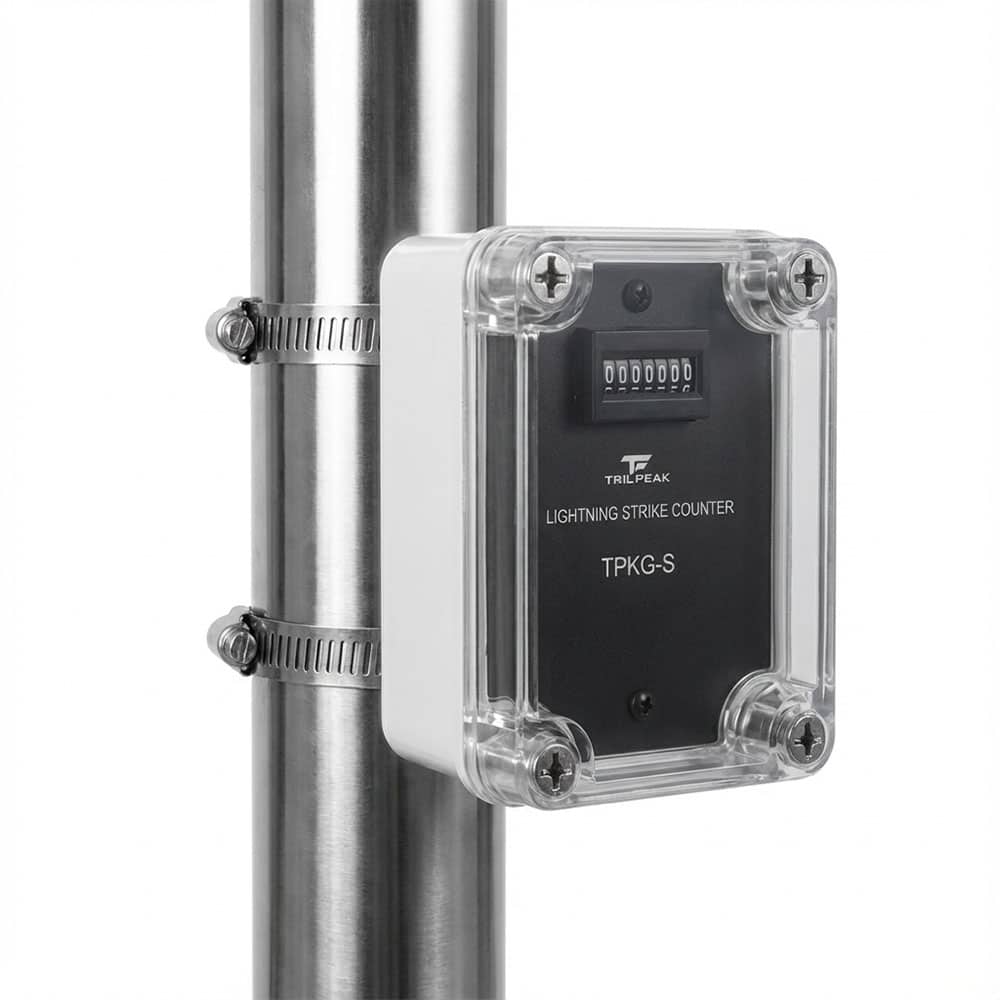
TPKG Lightning Strike Counter — Mechanical & IP67 Models
Both TPKG models share the same detection range (3–100 kA) and operating principle. The TPKG-3M uses stainless steel 304 for a compact, corrosion-resistant installation. The TPKG-S adds IP67 protection and a larger register capacity in an ABS housing — available in two color variants. Neither model requires a power supply. Both are available alongside ESE air terminals and grounding accessories as a complete IEC 62305 system from one factory.

Compact stainless steel 304 housing. Installs via stainless hoop directly onto the down conductor. Self-powered by the lightning impulse — no batteries, no wiring.
| Detection range | 3 kA (8/20 μs) – 100 kA (10/350 μs) |
| Register capacity | 0 – 99,999 impulses |
| Housing | Stainless steel 304 |
| Ingress protection | — |
| Dimensions | 150 × 70 × 40 mm |
| Temperature | −20°C to +65°C |
| Mounting | SS hoop · no power needed |
| Resettable | Yes |


IP67-rated ABS housing for fully weatherproof installations. Extended register capacity and TYPE:A / TYPE:B mounting options for different conductor configurations.
| Detection range | 3 kA (8/20 μs) – 100 kA (10/350 μs) |
| Register capacity | 0 – 9,999,999 impulses |
| Housing | ABS plastic |
| Ingress protection | IP 67 |
| Dimensions | 110 × 80 × 70 mm |
| Temperature | −20°C to +65°C |
| Mounting | SS hoop · TYPE:A / TYPE:B |
| Resettable | Yes |
Where the Lightning Strike Counter Fits in IEC 62305
The lightning strike counter is installed at the down conductor — bridging the external LPS air terminal and the grounding system. It occupies the same conductor path as the earth termination and is a mandatory maintenance tool per IEC 62305-1. TrilPeak supplies all four zones from one factory. See: what does a complete lightning protection system include?
How the Lightning Strike Counter Works — No Power Required
The TPKG counter detects the electrical energy conducted to ground through the down conductor when a lightning strike occurs. It does not require an external power supply, batteries, or data wiring of any kind — entirely self-contained and self-powered by the strike energy itself.
When a lightning impulse travels down the conductor, the counter harvests sufficient energy from the impulse current to advance the mechanical register by exactly one count. The minimum qualifying current is 3 kA (8/20 μs waveform).
The register is a mechanical odometer-style counter visible through a clear window. It cannot be rolled back accidentally and is resettable only by a deliberate manual action during a scheduled inspection. Counts are legible at a glance without any reader equipment.
IEC 62305-1 requires that the LPS technical file records strike activations. The TPKG counter reading is logged at each periodic inspection to determine whether a detailed examination is triggered by a high strike count since the previous service. See: grounding accessories and LPS maintenance.
Compatible with All External LPS Down Conductor Types
The TPKG counter is installed via a stainless steel hoop that clamps directly onto the down conductor — copper tape, round copper wire, or aluminium conductor — in any standard down conductor configuration. It does not interrupt the conductor path.
Lightning rods (Franklin rods), ESE air terminals, Faraday cages, and any external LPS with a continuous down conductor to earth. Suitable for new installations and retrofit onto existing systems.
The operating range of −20°C to +65°C covers all climatic zones where lightning protection systems are deployed. The TPKG-S IP67 housing provides full dust and water immersion protection for exposed or coastal installations.
Install in the down conductor between the air terminal and the earth rod. All strike current must pass through the counter. Accessible position at eye level is recommended for easy visual inspection without tools.
Lightning Strike Counter — Installation Steps
The TPKG counter installs in minutes on any existing or new down conductor. The steps below apply to both TPKG-3M and TPKG-S. Full IEC 62305-3 down conductor guidance is in our air terminal and LPS guide.
Select Installation Position
Choose a position on the down conductor that is accessible for visual inspection — ideally at eye level. The counter must be located between the air terminal and the earth electrode. All lightning current must pass through it.
Open the Stainless Steel Hoop
The TPKG mounts via an integral stainless steel hoop that opens to accept the down conductor. No tools required for hoop installation — secure the bolts finger-tight before tightening to the specified torque.
Clamp onto Down Conductor
Pass the down conductor (copper tape, round wire, or aluminium) through the open hoop. Close the hoop and tighten fasteners fully. Verify the counter body orientation so the display window faces outward and is legible from ground level.
Verify Zero Reading / Reset if Required
Check that the mechanical counter reads zero before commissioning. If retrofitting to an existing installation, note and record the current reading in the LPS technical file as the new baseline.
No Wiring or Power Connection Needed
The counter requires no electrical connection to a power supply. Once the hoop is clamped to the conductor it is operational. Confirm that the conductor path is continuous from air terminal through counter to earth rod — all current must pass through the sensor path.
Record in LPS Technical File
Enter the installation date, model, location, and initial reading in the LPS maintenance file as required by IEC 62305-1. Schedule periodic inspections to log the counter reading and reset as required by the maintenance plan.
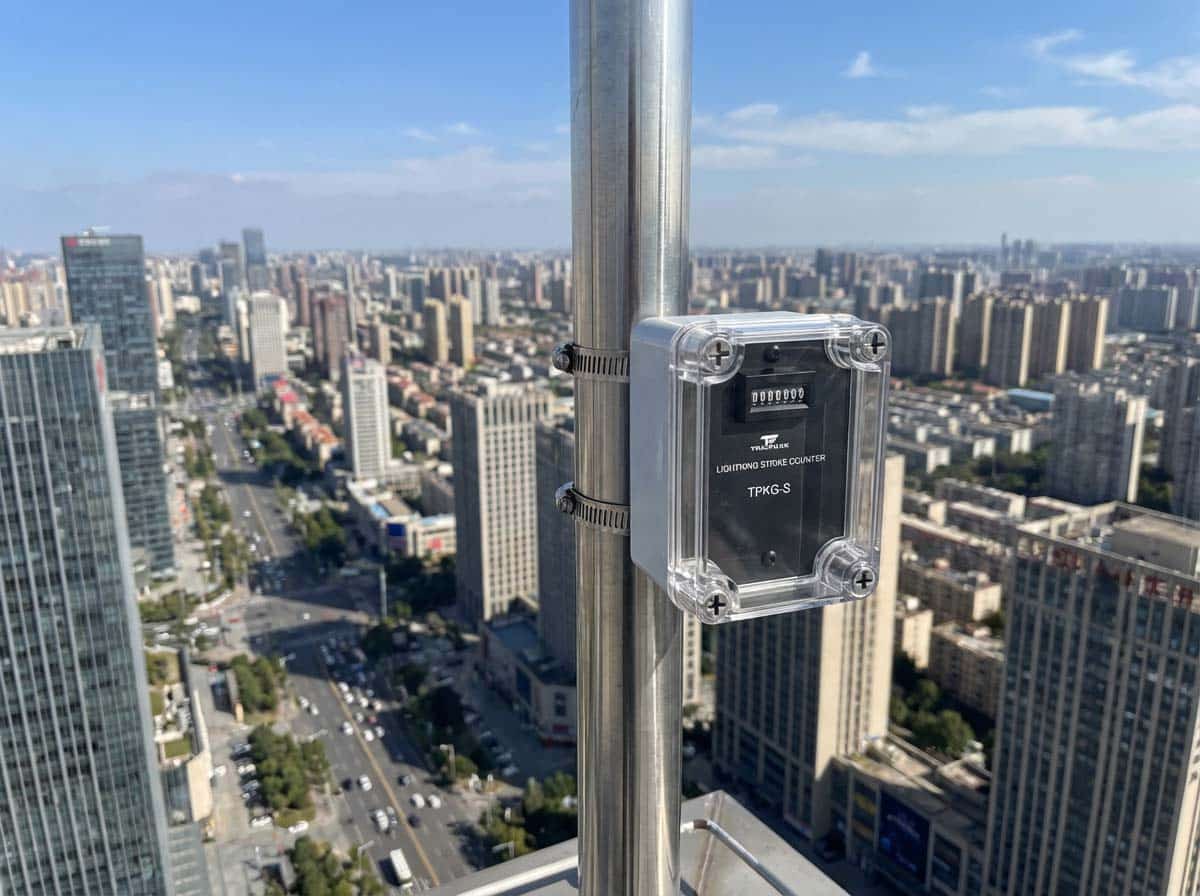
One supplier for the complete LPS system. Ordering TPKG counters alongside ESE air terminals, grounding accessories, and Type 1 SPD means one purchase order, one CE document set, and one contact for the complete IEC 62305 BOM. Ask our engineers to prepare a system BOM →
IEC 62305-1 Clause 7.3 requires that following any lightning strike known or suspected to have occurred, the LPS must be inspected. The TPKG counter provides the primary evidence that a strike event has taken place, triggering the required inspection and documenting activation frequency for the maintenance schedule.
Complete LPS Supply — Including Strike Counters
TrilPeak's OEM programme covers ESE air terminals, TPKG lightning strike counters, grounding accessories, and surge protective devices under your brand label. Our ODM service supports custom housing and counter specifications. One factory, one CE document set. Volume pricing available for large orders.
Lightning Strike Counter — Frequently Asked Questions
Where is a lightning strike counter installed?
The counter is installed in the down conductor between the air terminal and the earth rod. All lightning current must pass through it. It clamps directly onto the conductor using a stainless steel hoop — no interruption to the conductor path, no power wiring needed.
What current range does the TPKG-3M detect?
The TPKG-3M detects impulse currents from 3 kA (8/20 μs) minimum to 100 kA (10/350 μs) maximum — covering the full range of lightning strikes expected on a compliant IEC 62305 installation. The TPKG-S has the same detection range.
What is the difference between TPKG-3M and TPKG-S?
The TPKG-3M uses stainless steel 304, measures 150×70×40 mm, and registers up to 99,999 impulses. The TPKG-S uses ABS with IP67 protection, measures 110×80×70 mm, and registers up to 9,999,999 impulses. Both operate over the same current range and temperature range.
Does a lightning strike counter need a power supply?
No. Both TPKG models are completely self-powered. They harvest energy from the lightning impulse current to advance the mechanical counter. No batteries, no wiring, and no external supply of any kind are required.
Why is a strike counter required for IEC 62305 maintenance?
IEC 62305-1 requires an LPS technical file recording strike activations to determine when detailed inspection is triggered. The counter provides objective evidence of activation frequency and supports the mandatory maintenance schedule. An inspection is required after any confirmed strike event shown on the counter. For full IEC 62305-1 maintenance requirements, refer to the IEC official standards.
Can TrilPeak supply counters with ESE air terminals and SPD?
Yes. TrilPeak supplies ESE air terminals, TPKG strike counters, grounding accessories, and the full SPD range from one factory. Contact us with your project details for a complete IEC 62305 BOM with CE documentation. Contact us →
Request TPKG Lightning Strike Counters for Your LPS Project
TrilPeak supplies TPKG-3M and TPKG-S lightning strike counters alongside ESE air terminals, grounding accessories, and Type 1 SPD — complete IEC 62305 system from one CE-certified factory.