Telecom Base Station SPD Guide: Power, Signal & Grounding Protection
Telecom base stations are among the most surge-exposed electrical installations in any network. Tower structures attract direct lightning strikes. The antenna feeders, signal cables, and power lines that run up and down the tower structure act as efficient coupling paths for induced transients. Remote and rural sites — where network coverage requirements place towers in exposed terrain — often have no nearby structures to provide shielding, and grid power quality at the end of long distribution lines is typically poor.
The consequence of inadequate surge protection is not limited to equipment replacement cost. A base station outage affects the coverage area it serves, triggers maintenance dispatch to a remote site, and may violate the operator's network availability commitments. For equipment operators and tower companies specifying protection for new sites or upgrading existing installations, the SPD specification needs to cover every conductive path that enters the equipment shelter or cabinet — power, signal, and antenna feeder.
This telecom base station SPD guide covers the three protection layers for base station installations: the -48 V DC power system, signal and data lines, and antenna feeder protection, along with the grounding requirements that make the protection system work.
Quick Answer
What is a telecom base station SPD: A Surge Protective Device (SPD) installed on power, signal, or antenna feeder lines to protect radio, rectifier, and monitoring equipment from lightning-induced and switching transients.
Why it matters: Tower structures attract direct lightning strikes, and long cable runs couple induced surges into connected equipment — a single unprotected path can take down the site.
Where it's installed: At the AC mains entrance, the -48 V DC rectifier/battery bus, RS485 and Ethernet lines, and the antenna feeder entry point.
1. The Surge Environment at a Telecom Tower
A telecom tower concentrates several surge risk factors that are rarely present simultaneously in other installations. Tower height increases direct strike probability, long cable runs couple induced transients into equipment, rural grid power is often poor quality, and multiple earthing points can differ in potential during a surge event.
Tower height places the structure well above surrounding terrain, increasing direct strike probability. A 40-metre tower on open ground has a significantly higher lightning interception rate than a rooftop installation of equivalent height in an urban environment where surrounding structures provide partial shielding.
Long conductive paths connect the tower-mounted antenna and radio equipment to the ground-level equipment shelter. Antenna feeder cables, control cables, and signal lines running the full tower height develop large induced voltages during a nearby or direct strike. A transient that induces 10 kV across a 40-metre cable run will present that voltage to whatever equipment is connected at each end unless protected.
Rural grid power quality at remote sites is frequently characterised by high switching transient frequency, voltage fluctuations, and limited fault current capability — conditions that generate repeated low-energy transients that degrade unprotected equipment over time even without a direct lightning event.
Multiple earthing points — tower base, equipment shelter earth bar, and utility power earth — can differ in potential during a surge event. Without proper equipotential bonding and coordinated SPD placement, surge current will flow between earth points through the connected equipment rather than through the intended protection path.
2. -48 V DC Power System Protection
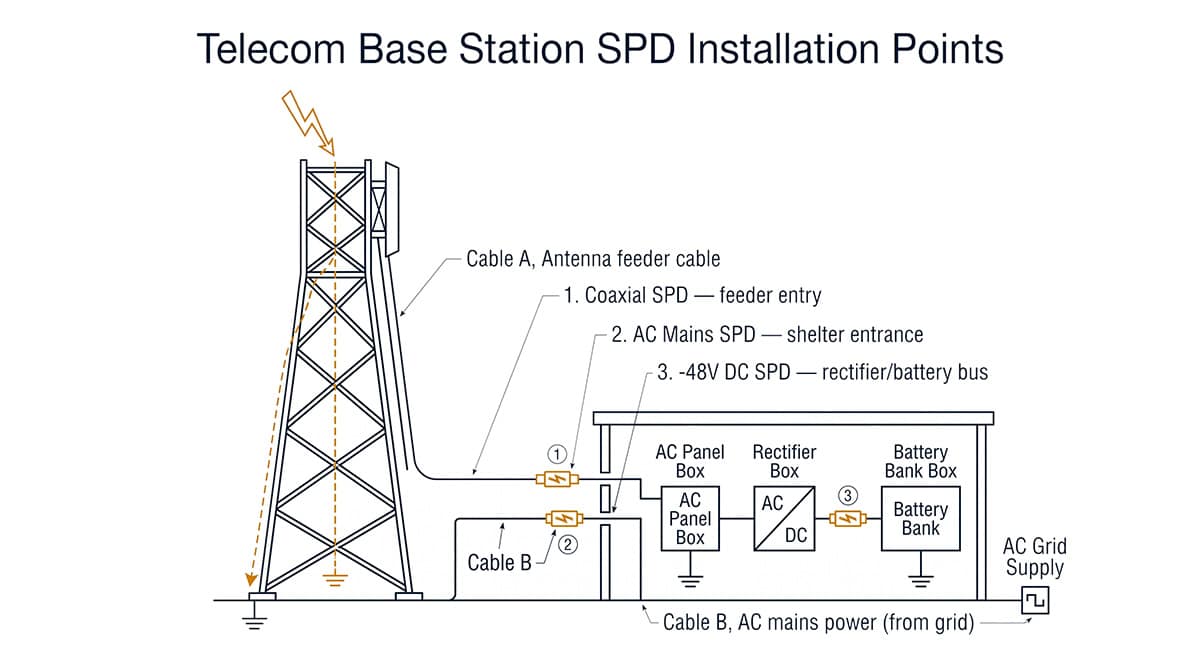
Telecom base stations run primarily on -48 V DC power, which requires SPDs referenced to ground rather than connected between two live conductors as in an AC system. The sections below cover the DC bus voltage range and MCOV selection, AC mains protection ahead of the rectifier, and the two installation positions for DC surge protection.
2.1 Why Telecom Uses -48 V DC
The telecom industry's standard power architecture uses -48 V DC (negative rail at -48 V relative to ground, positive rail at 0 V / ground reference). This convention dates to early telephone exchange design and persists because the negative polarity reduces electrochemical corrosion on copper conductors, and the DC architecture with battery backup provides inherent resilience during AC mains interruptions.
The practical implication for SPD specification is that the positive rail is at ground potential — the SPD must protect the negative rail against transients referenced to ground, not between two live conductors as in an AC system.
2.2 SPD Selection for -48 V DC Systems
Maximum Continuous Operating Voltage (MCOV) requirement: For a nominal -48 V DC system, the actual bus voltage varies between approximately -42 V (battery discharged) and -56 V (float charge). The SPD's MCOV must exceed the maximum continuous operating voltage of -56 V DC by an adequate margin. Standard -48 V DC telecom SPDs are rated with MCOV of 60–72 V DC to provide this margin.
Connection mode: The SPD is connected between the negative DC rail and the protective earth (PE) conductor. The positive rail, being at ground reference, does not require a separate SPD element in a standard grounded telecom power architecture.
Discharge current rating: For tower-mounted rectifier inputs and battery plant connections, Imax ≥ 20 kA (8/20 μs) is appropriate for typical sites. High-exposure sites — direct tower attachment, hilltop, or keraunic level above 60 — warrant Imax ≥ 40 kA or Type 1+2 combined protection at the point where the AC feed enters the equipment shelter.
2.3 AC Mains Protection at the Equipment Shelter Entrance
Before the rectifier converts AC to -48 V DC, the AC mains supply requires protection at the point it enters the equipment shelter. A Type 1+2 combined SPD at the AC distribution board provides both direct lightning current handling and switching transient suppression. This is the highest-energy protection point in the installation and should be specified before any downstream DC or signal SPDs.
For sites with overhead AC power feeds — common at rural and remote locations — Type 1 impulse current rating (Iimp) of ≥ 12.5 kA per phase is the minimum, with 25 kA appropriate for high-exposure sites.
2.4 Installation Positions for DC Protection
Position 1 — Rectifier DC output / battery bus: At the main DC distribution point where rectifiers connect to the battery plant and load distribution, a -48 V DC SPD protects all downstream equipment from transients entering via the battery cables or induced in the DC distribution wiring within the shelter.
Position 2 — Remote radio unit (RRU) DC feed: Where DC power is routed up the tower structure to power remote radio units, an SPD at the tower base on the DC feed cable protects the RRU from transients induced over the full cable length. RRU DC feeds are among the highest-risk conductive paths at a tower site.
3. Signal and Data Line Protection
Beyond power protection, base stations require SPDs on the RS485 monitoring lines, Ethernet management network, and antenna feeder that also enter the equipment shelter. Each of these signal paths has different voltage, data-rate, or frequency requirements that determine SPD selection.
3.1 RS485 Control and Monitoring Lines
RS485 serial communication is widely used in telecom base stations for battery monitoring systems, rectifier control, environmental monitoring (temperature, door alarms, generator status), and equipment management within the shelter. These lines are typically low-voltage (5 V or 3.3 V logic levels) and run between equipment within the shelter, between the shelter and tower-mounted equipment, or between shelter and external monitoring points.
The most vulnerable RS485 runs are those that exit the shelter enclosure or run along the tower structure. Any RS485 cable that connects equipment with different earthing points — shelter earth versus tower earth, for example — is a potential surge coupling path during a lightning event.
RS485 SPD selection requires matching the signal operating voltage (typically 5 V) and the data rate of the specific protocol in use. The SPD's capacitance specification must be checked against the RS485 cable's impedance and the protocol's timing requirements: excessive capacitance degrades signal integrity at higher data rates and can cause communication errors that are difficult to diagnose as SPD-related.
3.2 Ethernet and IP Network Lines
Base station management and monitoring increasingly uses IP-based interfaces — operations and maintenance (O&M) access, performance monitoring, and integration with network management systems. Ethernet cables connecting the base station equipment to external networks, to other shelters on the same site, or running along tower structures are surge exposure paths.
Ethernet SPDs should be installed at the point where the Ethernet cable enters the equipment shelter from outside. For Power over Ethernet (PoE)-powered equipment (cameras, access control, environmental sensors), the SPD must be rated for the PoE power level in addition to signal protection.
For Ethernet runs between separately earthed structures on the same site — a common configuration where a main equipment building and a tower shelter have independent earth electrodes — SPDs at both ends of the inter-building cable are required. A single SPD at one end leaves the equipment at the other end unprotected from the return surge path.
3.3 Antenna Feeder and Coaxial Line Protection
The antenna feeder cable — the coaxial or waveguide transmission line connecting tower-mounted antennas to ground-level radio equipment — is the highest-energy surge path at most tower sites. A direct strike to the antenna or tower structure will couple directly into the feeder, and the surge energy that travels down to the equipment room can destroy radio transceivers, base band units, and connected switching equipment without protection.
Coaxial SPDs (also called surge arresters or lightning protectors for coaxial lines) are installed at the point where the feeder cable enters the equipment shelter — typically at the shelter wall entry point or at the equipment rack input. The SPD must be selected for the frequency range of the antenna system (matching the pass band of the radio equipment), the impedance of the feeder (typically 50 Ω), and the maximum insertion loss acceptable for the radio link budget.
For tower-mounted equipment (RRUs, active antennas), a second coaxial SPD at the tower-top feed point provides additional protection for the cable run and the tower-mounted equipment, though this position requires weatherproof units rated for outdoor installation.
4. Grounding: The Foundation of Surge Protection
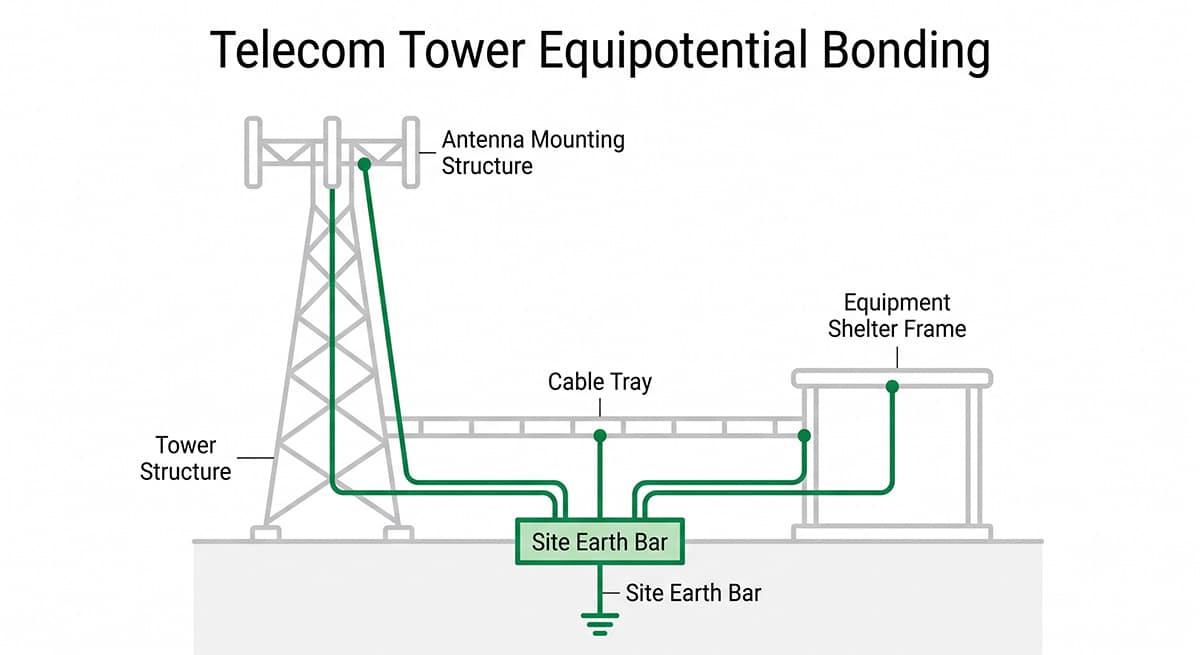
No surge protection system performs as designed without a low-impedance grounding system that provides a common reference point for all SPD discharge currents. Equipotential bonding, earth electrode resistance, and short SPD earth leads together determine whether surge current actually reaches ground instead of flowing through connected equipment.
Equipotential bonding is the most important single requirement at a tower site. Every metallic structure — the tower base, equipment shelter frame, cable trays, equipment racks, and antenna mounting structures — must be bonded to a single site earth bar with appropriately sized conductors. SPD discharge currents that cannot return to ground through a low-impedance bonded path will find an alternative return route through connected equipment.
Earth electrode resistance should be ≤ 10 Ω for standard telecom sites, and ≤ 5 Ω is recommended for high-exposure sites. Resistance above these values indicates that surge currents will develop significant voltage across the earth impedance during a discharge event — voltage that appears across connected equipment as a common-mode stress.
Tower earth connection: The tower structure must be directly connected to the site earth bar with a flat copper earth strap or equivalent, as short and direct as possible. The tower earth connection carries the highest instantaneous surge current of any conductor on the site during a direct strike and must be sized accordingly — minimum 50 mm² copper equivalent for standard sites.
SPD earth connections: All SPDs must be connected to the site earth bar via the shortest practical path, using conductors of adequate cross-section. Long or coiled earth leads between the SPD and the earth bar introduce inductive impedance that reduces the SPD's effectiveness at the fast rise times characteristic of lightning-induced transients.
5. Protection System Summary by Circuit Type
The table below summarizes SPD type, governing standard, and key selection parameter for each circuit at a telecom base station.
| Circuit | SPD Type | Standard | Key Selection Parameter |
|---|---|---|---|
| AC mains entrance | Type 1+2 | IEC 61643-11 | Iimp ≥ 12.5 kA per phase for overhead feed |
| -48 V DC bus | DC SPD | IEC 61643-11 | MCOV ≥ 60 V DC; negative rail to PE |
| RRU DC feed (tower) | DC SPD | IEC 61643-11 | Installed at tower base on DC cable |
| RS485 monitoring lines | Signal SPD | IEC 61643-21 | Match signal voltage and data rate |
| Ethernet management | Ethernet SPD | IEC 61643-21 | PoE-rated if applicable |
| Antenna feeder (coaxial) | Coaxial SPD | IEC 61643-21 | Match frequency range and impedance |
6. Frequently Asked Questions
6.1 Why do telecom systems use -48V DC instead of AC or positive DC?
The -48 V DC convention dates to early telephone exchange design. The negative polarity reduces electrochemical corrosion on copper conductors, and the DC architecture with battery backup provides inherent resilience during AC mains interruptions without requiring additional UPS infrastructure.
6.2 What MCOV should I specify for a -48V DC telecom SPD?
A nominal -48 V DC system operates between approximately -42 V (battery discharged) and -56 V (float charge). The SPD's MCOV must exceed the maximum continuous operating voltage of -56 V DC. Standard -48 V DC telecom SPDs are rated with MCOV of 60–72 V DC to provide adequate margin.
6.3 Do I need SPDs at both ends of an inter-building Ethernet cable?
Yes. For Ethernet runs between separately earthed structures on the same site, SPDs at both ends of the inter-building cable are required. A single SPD at one end leaves the equipment at the other end unprotected from the return surge path.
6.4 What frequency range does a coaxial SPD need to cover for a base station antenna feeder?
The coaxial SPD must match the pass band of the radio equipment served by the antenna. This varies by technology and operator. Confirm the frequency range from the antenna system specification and verify that the SPD's insertion loss is within the acceptable range for the radio link budget.
6.5 What earth electrode resistance is required at a telecom tower site?
Earth electrode resistance should be ≤ 10 Ω for standard telecom sites. ≤ 5 Ω is recommended for high-exposure sites. Resistance above these values means that surge currents will develop significant voltage across the earth impedance during a discharge event — voltage that appears across connected equipment as common-mode stress.
This telecom base station SPD guide has outlined the three protection layers — -48 V DC power, RS485/Ethernet signal lines, and antenna feeder — that need to work together with a properly bonded grounding system to keep a tower site running through lightning season. For sites sourcing SPDs across all three layers, request IEC 61643-11 / IEC 61643-21 compliance documentation and CE certification from the manufacturer as part of the standard technical file — see our SPD factory audit checklist for what to verify before ordering.
Related Resources & Standards
Need SPDs Rated for -48V DC Telecom Sites?
TrilPeak supplies IEC 61643-11 certified SPDs for AC mains, -48V DC, RS485, Ethernet, and coaxial feeder protection at telecom base stations. CE certified · engineering reply within 24h.