Lightning Protection System Components Explained: The Complete 5-Part IEC Guide
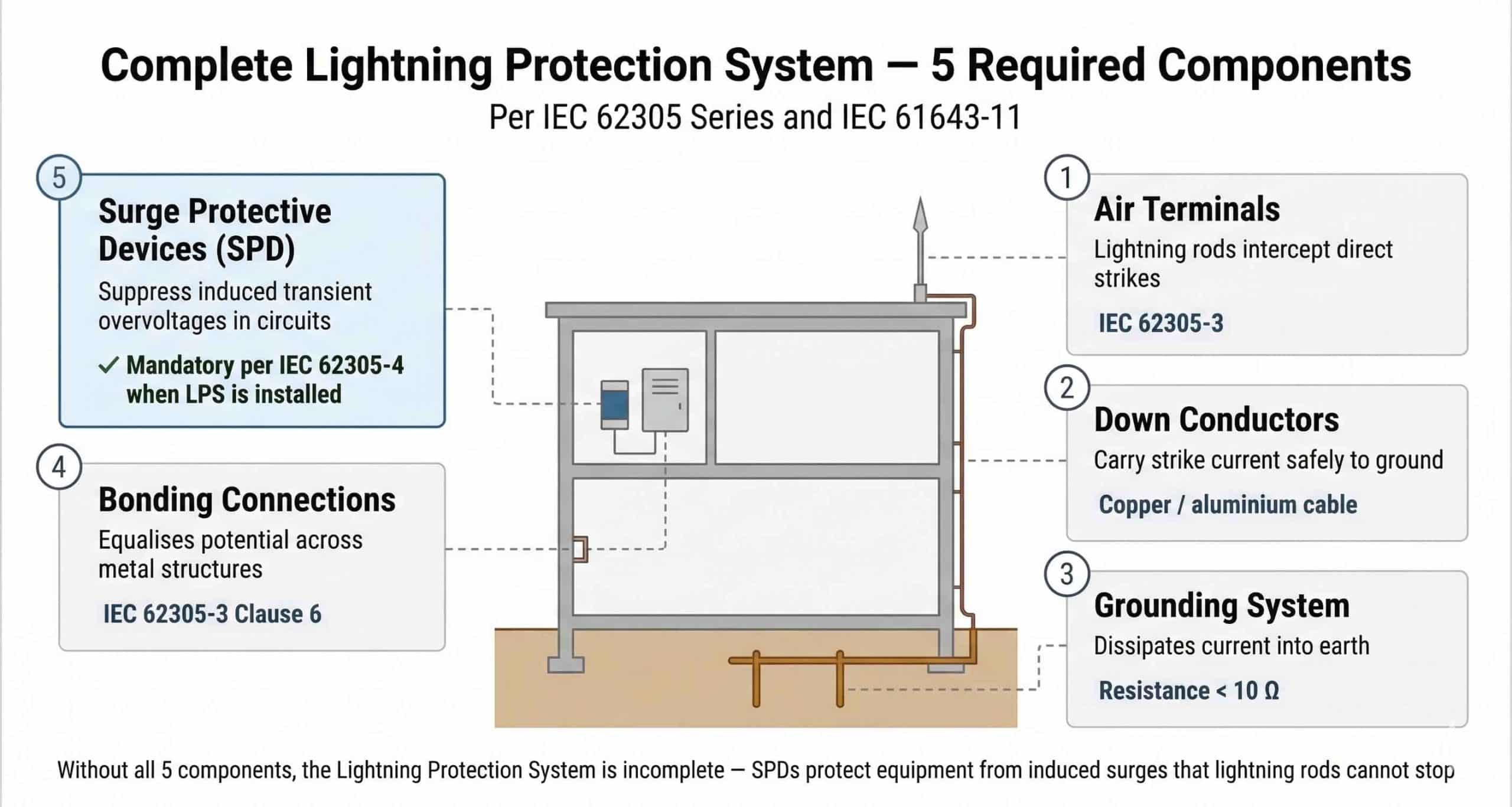
The lightning protection system components that make up a complete LPS (Lightning Protection System) work together to safely intercept, conduct, and dissipate direct lightning strikes into the ground. A lightning protection system is a network of components installed on a building for this purpose. It protects structures from fire, structural collapse, and electrical damage. The 5 core components per IEC 62305 are: air terminals, down conductors, grounding electrodes, bonding connections, and surge protective devices (SPDs).
Quick Answer: A lightning protection system (LPS) is a network of components installed on a building to safely intercept, conduct, and dissipate direct lightning strikes into the ground. It protects structures from fire, structural collapse, and electrical damage. The 5 core components per IEC 62305 are: air terminals, down conductors, grounding electrodes, bonding connections, and surge protective devices (SPDs).

Lightning strikes Earth approximately 8 million times per day — around 6,000 strikes per minute. Each strike carries up to 1 billion volts and generates temperatures of 30,000 Kelvin, five times hotter than the sun's surface. Without a properly engineered set of lightning protection system components, that energy seeks the nearest conductive path to ground: your building's structural steel, electrical wiring, plumbing, or gas lines.
This guide explains how a lightning protection system works, what its components do, which standards govern its design, and how to determine whether your building requires one.
Common Misconception: Lightning rods do NOT attract lightning strikes. They provide a preferred, safe path for strikes that would occur anyway. A building with a properly installed lightning protection system is not struck more frequently — it simply handles strikes safely when they do occur.
1. How Does a Lightning Protection System Work?
A lightning protection system manages lightning strike energy through a four-step sequence, with each step handled by dedicated components working in coordination.

Step 1 — Interception: Air terminals (lightning rods) installed at the highest points of the roof create preferred strike points. When a downward lightning leader approaches, the air terminal intercepts it before it reaches vulnerable areas such as chimneys, vents, roof edges, or HVAC equipment.
Step 2 — Conduction: Down conductors — heavy-gauge copper or aluminium cables bonded to the air terminals — carry the full lightning impulse current (100–200 kA) safely down the exterior of the building. Multiple parallel paths distribute the current and provide redundancy.
Step 3 — Dissipation: The current reaches the grounding system — an array of electrodes driven deep into the earth. These electrodes dissipate the lightning energy into the ground, away from the building, its occupants, and all connected utilities. IEC 62305-3 requires ground resistance below 10 Ω.
Step 4 — Surge Protection: Even when the external system performs perfectly, electromagnetic induction from the strike generates transient overvoltages inside the building's wiring. Surge protective devices (SPDs) installed at the electrical service entrance and distribution panels suppress these induced voltages before they reach sensitive equipment.
Why Step 4 Is Non-Negotiable: Steps 1–3 handle the direct strike. Step 4 handles the electromagnetic consequence of that strike — induced surges that propagate through every cable in the building at near-light speed. IEC 62305-4 makes coordinated SPD installation mandatory when external lightning protection is present. A system without SPDs is an incomplete system.
2. The 5 Lightning Protection System Components Explained
2.1 Air Terminals (Lightning Rods)
Air terminals are vertical metal rods installed at the highest points and edges of the roof. Through geometric field enhancement, the pointed conductor concentrates the electric field during a thunderstorm, promoting upward streamer formation that intercepts the downward lightning leader. Per NFPA 780, copper air terminals must be a minimum 1/2 inch (1.27 cm) in diameter and 10–24 inches tall. Placement follows the rolling sphere method or mesh/grid method to ensure complete coverage of the roof surface.
2.2 Down Conductors
Down conductors are the primary current-carrying cables connecting air terminals to the grounding system. NFPA 780 specifies a minimum of AWG #2 copper (220 mm²) or AWG #1/0 aluminium (350 mm²). Installations require at least one down conductor every 100 feet of building perimeter, routed as directly as possible with minimal bends. Where mechanical damage is possible, conductors are protected in PVC conduit. Multiple conductors reduce the current carried by each individual path, limiting the voltage rise at the grounding electrodes during a strike event.
2.3 Grounding System
The grounding system is where lightning energy is safely transferred to the earth. A compliant system consists of copper-clad steel ground rods driven a minimum of 8 feet (2.4 m) deep — preferably 10 feet (3 m) — at each down conductor termination. IEC 62305-3 and NFPA 780 both require a ground resistance target below 10 Ω. In rocky or sandy soils with high resistivity, achieving this target may require multiple rods, longer rods, or chemical ground enhancement. Ground resistance is verified by professional testing during commissioning and every 3–5 years thereafter.
2.4 Bonding Connections
Bonding connects all large metallic objects on the building — HVAC units, metal roofing, plumbing vents, satellite dishes, structural steel — to the lightning protection system through equipotential bonding conductors. Without bonding, the voltage difference between the lightning protection system and nearby metallic objects during a strike can cause a dangerous side flash: a secondary arc discharge that can ignite fires or injure occupants. IEC 62305-3 Clause 6 defines the bonding requirements. Bonding is required at every level where metallic objects are present.
2.5 Surge Protective Devices (SPDs)
SPDs are the internal component of a complete lightning protection system. Installed in the electrical panels, they use Metal Oxide Varistors (MOVs) that switch from high-impedance (>1 MΩ) to low-impedance (<1 Ω) in under 25 nanoseconds when voltage exceeds the protection level. A coordinated three-tier strategy is required per IEC 62305-4:
| SPD Type | Installation Point | Waveform Rated | When Required |
|---|---|---|---|
| Type 1 | Main service entrance | 10/350 µs | Mandatory when LPS is installed |
| Type 2 | Sub-distribution panels | 8/20 µs | Recommended for all installations |
| Type 3 | Equipment terminals | 8/20 µs | Sensitive electronics, >15m from Type 2 |
For a full technical breakdown of SPD selection, see our Type 1 vs Type 2 vs Type 3 SPD guide.
3. Types of Lightning Protection Systems
| System Type | Protection Method | Best For | Standard Recognition | Typical Cost |
|---|---|---|---|---|
| Franklin Rod (Conventional) | Rolling sphere / protective angle method | Residential, small commercial | NFPA 780, IEC 62305, UL 96A | $2,000–$5,000 |
| Faraday Cage (Mesh) | Conductive grid across entire roof | Large commercial, complex roofs, critical facilities | NFPA 780, IEC 62305, UL 96A | $5,000–$15,000+ |
| ESE (Early Streamer Emission) | Claimed extended protection zone | — | Not recognised by LPI / NFPA / UL | Varies |
The Franklin Rod system and Faraday Cage system are both fully recognised under NFPA 780 and IEC 62305. The ESE system remains controversial in North America — major standards bodies do not certify ESE devices, and their claimed extended protection radii are not validated by independent testing under IEC 62305. Verify local code acceptance before specifying ESE technology.
4. Do You Need a Lightning Protection System?
Not every building requires external lightning protection. IEC 62305-2 provides the formal risk assessment methodology. The key inputs are structure height, geographic keraunic level (average thunderstorm days per year), occupancy type, and consequence of failure. Structures that exceed the calculated risk threshold require a compliant lightning protection system.
As a practical guide, the following buildings should be assessed and typically require external protection:
- Industrial facilities with PLCs, VFDs, SCADA systems, or process control equipment — see our industrial surge protection guide
- Structures over 20–30m in height or taller than surrounding buildings
- Buildings in regions with more than 25 thunderstorm days per year
- Isolated structures on hilltops, open fields, or near water
- Data centres and critical infrastructure — see our data centre surge protection guide
- Agricultural structures: barns, silos, and processing facilities
- Historic buildings and structures with irreplaceable contents
- Facilities storing flammable or explosive materials
Even where external lightning protection is not mandated by code, SPD installation is always recommended — switching transients from the utility grid and nearby lightning strikes cause equipment damage independently of direct strike risk.
5. Lightning Protection System Cost
| Building Type | Typical Cost Range | Cost per m² |
|---|---|---|
| Small residential (140–230 m²) | $2,000–$5,000 | $10–$20 |
| Large residential (230–370 m²) | $4,000–$8,000 | $15–$25 |
| Small commercial (460–930 m²) | $8,000–$20,000 | $15–$30 |
| Large commercial / industrial | $20,000+ | Varies |
Cost is driven by roof complexity, building height, material choice (copper costs more than aluminium but lasts 50+ years vs 30–40 years), soil conditions, and certification level. A UL Master Label or LPI-175 certification adds cost but provides the highest level of documented assurance. For critical facilities, the investment recovers quickly: a single lightning-related equipment loss or fire can exceed the full system cost many times over.
SPD hardware costs separately: Type 1 SPDs run $400–$2,660 per device, Type 2 SPDs $150–$920, plus $500–$2,000 installation per panel. For solar PV systems, DC SPDs are required separately at the array and inverter.
6. Installation Standards and Certification
A compliant lightning protection system must be designed, installed, and inspected by certified professionals following recognised standards. The primary standards are IEC 62305 (Parts 1–4) covering the complete protection methodology from risk assessment through system design and SPD coordination, NFPA 780 covering North American installation requirements, and UL 96A covering testing and certification requirements. Look for LPI-certified installers, require as-built documentation and test reports, and confirm UL Master Label or equivalent third-party certification on completion.
7. Maintenance Schedule
A lightning protection system requires periodic inspection to remain effective. The recommended schedule is: annual visual inspection checking for loose connections, corrosion, and mechanical damage to air terminals and conductors; ground resistance testing every 3–5 years to confirm resistance remains below 10 Ω; immediate professional inspection after any confirmed direct strike event; and verification of system integrity after any roof repairs or modifications that could affect conductor routing or air terminal placement.
Copper systems last 50+ years with proper maintenance. Aluminium systems last 30–40 years. SPDs require replacement every 5–10 years, or immediately after a major surge event — a failed SPD provides zero protection. Maintain spare SPD inventory for critical facilities.
8. Conclusion
A lightning protection system is not a single device — it is a coordinated network of five components working together to safely manage one of nature's most destructive forces. The external system (air terminals, down conductors, grounding, bonding) handles the direct strike. The internal system (SPDs) handles the electromagnetic consequence of that strike. Both are required for complete protection under IEC 62305.
For buildings that exceed the IEC 62305-2 risk threshold, professional design and installation by certified contractors is the only path to a compliant, insurable, and reliably performing system. SPD protection, meanwhile, is beneficial for virtually every building with electrical equipment regardless of whether external lightning protection is installed.
9. Frequently Asked Questions: Lightning Protection System Components
9.1 What are the basic components of a lightning protection system?
A complete lightning protection system has 5 components per IEC 62305: (1) Air terminals (lightning rods) on the roof to intercept strikes, (2) Down conductors carrying current from roof to ground, (3) Grounding electrodes driven into the earth to dissipate energy, (4) Bonding connections linking all metallic objects to prevent side flashes, and (5) Surge protective devices (SPDs) in the electrical panels to suppress induced transient overvoltages. All 5 components are required — a system missing any one component is incomplete and does not provide full protection.
9.2 Do lightning rods attract lightning to my building?
No. This is the most persistent misconception about lightning protection systems. Lightning rods do not attract strikes. They provide a preferred, controlled path for strikes that would occur at that location anyway. The pointed conductor creates a preferred attachment point through geometric field enhancement — it does not increase strike frequency. Buildings with properly installed lightning protection systems are not struck more often; they simply manage strikes safely when they occur.
9.3 What is the difference between a lightning protection system and a surge protector?
A lightning protection system (external LPS) handles direct strikes: air terminals intercept the strike, down conductors carry the current, and grounding electrodes dissipate it into the earth. It protects the building structure. A surge protector (SPD) is an internal device installed in electrical panels that suppresses transient overvoltages induced in wiring by nearby lightning, utility switching, or other sources. It protects electrical equipment. Per IEC 62305-4, both are required together — external LPS without coordinated SPDs leaves all electrical equipment unprotected from induced surges.
9.4 How long do lightning protection system components last?
Copper lightning protection systems last 50+ years with annual inspections and proper maintenance. Aluminium systems last 30–40 years. Grounding electrodes may corrode faster in acidic or salt-laden soils and should be tested every 3–5 years. Surge protective devices (SPDs) have a shorter service life of 5–10 years depending on surge exposure, and must be replaced immediately after major surge events regardless of visual status indicators.
9.5 How many air terminals does my building need?
The number depends on roof size, shape, and the design method used. NFPA 780 specifies three placement methods: the rolling sphere method (using a theoretical sphere radius based on protection level), the mesh method (grid pattern typically 10×10 or 20×20 feet), and the protective angle method (terminals creating 45°–60° protection zones). A typical residential home requires 4–8 air terminals. Larger or more complex roofs require more. Professional design by an LPI-certified installer ensures complete coverage and code compliance.
9.6 What ground resistance is required for a lightning protection system?
Both IEC 62305-3 and NFPA 780 require a target ground resistance below 10 Ω. Ground rods must be driven at least 8 feet (2.4 m) deep, with 10 feet (3 m) preferred. In rocky or sandy soil with high resistivity, achieving the 10 Ω target may require multiple rods spaced at least 6 feet apart, longer rods up to 20 feet, interconnected grounding grids, or chemical ground enhancement. Ground resistance is verified by professional testing at commissioning and every 3–5 years thereafter.
9.7 Can I install a lightning protection system on an existing building?
Yes. Retrofit installations follow the same IEC 62305 and NFPA 780 standards and provide the same level of protection as new construction systems. Retrofit work typically costs 20–30% more than new construction installation due to working around existing roof structures, routing conductors on completed exterior walls, and integrating with existing electrical systems. Despite the additional cost, retrofit systems are widely installed and provide full code-compliant protection.
9.8 Should I choose copper or aluminium components?
Copper is preferred for its superior conductivity, corrosion resistance, and 50+ year lifespan. It is the standard material for critical connections and grounding. Aluminium is more economical and lighter, making installation easier, but has a shorter lifespan (30–40 years) and requires larger conductor cross-sections for equivalent performance. For coastal or corrosive environments, copper is strongly recommended. Avoid mixing copper and aluminium directly — use bimetallic connectors where the two materials must join to prevent galvanic corrosion.
Related Resources & Standards
Need SPDs for Your Lightning Protection System?
TrilPeak supplies IEC 61643-11 certified Type 1, Type 2, and Type 3 surge protective devices — the mandatory internal component of every compliant lightning protection system.