When to Replace a Surge Protector: 5 Warning Signs [2026]
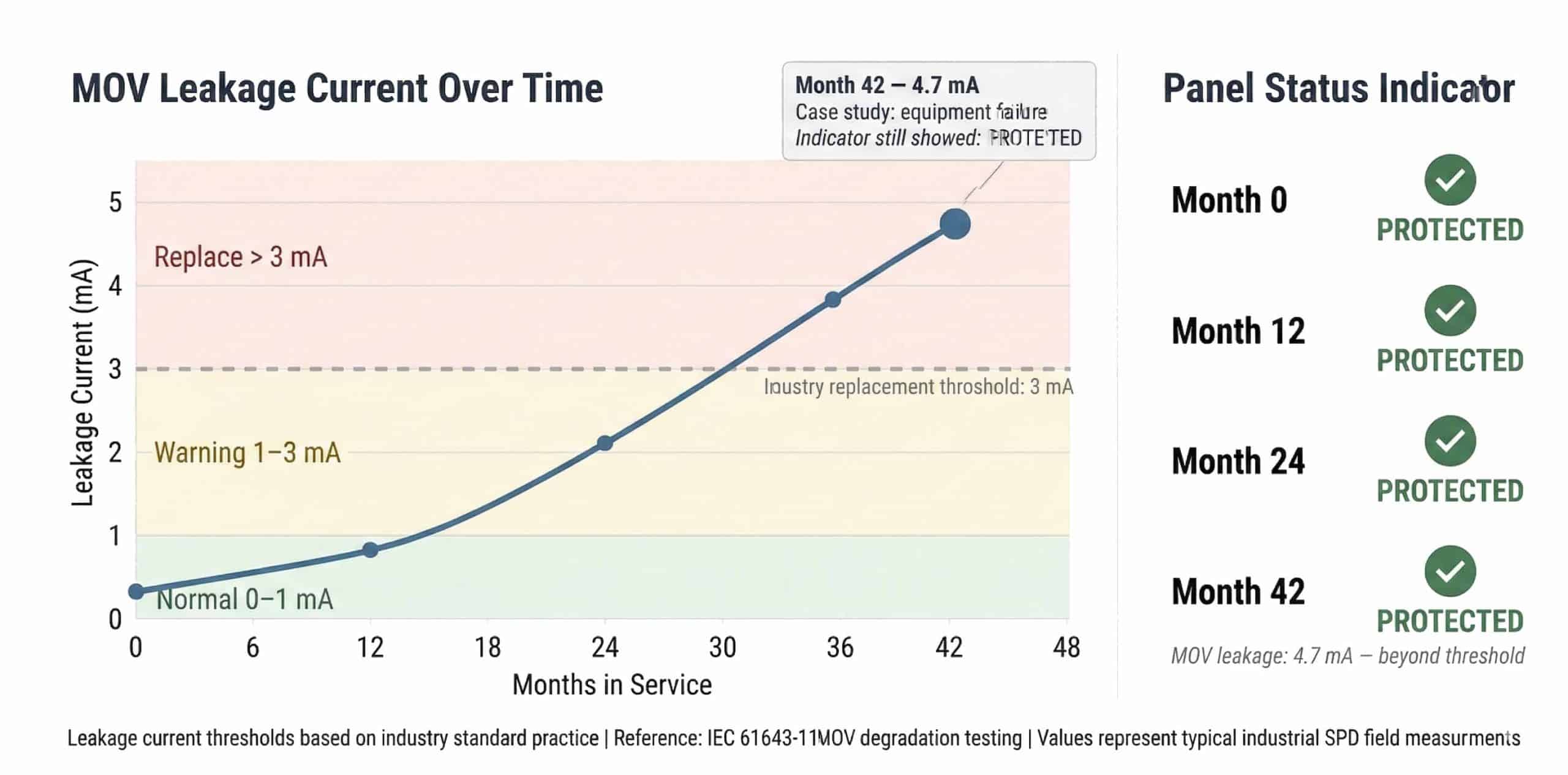
When to replace surge protector units is a question that requires data, not a calendar — industrial SPDs (Surge Protective Devices) fail silently, with their MOVs (Metal Oxide Varistors) degrading incrementally until protection capacity drops to near zero, while the status indicator can still show green. Determining when to replace surge protector devices requires leakage current testing and standards-informed decision criteria, not visual inspection alone. As a general industry guideline, Type 2 SPDs are commonly reviewed for replacement every 5–8 years or when leakage current rises significantly above baseline; Type 1 SPDs are commonly reviewed every 7–12 years or after any confirmed direct lightning strike.
Quick Answer: When to Replace a Surge Protector
Yes, surge protectors do expire — but not on a fixed calendar. MOV degradation is cumulative and irreversible. The status indicator alone cannot confirm protection capacity; only leakage current testing can. Five criteria determine replacement: leakage current trend, status indicator (as a confirmatory signal only), thermal anomaly, post-lightning event, and visible physical damage.
How Long Do Surge Protectors Last? Quick Answer for Homeowners
For home and light commercial use, surge protectors typically last 3–5 years — replace immediately if the status indicator turns red, after any nearby lightning strike, or if connected equipment starts showing unexplained failures.
Do surge protectors expire? Yes, functionally they do. The MOV components inside degrade with every surge they absorb, until protection capacity drops to near zero — often while the device still passes data and powers equipment normally. For a home power strip or consumer surge protector, the practical rule is simple:
- Replace on a schedule: every 3–5 years regardless of appearance
- Replace immediately if the indicator light turns red or goes out
- Replace after a major lightning event nearby, even if the device looks fine
- Replace if equipment starts failing — the surge protector may have already stopped protecting
For industrial facilities — manufacturing plants, data centres, hospitals — the question of when to replace surge protector units is more complex. MOV leakage current testing, IEC 61643-11 criteria, and facility-specific maintenance schedules apply. The sections below cover the industrial approach in full.
1. Why Industrial SPD Lifespan Is Not a Calendar Question
When to replace surge protector units in industrial settings cannot be determined by calendar age alone — MOV wear depends on surge exposure history, SPD type, and operating conditions far more than years in service. Consumer guides talk about "3–5 year replacement cycles," but that framing does not transfer well to industrial applications — following it can mean replacing SPDs too early in low-exposure sites, or far more dangerously, too late in high-exposure ones.
How long a surge protector lasts in industrial environments depends on three variables, not one: SPD Type, surge exposure frequency, and ambient operating conditions.
| SPD Type | Commonly Cited Service Life Range* | High-Surge Environment | Primary Aging Mechanism |
|---|---|---|---|
| Type 1 (service entrance) | 7–12 years | Often shorter, 3–5 years | 10/350 µs lightning impulse accumulation |
| Type 2 (distribution board) | 5–8 years | Often shorter, 2–4 years | VFD (Variable Frequency Drive) switching transients, repetitive 8/20 µs |
| Type 3 (point-of-use) | 3–5 years | Often shorter, 1–3 years | Low-energy repetitive surges from connected loads |
*These ranges reflect common industry maintenance practice and manufacturer guidance, not a fixed lifespan mandated by IEC 61643-11. IEC 61643-11 defines SPD performance, classification, and test methods — it does not specify a universal calendar lifespan. Actual remaining service life should be confirmed by leakage current testing rather than age alone, and always cross-checked against the specific SPD manufacturer's maintenance documentation.
A Type 2 SPD protecting a VFD-heavy MCC (Motor Control Center) in a steel plant may accumulate hundreds of transient events per year — consuming years of "calendar life" in a fraction of the nominal range. The only reliable way to know actual remaining life is to measure it. For facilities running PLC (Programmable Logic Controller) and VFD circuits, leakage current testing is strongly recommended as standard practice.
2. 5 Criteria for Determining When to Replace Surge Protector Units
These five surge protector replacement criteria are ranked by diagnostic reliability — leakage current testing is the only direct measurement of remaining MOV capacity, while the other four are confirmatory signals that strengthen the replacement decision when combined.
2.1 Criterion 1 — Rising Leakage Current: The Most Direct MOV Indicator
MOV leakage current is widely regarded as the most reliable indicator for when to replace a surge protector. As the MOV's internal grain structure accumulates micro-damage from repeated surge events, electrical resistance falls — causing more current to flow through the MOV at normal operating voltage. This degradation is generally irreversible and cumulative.
| Leakage Current Trend | MOV Condition | Action Commonly Recommended |
|---|---|---|
| Stable, low baseline | Normal operating range | Continue service; maintain testing schedule |
| Gradual upward trend | Early-stage degradation | Increase testing frequency; plan replacement |
| Sharp or sustained rise above baseline | Significant degradation — replacement commonly recommended | Take offline; install replacement |
Specific leakage current thresholds vary by manufacturer, SPD model, and rated voltage — always confirm against the specific SPD's datasheet or maintenance manual rather than applying a single fixed milliamp value across all devices. Testing frequency: critical facilities (data centres, hospitals, semiconductor fabs) commonly test monthly; general industrial facilities commonly test quarterly. A green status indicator alone cannot confirm these values are within range.
Note on temperature correction: leakage current generally increases with ambient temperature, though the exact rate varies by MOV formulation and manufacturer — always record ambient temperature alongside measurements and consult the manufacturer's published temperature correction curve for trend analysis. Inconsistent test temperature is a common source of false-positive replacement triggers.
2.2 Criterion 2 — Status Indicator Fault: Confirm, Don't Assume
When the indicator changes from green to red, the thermal disconnector has typically activated — but this is a lagging indicator, not a leading one. By the time it trips, the MOV has often already been degraded for some time.
What a red indicator confirms: the thermal disconnector has activated. What it does not confirm: that the SPD was providing effective protection before the trip; or that the circuit is now fully isolated (verify with a multimeter — typically should read a very high resistance between input and PE terminals, per manufacturer guidance).
What a green indicator does not confirm: anything definitive about MOV protection capacity. The indicator is typically a single-point mechanical or electronic switch — it is not a continuous protection-level meter.
2.3 Criterion 3 — Thermal Anomaly on Infrared Scan
Annual IR thermography is a widely used practice for switchboard maintenance generally. For SPDs specifically, a meaningfully elevated temperature above ambient — particularly an asymmetric reading where one phase runs hotter than the others on a 3-phase unit — is commonly treated as a warning sign warranting leakage current testing within a short window.
Single-phase thermal anomalies are particularly significant: they can indicate asymmetric MOV degradation, where the healthy phases may absorb disproportionate energy in the next surge event, potentially accelerating cascade failure across the unit.
2.4 Criterion 4 — Post-Lightning Protocol (Especially Relevant for Type 1)
After any confirmed direct lightning event — identified by a surge counter spike, simultaneous multi-breaker trip, or local meteorological confirmation — the following approach is commonly applied:
Type 1 SPD (service entrance): Many engineering practices and manufacturer guidelines recommend replacement after a confirmed direct lightning strike, since direct lightning current at the LPZ (Lightning Protection Zone) 0B→1 boundary can cause structural MOV damage that is not always detectable by field testing alone. The decision should be confirmed against the manufacturer's post-event inspection guidance rather than treated as an automatic, unconditional rule in every case.
Type 2 SPD (distribution board): Testing leakage current and insulation resistance promptly after a confirmed event is common practice. If either result is poor, surge protector replacement is commonly recommended. Even where both pass, some engineering teams schedule a precautionary replacement within several months, since a Type 2 unit that absorbed a major event may carry elevated risk on a subsequent surge.
2.5 Criterion 5 — Visible Physical Damage
The following physical conditions commonly prompt immediate surge protector replacement regardless of other test results:
- Housing discoloration progression: yellow-brown to dark brown to black can indicate cumulative internal overheating
- Visible carbonization or burn marks on housing or terminal area
- Housing cracks — even hairline — can indicate thermal stress fracture from high-energy events
- Terminal corrosion (green copper oxidation) — increases contact resistance and can degrade effective Up (voltage protection level)
- Loose terminal fasteners — a common and often overlooked cause of installation-level performance degradation independent of MOV condition
Many catastrophic SPD failures show at least one of these signs beforehand. Routine visual inspection during panel checks costs nothing and can catch fast-degradation cases between scheduled leakage tests.
3. Industrial vs. Consumer SPD Replacement: Why the Approach Differs
Consumer surge protector guides commonly use joule ratings and simple calendar rules, but neither approach is well suited to industrial SPD specification or maintenance planning.
| Consumer Power Strip SPD | Industrial Type 1+2 SPD | |
|---|---|---|
| Common reference standard | UL 1449 (joule rating) | IEC 61643-11 Class I/II performance and test requirements |
| Rated capacity metric | 200–3,000 J (consumer marketing metric) | Iimp 12.5–50 kA (10/350 µs, engineering metric) |
| Replacement approach | Calendar age / indicator light | Leakage current trend plus confirmatory criteria above |
| Post-lightning approach | Check the indicator light | Inspection and testing protocol per Section 2.4 |
| Typical failure consequence | Damaged consumer electronics | Production equipment damage and downtime cost |
| Monitoring capability | Typically none | Often available — remote alarm contact to BMS/SCADA |
This is also why generic consumer "surge protector lifespan" content is not a reliable basis for industrial procurement decisions — industrial SPD condition is best assessed through testing and event history, not time alone. A Type 1+2 industrial SPD with consistently clean leakage tests at year six can have more useful remaining life than a two-year-old unit that absorbed a major lightning event without follow-up testing.
4. SPD Replacement Decision Matrix
The matrix below summarises how the five criteria from Section 2 combine into a practical when to replace surge protector decision — a single high-severity result in any row warrants prompt action regardless of the other rows.
| Condition | Consider Immediate Replacement | Plan Within Several Months | Continue — Retest on Schedule |
|---|---|---|---|
| Leakage current | Sharp or sustained rise above baseline | Gradual upward trend | Stable, low baseline |
| Status indicator | Red plus elevated surface temperature | Red (verify circuit isolation) | Green (confirm with leakage test) |
| IR thermography | Significantly above ambient, especially asymmetric | Moderately above ambient | Close to ambient |
| Lightning event | Type 1 — commonly recommended after confirmed strike | Type 2 — if leakage/IR results are borderline | No confirmed event |
| Physical damage | Any of the 5 signs in Section 2.5 | — | No visible damage |
| Age (no test data available) | Beyond the upper end of the type's commonly cited range | Within the upper portion of the commonly cited range | Within the typical range |
A decision based on a single parameter carries lower diagnostic confidence than one based on two or more aligning indicators. The status indicator alone is generally the lowest-confidence criterion in this framework and should not be the sole basis for a surge protector replacement decision. For coordination of SPD replacement with upstream overcurrent protection, see the circuit breaker vs surge protector coordination guide.
5. Maintenance Schedule by Facility Type
Testing frequency should scale with facility criticality — the cost of one unplanned surge protector replacement after failure in a high-criticality facility commonly exceeds the cost of years of planned testing and proactive replacement.
| Facility Type | Leakage Current Testing | Visual Inspection | IR Thermography |
|---|---|---|---|
| Data centre / hospital / semiconductor | Monthly | Monthly | Quarterly |
| Industrial manufacturing (VFD-heavy) | Quarterly | Monthly | Semi-annual |
| Commercial / light industrial | Semi-annual | Quarterly | Annual |
For data centre and other mission-critical applications, proactive replacement well ahead of the upper end of the rated service life range is common practice, since the cost of one unplanned failure in a Tier III/IV facility can exceed the cost of many years of planned replacements.
6. Specifying a Replacement: What to Confirm Before You Order
When sourcing replacement SPDs, four specification points determine whether the new unit fits correctly and performs as expected — skipping any of them is a common cause of installation rework.
| Specification Point | Why It Matters |
|---|---|
| SPD Type (1, 2, 3, or 1+2 combined) | Must match the original installation point and LPZ boundary — see the Type 1 vs Type 2 vs Type 3 SPD guide for selection criteria |
| Earthing system and pole configuration | TN-S, TT, TN-C, or IT determine the correct pole count and Uc rating |
| SCPD (backup breaker) compatibility | Confirm the existing backup breaker rating still matches the replacement SPD's Imax — see the circuit breaker vs surge protector coordination guide |
| Monitoring features needed | Surge counters and remote alarm contacts enable predictive maintenance rather than reactive replacement |
For volume replacement programmes, retrofit projects, or technical sign-off before purchase, TrilPeak's engineering team can review your existing panel schedule and confirm Type, earthing compatibility, and SCPD rating before you order — see request a quote or use the SPD Selector Tool for a guided spec in under 60 seconds.
7. Conclusion: Measure First, Replace on Data
Knowing when to replace surge protector units means tracking a measurable degradation threshold — not waiting for a red indicator or following a fixed calendar date. Leakage current testing is the most direct way to track that threshold. The five criteria in this guide — leakage current trend, status indicator (as a confirmatory signal only), thermal imaging, post-lightning protocol, and visual inspection — give facility managers and procurement engineers a defensible, multi-signal basis for surge protector replacement decisions.
The alternative — replacing only on calendar age or waiting for a red indicator — means operating with uncertain protection levels between scheduled inspections. Establishing a leakage current baseline on existing Type 1 and Type 2 SPDs, and testing on the schedule appropriate to facility criticality, is the most reliable starting point for any when to replace surge protector programme.
8. Frequently Asked Questions: When to Replace Surge Protector Units
8.1 Do surge protectors expire, and how do I know when mine has?
Functionally, yes — MOV degradation is cumulative and generally irreversible, even though there is no single fixed expiry date set by an international standard. The SPD is commonly considered to be approaching end of useful life when leakage current rises significantly above its established baseline, even if the status indicator still shows green. As general industry guidance, industrial Type 1 SPDs are commonly reviewed around 7–12 years and Type 2 around 5–8 years, though high-surge environments can shorten these considerably. The most reliable approach is leakage current testing against a known baseline rather than calendar age alone.
8.2 How long do surge protectors last in industrial facilities?
Typical industry-cited ranges are: Type 1 service entrance SPDs around 7–12 years in normal exposure, often shorter in high lightning-density regions; Type 2 distribution SPDs around 5–8 years, often shorter in VFD-heavy manufacturing environments; Type 3 point-of-use SPDs around 3–5 years. These figures assume typical surge exposure — facilities with frequent utility switching events, high VFD density, or overhead supply in high-lightning-density zones should expect the shorter end of each range and test more frequently.
8.3 What is a typical surge protector lifespan for a whole-building or service entrance SPD?
For service entrance (Type 1) devices, a commonly cited range is 7–12 years under typical industry maintenance practice, with replacement commonly recommended after a confirmed direct lightning strike. Industrial Type 1+2 combined units used in main distribution board applications are commonly tested with leakage current measurement every few years, with proactive replacement considered well before the upper end of the rated range for critical facilities. Always confirm specific intervals against the manufacturer's documentation for the installed product.
8.4 Can you tell if a surge protector is still working without specialist equipment?
Only partially. A green status indicator confirms only that the thermal disconnector has not tripped — it does not confirm MOV protection capacity. Visual inspection can identify housing damage, discoloration, and terminal corrosion. A multimeter can help confirm isolation after a disconnector trip, per manufacturer guidance. What basic visual inspection and multimeters generally cannot determine is MOV leakage current trend or cumulative energy absorbed. For critical equipment, periodic leakage current testing is the most reliable approach available without relying on assumption alone.
8.5 When should a Type 1 SPD be replaced after a lightning strike?
Many engineering practices and manufacturer guidelines recommend replacement promptly after a confirmed direct lightning strike on a Type 1 SPD at the service entrance, since direct lightning impulse current can cause structural damage to the MOV that is not always detectable through field testing. The specific decision should be confirmed against the manufacturer's post-event inspection guidance. Keeping spare Type 1 SPDs on site for rapid replacement is common practice in lightning-prone regions. For downstream Type 2 units, a testing-based protocol — confirming leakage current and insulation resistance before deciding — is more commonly applied.
8.6 What is the practical value of planned SPD replacement versus reactive replacement?
Planned surge protector replacement based on testing data is generally far less costly than reactive replacement after a failure. Industrial SPD hardware and installation costs are typically a small fraction of the equipment damage and downtime that an unprotected surge event can cause in a manufacturing facility. For data centres and semiconductor fabs, the gap is even larger, since a single unprotected event can affect both equipment and stored data. A periodic testing programme is generally viewed as a cost-effective way to avoid the larger, less predictable cost of reactive replacement after failure.
8.7 How does SPD replacement planning fit into a broader asset management programme?
Asset management frameworks such as ISO 55001 generally call for documented degradation criteria, maintenance intervals, and replacement triggers for critical infrastructure assets. A surge protector replacement programme that uses a leakage current trend threshold, combined with event-based triggers such as post-lightning inspection and documented periodic test records, fits naturally into this kind of asset management documentation. It is a reasonable practice to maintain these records as part of a broader asset management or maintenance management system, even though SPD-specific clauses are not separately defined within ISO 55001 itself.
Related Resources & Standards
Need Help Specifying a Replacement SPD?
TrilPeak engineers review panel schedules and confirm SPD Type, SCPD rating, and earthing compatibility before you order — Type 1, Type 2, Type 3, and Type 1+2 combined, with optional surge counters and remote alarm contacts for predictive maintenance.