
Lightning Protection
System (LPS)
Air Terminals · Grounding · SPD Coordination
ESE & Franklin air terminals, grounding electrodes, strike counters, and Type 1 SPD — every component of a complete external lightning protection system from one ISO 9001 certified factory. TrilPeak supplies complete IEC 62305 LPS product ranges to EPC contractors, distributors, and OEM brands in 50+ countries. Factory-direct pricing. 24-hour quote response.

Lightning Protection System Components — Complete IEC 62305 Range
Four product families covering every component of a compliant IEC 62305 installation — from strike interception at the air terminal through to internal surge protection coordination. All manufactured to IEC 62305 and IEC 62561 standards.

Early Streamer Emission air terminals delivering up to 107 m protection radius — the active solution for large structures, open areas, and projects where conventional rod networks are impractical.
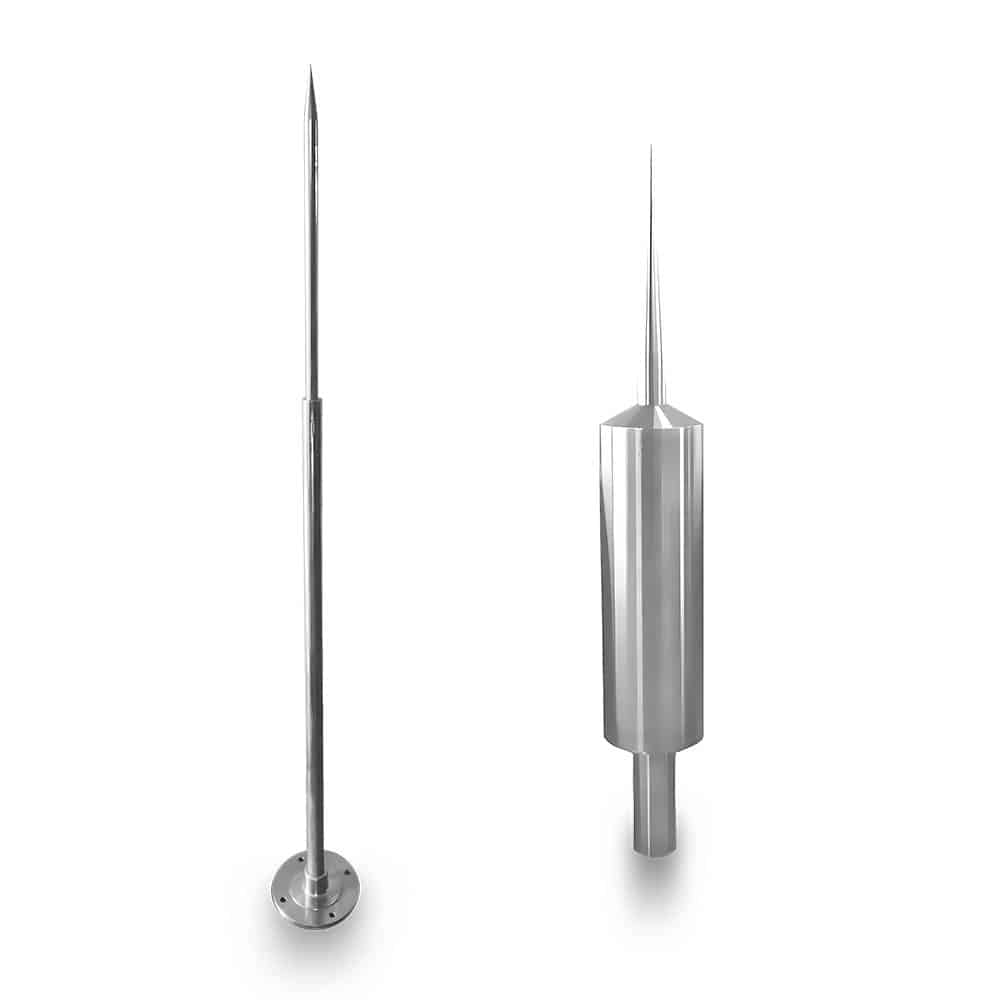
Conventional passive air terminals — the universally accepted IEC 62305-3 standard. Available in pure copper, aluminium alloy, and stainless steel. The most widely specified lightning rod globally.

IEC 62561-2 compliant grounding electrodes supplied to your specification. Send your drawing or project requirements — we confirm material, dimension and quantity and quote within 24 hours.
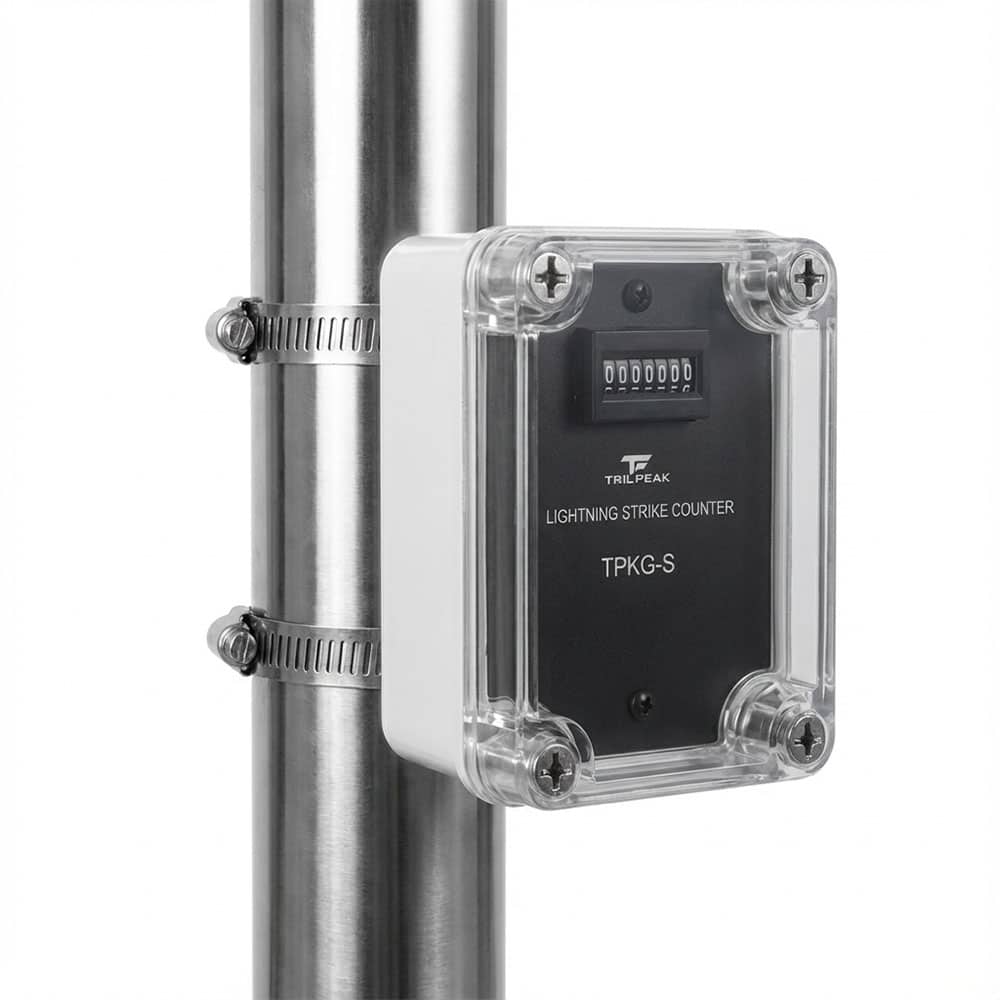
Mechanical and electronic strike counters recording every lightning discharge event on the down conductor — essential for maintenance scheduling, insurance documentation, and IEC 62561-6 compliance.
IEC 62305 Lightning Protection System — Compliance by Standard
Four interrelated standards governing LPS design from initial risk assessment through to component testing. A compliant installation must satisfy all four parts — not just select components.
General Principles — LPS Design Framework
Defines lightning current parameters, damage categories, and the protection level (LPL I–IV) framework. Every external lightning protection system design starts here — LPL determines the minimum Iimp for air terminals and down conductor cross-section.
View LPS product range →Risk Management — Is an LPS Required?
Quantifies annual probability of lightning damage. Determines whether a complete lightning protection system is required and at which protection level — the mandatory first step before any product selection or design work begins.
LPS risk assessment guide →External LPS — Air Terminals & Grounding
Covers external lightning protection system design: air termination methods (rolling sphere / protection angle / mesh), down conductors, earth termination, equipotential bonding, and separation distance calculations.
ESE & Franklin air terminals →Internal LPS — Type 1 SPD Coordination
Governs internal lightning protection system: SPD selection by zone, equipotential bonding, shielding, and cable routing. Mandates Type 1 SPD at service entrance when external LPS is present — coordinated with IEC 60364-5-53.
Type 1 SPD products →Complete Lightning Protection System — Find the Right Products
Four product categories — every complete lightning protection system needs all four. Select each category to find the right model for your project specification.
ESE (TPKB / TPKSE): single terminal covers large areas up to 107m radius — ideal for industrial sites, large roofs, open areas. ESE air terminals →
Franklin Rod (TPKA / TPKT / TPKBF): universally accepted IEC 62305-3 & NFPA 780 passive rod — standard for buildings, mesh arrays, NFPA projects. Franklin rods →
Solid copper (99.9% pure) or copper-bonded steel (≥254µm Cu layer · IEC 62561-2). Diameter 12–25mm, lengths 1.5m / 2.4m / 3m, custom on request. Target resistance ≤10Ω. Send your project drawing or spec sheet — we quote within 24 hours. Grounding accessories →
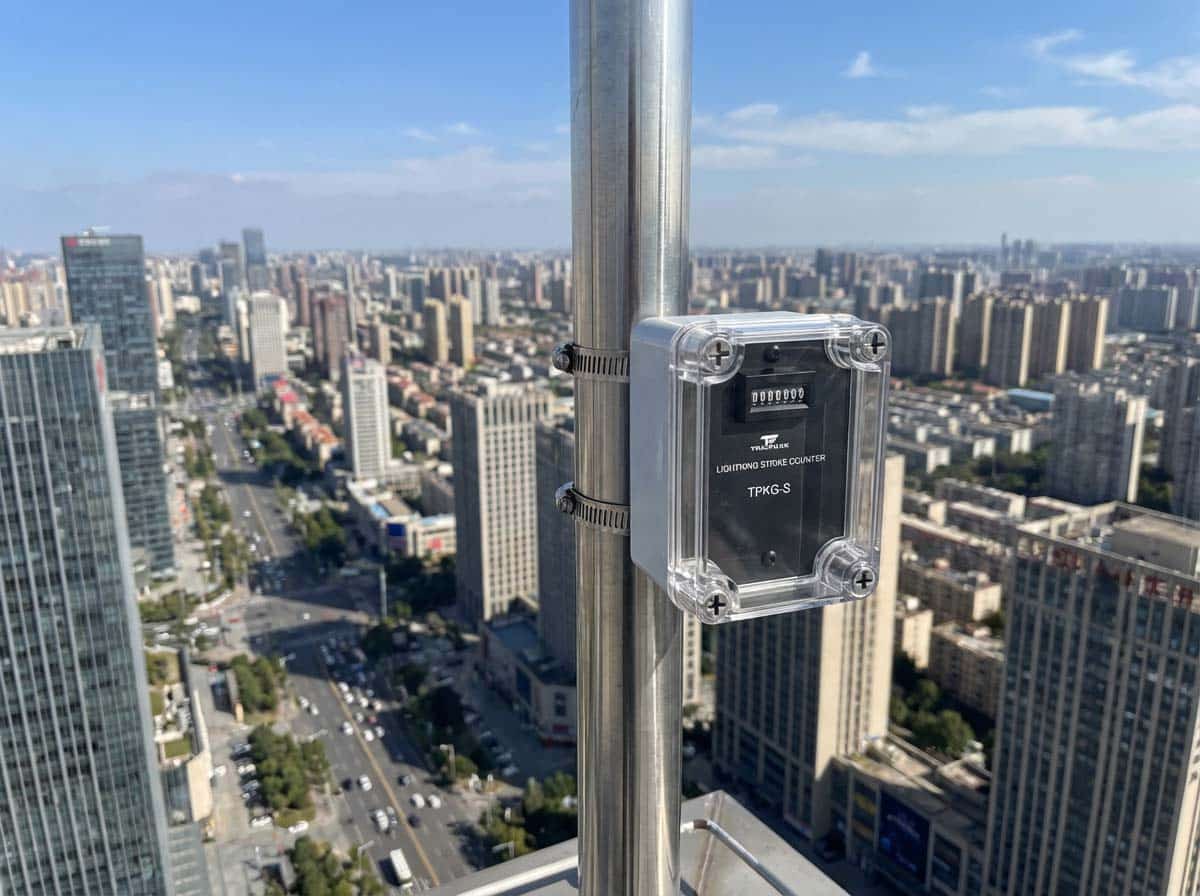
IEC 62305-1 requires a strike counter on every down conductor. Choose TPKG-3M (SS304, IP54, 99,999 count) for standard sites or TPKG-S (ABS, IP67, 9,999,999 count) for coastal or high-exposure environments. Both are self-powered — no battery or wiring required.
IEC 62305-4 mandates a Type 1 SPD at the service entrance whenever an external LPS is installed. A Type 1+2 combined SPD eliminates the 10m separation requirement. TrilPeak supplies the full AC and DC SPD range alongside all LPS components — one PO, one CE document set.
Factory-Direct LPS Manufacturer — 25 Years, 50+ Countries
TrilPeak manufactures LPS components in-house — copper processing, CNC machining, surface treatment, and 100% per-unit inspection. Not a trading company. Direct factory supply with full material traceability and IEC compliance documentation on every shipment.
All products manufactured to IEC 62305 and IEC 62561 series. ISO 9001:2015 factory quality system. Salt-spray, pull-strength, and dimensional verification testing on every batch.
We process our own copper rod stock and machine all tip geometries, threading, and base fittings in-house — not purchased from sub-suppliers. Gives you component-level traceability.
Custom rod diameter, length, alloy grade, surface treatment, or tip geometry. Private label branding supported. Prototypes in 7–10 days. NDA standard. Samples available at standard product price.




ISO 9001:2015 Certified Factory — IEC 62305 Compliant Products
TrilPeak operates under ISO 9001:2015 quality management. Select LPS products carry independent third-party certification. All products are manufactured to IEC 62305 and IEC 62561 series standards, with salt-spray testing, pull-strength verification, dimensional inspection, and material traceability documentation provided per shipment.
LPS OEM & Private Label Manufacturing
In-house copper processing, CNC machining, and 100% per-unit inspection — factory-direct to EPC contractors, distributors, and OEM brands worldwide.
Private Label
Your brand engraved or stamped on air terminals, grounding rods, and counters. Custom packaging and datasheets in any language. NDA standard.
OEM Programme →Custom Specification
Custom rod diameter, length, alloy grade, surface treatment, or tip geometry. Engineering drawings provided. Prototypes in 7–10 days for evaluation.
ODM Capabilities →Stock Programme
Full LPS range available for distributor stocking. IEC test reports and DoC for customs clearance. Flexible MOQ for mixed stock orders.
Distributor Programme →Complete LPS Kit
Air terminals + grounding + connectors + counters + Type 1 SPD — all components for one project, with matched documentation and consolidated shipping.
Lightning Protection System — Wholesale Supply & Export Documentation
Transparent B2B sourcing terms for EPC contractors, international distributors, and OEM brand owners sourcing from factory direct.
Order Quantities & Samples
Flexible MOQ supporting project procurement, distributor stocking, and growing OEM brands at any scale.
Lead Time & Delivery
Factory-direct from our 20,000 m² manufacturing facility. Stocked standard products ship fastest.
Export Documentation
Complete compliance and customs documentation package issued within 24 hours of request.
Lightning Protection System — Technical FAQ & Buyer Resources
Engineering FAQs, design guides, and B2B sourcing intelligence for LPS specifiers, EPC contractors, and procurement teams.
Frequently Asked Questions — Lightning Protection System
What is a lightning protection system (LPS) and what does it consist of?
An LPS intercepts a lightning strike, safely conducts the current to earth, and limits the resulting surge on internal electrical systems. A compliant IEC 62305 system requires four subsystems: air termination, down conductors, earth termination, and internal SPD protection. All four must be present — missing any one leaves the others ineffective.
What is the difference between ESE and Franklin lightning rods?
A Franklin rod is a passive conventional air terminal governed by IEC 62305-3 — widely specified, universally code-accepted, protection radius typically 20–60 m depending on height. An ESE (Early Streamer Emission) air terminal generates an upward leader earlier, claiming protection radius up to 107 m per NF C 17-102. ESE is not recognized by IEC 62305 or NFPA 780 as a primary protection method. Full comparison and selection guide →
What earth resistance is required for an IEC 62305 LPS?
IEC 62305-3 recommends ≤10Ω for the earth termination system. In high-resistivity soils, multiple parallel electrodes or chemical ground enhancement may be required. Solid copper rods achieve lower resistance than copper-bonded steel of the same dimensions — copper is preferred where the lowest earth resistance is specified or where permanent burial in corrosive soils is expected.
How many down conductors does IEC 62305-3 require?
Minimum 2 down conductors for any structure, spaced equally around the perimeter. For structures with perimeter >25 m, maximum spacing is 10 m (LPL I), 15 m (LPL II), or 20 m (LPL III/IV). Each conductor must connect to its own earth electrode. An inline strike counter is recommended per conductor for maintenance and compliance documentation.
Why is a Type 1 SPD mandatory when an external LPS is installed?
When an external LPS is present, a portion of the direct lightning current (10/350 µs waveform) enters the building via service entrance conductors. Only a Type 1 SPD rated by Iimp is designed for this waveform. Both IEC 60364-5-53 and IEC 62305-4 mandate a Class I SPD at the service entrance. A Type 2 SPD alone would be destroyed by the energy of a direct lightning event.
What is the purpose of a lightning strike counter?
A strike counter per IEC 62561-6 records every lightning discharge event on the down conductor. The data drives: (1) determination of when to inspect and re-test the earth termination system; (2) insurance claim documentation; (3) verification that the system is correctly intercepting strikes. Most inspection protocols recommend earth resistance testing after every 5–10 recorded strikes.
What is the required separation distance between the LPS and internal wiring?
IEC 62305-3 clause 6.3 defines separation distance s = kᵢ × kc / km × l. Failure to maintain separation causes side-flashing between the down conductor and internal metallic parts — which can ignite fires or destroy connected equipment. Where the required separation cannot be achieved physically, equipotential bonding or SPD installation at the point of parallel routing is required.
What is the difference between solid copper and copper-bonded steel grounding rods?
Solid copper rods offer the highest conductivity and lowest corrosion risk — best for permanent structures and shallow installations in corrosive soils. Copper-bonded steel rods (≥254 µm copper layer per IEC 62561-2) combine the mechanical strength for deep-driven installations with copper's corrosion resistance at lower cost — the preferred choice for rocky soils and high-volume project specifications.
Are your LPS products certified and what documentation is provided?
All TrilPeak LPS products are manufactured to IEC 62305 and IEC 62561 series standards under ISO 9001:2015 quality management. Documentation provided with every wholesale order: IEC conformity documents, material test certificates (copper purity, coating thickness), salt-spray and pull-strength test reports, product datasheets, and installation manuals. CE marking documentation available for EU market projects.
Does my building legally require a lightning protection system?
Legal requirements vary by jurisdiction, but IEC 62305-2 provides the universal risk-assessment framework used globally. Protection is required — or strongly recommended — for structures with high occupancy, critical infrastructure, explosive/flammable content, or locations with high ground flash density. For most commercial and industrial buildings, a risk assessment under IEC 62305-2 will determine the required LPL. Consult your local electrical regulations and building code for jurisdiction-specific mandates.
Request Lightning Protection System Wholesale Pricing & Documentation
Tell us your product type (ESE rod, Franklin rod, grounding electrodes, strike counter, or complete kit), quantity, and custom specifications. Engineers respond within 24 hours with factory-direct pricing, lead time, and full IEC compliance documentation.