
Surge Protective
Device (SPD)
AC · DC · Signal Line Protection
Type 1, 2, 3 & 1+2 — every voltage class, every earthing system. TrilPeak manufactures IEC 61643-11 compliant surge protective devices for global distributors, OEM brands, and panel builders. Factory-direct pricing, CE certified by ECM Italy. Quote within 24 hours.

Complete Surge Protective Device Range
Three product families — AC, DC, and signal line — covering every protection point from service entrance to sensitive equipment. All built to IEC 61643-11 and CE certified.
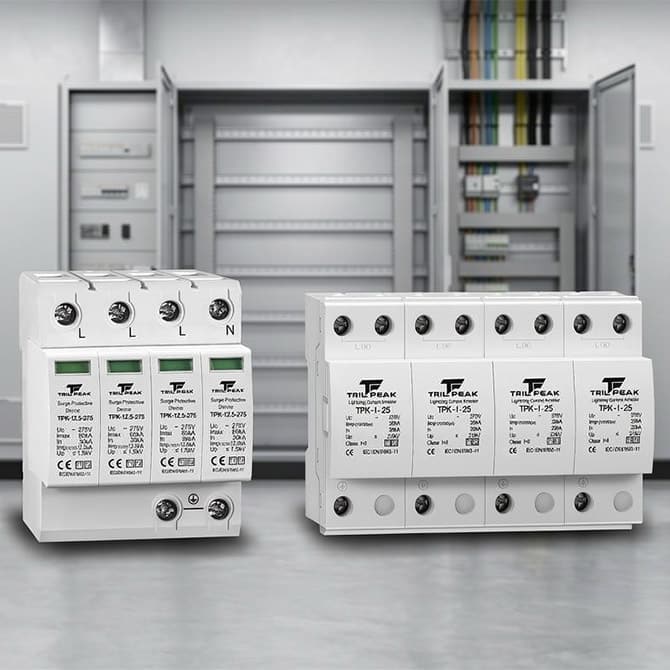
Low-voltage AC surge protection for commercial and industrial power distribution. Covers TN-S, TN-C, TT, and IT earthing systems.
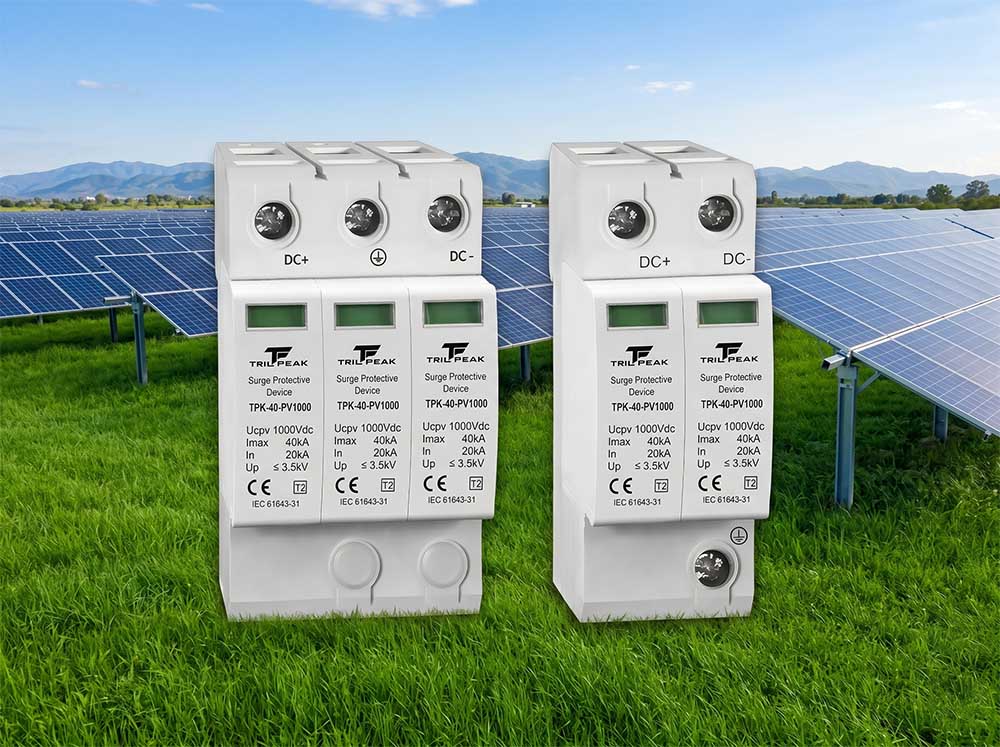
DC surge protective devices for solar PV strings up to 1500 V, EV charging, battery energy storage, and telecom DC rails.

Low insertion-loss protection for IP camera networks, RS485 industrial control buses, and Ethernet/PoE infrastructure.
How to Select the Right Surge Protective Device
Four engineering decisions — in the correct order. A mismatch at any step results in under-protection or premature SPD failure.
Service entrance with LPS: Type 1. Every main distribution board: Type 2. PLCs and sensitive equipment: Type 3. See the Type 1 vs Type 2 vs Type 3 comparison.
TN-S 230 V → Uc ≥275 V. TT → Uc ≥320 V. IT or 480 V → Uc 385–440 V. Full parameter table in the IEC 61643-11 technical guide.
Standard commercial: 20–40 kA (8/20 µs). Industrial: 40–100 kA. Direct lightning: Iimp 12.5–25 kA (10/350 µs). Read the single-phase vs 3-phase guide.
IEC 60364-5-53 mandates a series SCPD. Type 2 20 kA → 63 A MCB. Type 2 40 kA → 125 A MCB. Type 1 → 100–160 A gG fuse. See the MCB coordination guide.
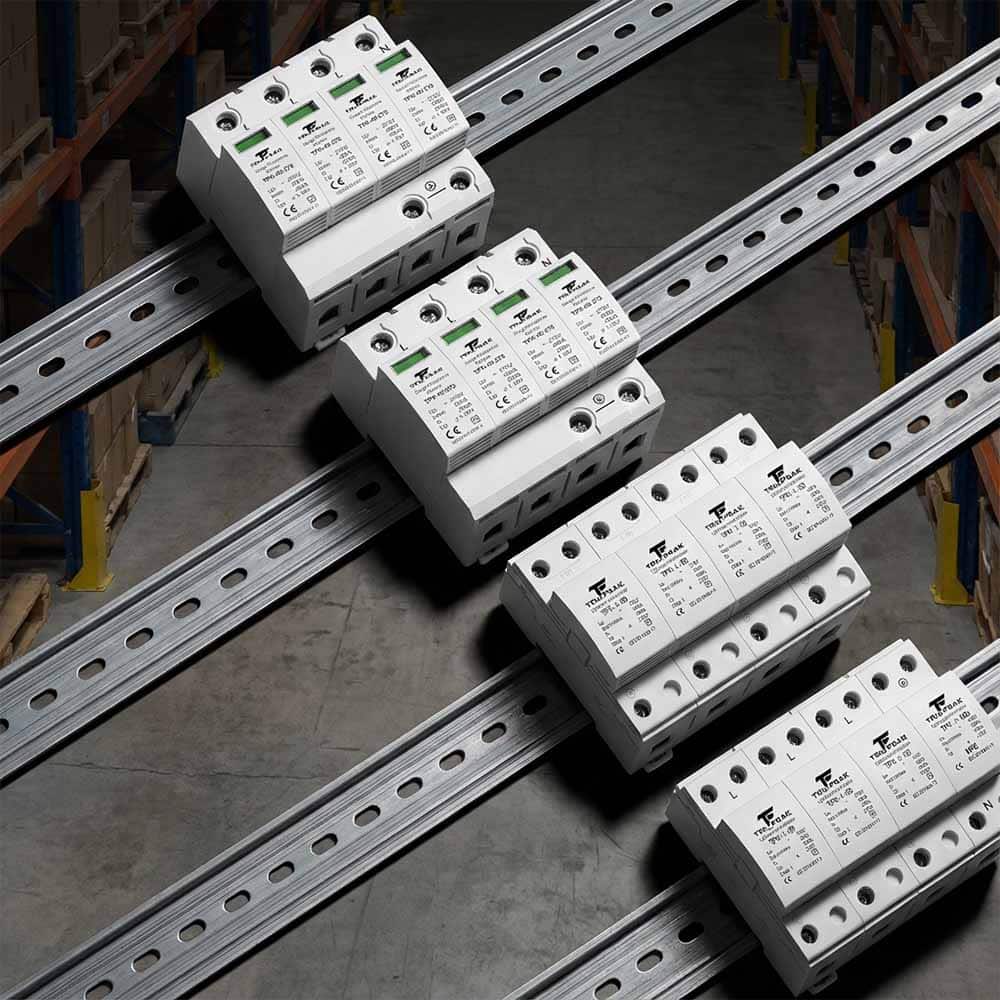
IEC 61643-11 Certified Surge Protective Devices
Every TrilPeak surge protective device is independently tested and certified to IEC 61643-11. CE Declaration of Conformity issued by ECM Italy — a European Notified Body — available for every catalogue model.
In-House SPD Manufacturing — OEM & ODM Ready
Unlike trading companies, TrilPeak manufactures core components in-house — from metal oxide varistors (MOV) to finished surge protective devices. Every unit passes 100% routine testing before dispatch.
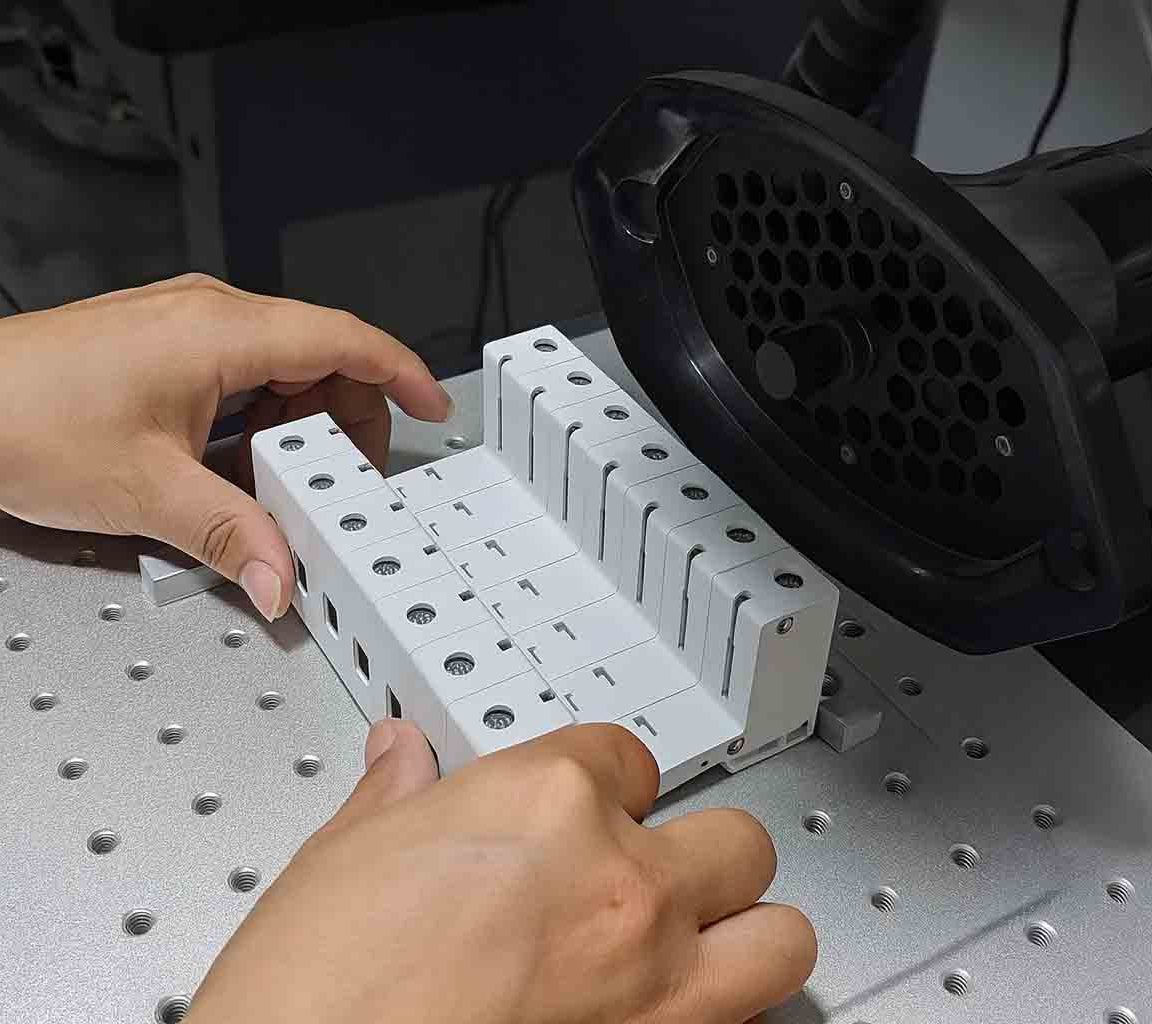
Vertically Integrated SPD Production
In-house tooling, injection moulding, copper stamping, automated assembly, and IEC-compliant testing — all under one roof. This gives B2B clients unmatched customisation flexibility and component-level traceability.
Private Label
Your brand on housing and labels. EU Declaration of Conformity in your company name with ECM Italy as Notified Body.
OEM Programme →Custom Design
Custom housing, specific terminal layouts, or non-standard Uc ratings. Full tooling and PCB design support.
ODM Capabilities →OBM Distribution
Distribute under the TrilPeak brand. Fast CE clearance docs, B2B platform support, and territory protection.
Distributor Programme →Assembly Kits
Semi-knockdown and complete-knockdown kits for local assembly. Optimise import duty classifications.
SKD / CKD Details →MOQ, Lead Time & Export Documentation
Transparent B2B sourcing terms for international distributors, OEM brand owners, and procurement teams.
Minimum Order Quantity
Flexible MOQ policy to support distributor market entry and growing OEM brands.
Lead Time & Delivery
Shipped direct from our 20,000 m² manufacturing facility with firm timeline commitments.
Export Documentation
Complete compliance and customs documentation package issued within 24 hours of request.
Surge Protective Device Technical Hub
Everything you need to specify, install, maintain, and source surge protective devices — organised by what you're trying to accomplish.
Frequently Asked Questions About Surge Protective Devices
What is a surge protective device (SPD) and how does it work?
A surge protective device limits transient overvoltages and diverts surge current safely to the protective earth, shielding connected equipment from lightning surges, switching transients, and grid disturbances. The core component is a metal oxide varistor (MOV) — a voltage-dependent resistor that conducts when voltage exceeds its clamping threshold, then recovers once the surge passes.
Under IEC 61643-11, surge protective devices are classified into Type 1 (service entrance), Type 2 (distribution board), and Type 3 (point-of-use).
What is the difference between a Type 1 and Type 2 surge protective device?
Type 1 SPD handles direct partial lightning current — tested with a 10/350 µs impulse (rated by Iimp). Mandatory at service entrance when an LPS is present. Type 2 SPD handles induced surges on an 8/20 µs waveform (Imax/In) at every main distribution board downstream. Type 1 events carry 10–20× the energy of Type 2 events.
How do I select the correct Uc (maximum continuous voltage) rating?
Uc must be ≥ 1.1 × nominal system voltage L-N. Undersizing is the most common cause of early SPD failure — it places the MOV under continuous thermal stress at normal operating voltage.
Quick reference: TN-S 230 V → Uc ≥ 275 V. TT system → Uc ≥ 320 V. IT or 480 V → Uc 385–440 V. Full earthing-system tables in the IEC 61643-11 parameter guide.
What backup MCB or fuse does IEC 60364-5-53 require in series with an SPD?
A short-circuit protection device (SCPD) in series is mandatory. It must clear a fault if the SPD fails short-circuit, without tripping the upstream protective device.
Minimum ratings: Type 2 20 kA → 63 A MCB. Type 2 40 kA → 125 A MCB. Type 1 → 100–160 A gG fuse per datasheet. See the MCB and SPD coordination guide.
Why is 10 m cable separation required between a Type 1 and Type 2 SPD?
Without 10 m of cable inductance between them, the Type 2 clamps faster than the Type 1 — absorbing the full 10/350 µs lightning current (10–20× its rated energy), causing immediate failure.
The 10 m cable adds sufficient inductance to allow the Type 1 to respond first. No space? Use a Type 1+2 combined SPD — engineered with internal decoupling to eliminate this requirement.
What is the maximum SPD lead length and why does it matter?
The total lead length (phase conductor + protective earth conductor combined) must not exceed 0.5 m. Each metre of lead adds roughly 1 µH of inductance, which creates an additional voltage drop during a surge event — reducing the effective protection level (Up) seen by the equipment.
Full wiring rules and worked examples are in the DIN rail SPD installation guide.
Get Factory Pricing for Your SPD Requirements
Tell us your protection type (AC / DC / signal), voltage class, earthing system, and order quantity. Our engineers respond within 24 hours with factory-direct pricing, confirmed lead time, and a full IEC 61643-11 documentation package.