Lightning Arrester vs Surge Arrester: 7 Key Differences Explained (IEC 62305)
Quick Answer
Surge arrester vs lightning arrester — are they the same? No. A lightning arrester and a surge arrester protect against completely different threats and cannot substitute for each other.
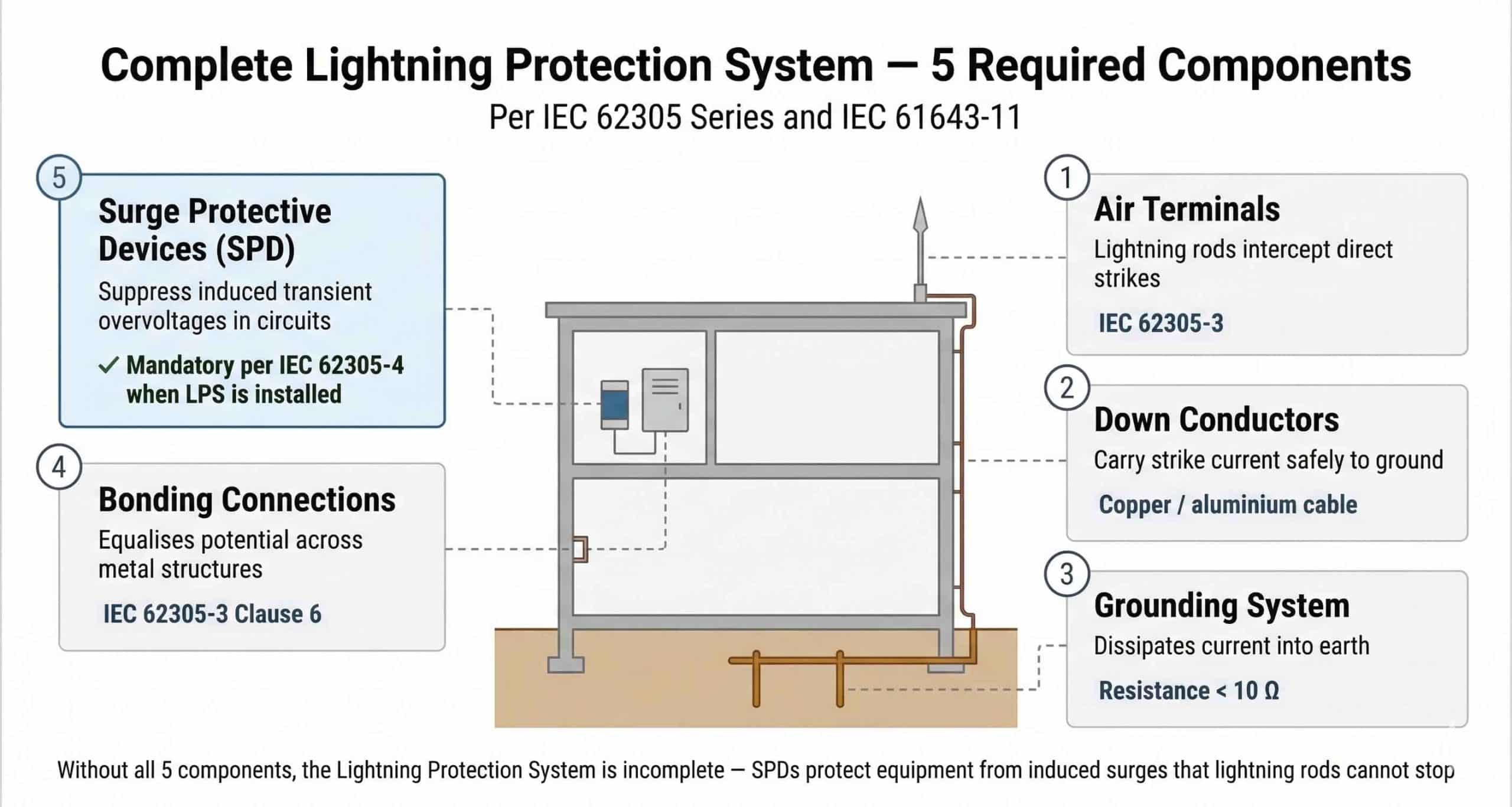
Lightning arrester (air terminal / lightning rod) — external device mounted on rooftops and transmission towers. Intercepts direct lightning strikes (20–200 kA) and conducts current safely to ground. Protects the building structure. Standard: IEC 62305-3.
Surge arrester / SPD (Surge Protective Device) — internal device installed inside electrical panels. Clamps induced transient overvoltages (2–20 kV) from lightning, switching, and grid faults. Protects connected equipment. Standard: IEC 61643-11.
Lightning surge arrester — a Type 1 SPD specifically rated for lightning-induced surges on power lines (10/350 µs, Iimp ≥ 12.5 kA); distinct from both the external air terminal and a standard Type 2 SPD.
Do you need both? Yes — IEC 62305-4 mandates surge protective devices (SPDs) whenever an external lightning protection system (LPS) is installed.
This guide covers the surge arrester vs lightning arrester comparison in full: 7 key differences, spelling variants (lightning arrestor, surge arrestor, lightning surge suppressor), types of lightning arrester, and the complete selection guide for contractors and EPC engineers working under IEC/EN standards.

1. What Is a Lightning Arrester? (Lightning Arrestor Defined)
Understanding the surge arrester vs lightning arrester distinction is essential for any electrical protection system. A lightning arrester — also commonly spelled lightning arrestor or lightning arresters — is an external protective device designed to intercept direct lightning strikes and provide a controlled, low-resistance path for the lightning current to safely discharge into the ground. It is the first line of defence against the raw physical energy of a lightning strike.
Note: Do not confuse the lightning arrester with a lightning surge arrester (also called a lightning surge suppressor or Type 1 SPD), which is an internal panel-mounted device that handles lightning-induced transient overvoltages — not the direct strike itself.
The terms lightning arrester, lightning rod, air terminal, and lightning conductor are often used interchangeably in the field. Technically, the air terminal is the pointed metallic tip that captures the strike, while the complete system — air terminal + down conductor + grounding electrode — is called the Lightning Protection System (LPS). In common usage, "lightning arrester" refers to the complete system or specifically the air terminal component.
1.1 How a Lightning Arrester Works
When a lightning bolt approaches a structure, the lightning arrester — mounted at the highest point — provides a preferential discharge path. The massive lightning current (typically 20–200 kA, occasionally exceeding 300 kA) travels down the metallic down conductor and disperses safely into the grounding electrode system below grade. The critical requirement is a grounding resistance below 10 Ω to ensure complete energy dissipation without dangerous step potentials.
Modern lightning protection design follows the rolling sphere method per IEC 62305-3, which defines the protected zone under each air terminal. A single conventional Franklin rod protects a cone-shaped zone with a radius equal to its height. For larger structures or wider protection zones, Early Streamer Emission (ESE) lightning arresters — such as TrilPeak's ESE series certified to NFC 17-102 — provide a single device protection radius of up to 80 metres, reducing the number of down conductors and simplifying installation on large industrial facilities.
1.2 Types of Lightning Arrester: Franklin Rod, ESE, and Shield Wire
- Franklin rod (conventional air terminal): Simple pointed metal rod — the oldest and most widely used design. One rod per protected zone; multiple rods required for large structures. Cost-effective for residential and small commercial buildings.
- Early Streamer Emission (ESE) arrester: Active air terminal that generates an upward leader earlier than conventional rods, extending the effective capture radius. A single ESE device can protect the same area as 5–10 conventional rods. Required for large industrial facilities, data centres, and telecom towers. TrilPeak ESE series: certified to NFC 17-102, protection radius up to 80 m.
- Overhead ground wire (shield wire): Used in transmission line protection — a grounded conductor suspended above the power lines intercepts strikes along the line.
- Surge arrester on power systems (high-voltage arrester): Metal oxide varistor (ZnO) devices installed on transmission and distribution lines, rated 3 kV to 1,000 kV — these are high-voltage protective devices, distinct from the low-voltage SPDs discussed below.
Note: The spelling lightning arrestor (with an "o") is a common variant of lightning arrester — both refer to the same device. The IEC and IEEE standards use "arrester." Both spellings are technically acceptable in professional use.
2. What Is a Surge Arrester? (Surge Arrester vs SPD Explained)
In the surge arrester vs lightning arrester comparison, the surge arrester operates entirely inside your electrical system. A surge arrester — also called a Surge Protective Device (SPD), surge suppressor, or transient voltage surge suppressor (TVSS) — is an internal electrical protection device installed inside distribution panels, equipment cabinets, and electrical enclosures. Its function is to detect and clamp transient overvoltages before they reach and damage connected electrical and electronic equipment.
The term "surge arrester" has historically been used for both high-voltage utility devices (rated above 1 kV, IEC 60099-4) and low-voltage building protection devices (rated below 1.2 kV, IEC 61643-11). In modern usage and in building electrical protection, surge arrester and SPD are used interchangeably to refer to the low-voltage devices installed in building distribution systems.
2.1 How a Surge Arrester (SPD) Works
The core component of most modern surge arresters is the Metal Oxide Varistor (MOV) — a zinc oxide-based non-linear resistor with voltage-dependent impedance characteristics:
- Normal operation: The MOV presents very high resistance (>1 MΩ) — essentially invisible to the circuit, drawing negligible leakage current.
- Surge event: When voltage exceeds the clamping threshold, the MOV transitions to low resistance (<10 Ω) within nanoseconds, diverting the surge current through a low-impedance path to the protective earth (PE) conductor.
- Post-surge: After the transient passes, the MOV resets to high-impedance state — the process is repeatable thousands of times until the MOV reaches end-of-life from cumulative energy absorption.
The voltage protection level (Up) — the residual voltage that passes through to the protected equipment during a clamping event — is the primary performance parameter. For equipment protection per IEC 60664-1: Type 1 SPDs must achieve Up < 4.0 kV, Type 2 < 2.5 kV, Type 3 < 1.5 kV.
2.2 Surge Arrester Types: IEC 61643-11 Classifications (Type 1, 2, 3 & 1+2)
| Type | Test Waveform | Impulse Current | Installation Point | Required When |
|---|---|---|---|---|
| Type 1 | 10/350 µs | Iimp ≥ 12.5 kA | Main service entrance (LPZ 0→1) | External LPS installed — mandatory per IEC 62305-4 |
| Type 2 | 8/20 µs | In: 20–40 kA | Sub-distribution panels (LPZ 1→2) | Standard equipment protection — always recommended |
| Type 3 | 8/20 µs (combined) | Imax: 5–10 kA | Equipment terminals (LPZ 2→3) | Sensitive electronics, >15 m from Type 2 |
| Type 1+2 | 10/350 µs + 8/20 µs | Iimp ≥ 12.5 kA | Main service entrance | Space-saving single device for LPZ 0→2 |
2.3 What Is a Lightning Surge Arrester? (A Third, Distinct Term)
A lightning surge arrester is not the same thing as either the lightning arrester (air terminal) or a general-purpose surge arrester (SPD) — it is a specific subtype of Type 1 SPD. The name describes its function precisely: it arrests the surge that lightning induces on a power line or service entrance conductor, not the lightning strike itself. A lightning surge arrester is tested to the 10/350 µs impulse waveform with Iimp ≥ 12.5 kA per IEC 61643-11, and is installed at the main service entrance — the same location as a standard Type 1 SPD. In practice, "lightning surge arrester" and "Type 1 SPD" refer to the same product category; the term is more common in North American and utility-adjacent terminology, while "Type 1 SPD" is the standardized IEC label used in technical specifications. A lightning surge arrester cannot intercept a direct strike on the structure — that remains the job of the external lightning arrester (air terminal) described in Section 1.
3. Surge Arrester vs Lightning Arrester: 7 Key Differences
The confusion between lightning arresters and surge arresters — whichever word order you search, lightning arrester vs surge arrester or surge arrester vs lightning arrester — is one of the most common misconceptions in electrical protection, even among experienced engineers. The table below covers all 7 fundamental differences between these two complementary systems.
- Location: Lightning arrester = external (rooftop) | Surge arrester = internal (panel)
- Threat: Lightning arrester = direct strike (100–200 kA) | Surge arrester = induced surge (2–50 kA)
- Protects: Lightning arrester = building structure | Surge arrester = electrical equipment
- Standard: Lightning arrester = IEC 62305-3 | Surge arrester = IEC 61643-11
- Interchangeable? No — IEC 62305-4 mandates both together
| # | Characteristic | Lightning Arrester (Air Terminal) | Surge Arrester (SPD) |
|---|---|---|---|
| 1 | Primary function | Intercepts direct lightning strikes; provides a controlled discharge path for 20–200 kA lightning current to ground — protecting the building structure | Clamps induced transient overvoltages (2–20 kV) from lightning, switching events, and grid faults — protecting electrical equipment inside the building |
| 2 | Threat type handled | Direct lightning strike (10/350 µs waveform, 20–200 kA) — a catastrophic, low-frequency event | Induced surges, switching transients, electrostatic discharge (8/20 µs waveform, 2–50 kA) — frequent, recurring events |
| 3 | Installation location | External — rooftop, highest structural point, transmission towers, building perimeter | Internal — inside main distribution board, sub-panels, equipment cabinets, at point of use |
| 4 | Governing standard | IEC 62305-3 (physical damage to structures); IEC 62305-2 (risk assessment) | IEC 61643-11 (AC SPDs); IEC 61643-31 (DC PV SPDs) |
| 5 | Voltage / energy rating | No voltage rating — handles raw lightning energy; component: copper or aluminium conductor | Rated voltage: 230 V–1500 V AC/DC; energy rating in joules; impulse current In 20–40 kA (Type 2) or Iimp 12.5–25 kA (Type 1) |
| 6 | Protection target | Building structure, roof, walls — physical / structural protection | Inverters, PLCs, VFDs, SCADA systems, computers, telecoms — equipment protection |
| 7 | Can one replace the other? | No — a surge arrester cannot stop a direct strike; a lightning arrester cannot protect equipment from induced surges. IEC 62305-4 mandates both systems together. | |

A perfectly installed lightning arrester system allows approximately 50% of lightning energy to couple electromagnetically into internal electrical circuits. This is why IEC 62305-4 mandates surge protective devices in addition to the external lightning protection system — not as an alternative.
4. Lightning Arrestor vs Surge Arrestor: Same Device, Different Spelling?
One of the most frequent search queries in the surge arrester vs lightning arrester topic involves spelling variations: lightning arrestor, lighting arrester (missing one "t"), lightning arrestors, lighting arrestor. These all refer to the same devices — the spelling differences do not indicate different products.
4.1 Arrester or Arrestor — Which Is Correct?
Both spellings are in active use in professional practice:
- "Arrester" — the spelling used by IEC standards (IEC 62305, IEC 61643), IEEE standards (C62.11, C62.41), and most international technical literature. This is the preferred form in formal engineering documentation.
- "Arrestor" — widely used in North American utility practice and in everyday professional communication. Fully accepted in industry.
4.2 Common Spelling Variants — All Refer to the Same Devices
| Spelling Variant | Refers To | Notes |
|---|---|---|
| lightning arrester | External air terminal / LPS component | IEC/IEEE standard spelling |
| lightning arrestor | External air terminal / LPS component | Common variant — same device |
| lightning arresters / lightning arrestors | Plural of above | Both valid |
| lighting arrester / lighting arrestor | Same as lightning arrester | Common misspelling (missing "n") — same meaning |
| surge arrester / surge arrestor | Low-voltage SPD in distribution panels | Both spellings used for same device |
| surge arrester (high voltage) | MV/HV ZnO arrester on power lines | Different from LV SPD; rated 3 kV–1,000 kV |
| lightning surge arrester | Type 1 SPD — also called lightning surge suppressor | Installed at service entrance; rated 10/350 µs; Iimp ≥ 12.5 kA per IEC 61643-11 |
5. Surge Arrester vs Surge Protector: Are They the Same?
In low-voltage building electrical protection — the most common context — surge arrester and surge protector mean the same thing: both terms describe an SPD (Surge Protective Device) installed in a distribution panel, rated to IEC 61643-11. The IEC standard uses "SPD" as the official term; common practice often calls the same device a "surge arrester" or "surge protector" interchangeably, and a buyer searching for either term should expect to find the identical product category.
In power transmission and distribution systems, "surge arrester" specifically refers to high-voltage devices rated 3 kV to 1,000 kV (IEC 60099-4), installed on overhead lines, transformers, and substations. These are fundamentally different from low-voltage building SPDs.
| Term | Context | Voltage Range | Standard | Installed Where |
|---|---|---|---|---|
| SPD / Surge Protective Device | Low-voltage building protection | ≤1.2 kV AC; ≤1.5 kV DC | IEC 61643-11 / IEC 61643-31 | Inside panels, distribution boards |
| Surge arrester (LV) | Same as SPD — LV building use | ≤1.2 kV AC | IEC 61643-11 | Inside panels |
| Surge arrester (HV) | Power transmission / utility | 3 kV–1,000 kV | IEC 60099-4 | Overhead lines, transformers, substations |
| Surge suppressor / TVSS | Legacy North American term | ≤1.2 kV AC | UL 1449 (legacy) | Inside panels |
6. Do Surge Protectors Protect Against Lightning?
The short answer: yes, surge protectors protect against lightning-induced surges, but no, they cannot protect against a direct lightning strike to the building.
6.1 What Surge Protectors (SPDs) Can Do Against Lightning
When lightning strikes within 1–2 km of a building, the rapidly changing electromagnetic field around the strike induces transient overvoltages of 2–20 kV in electrical cables, data lines, and signal wiring. A correctly installed and properly rated SPD clamps this induced surge voltage to a safe level (Up typically 1.0–2.5 kV for Type 2 devices) within nanoseconds, preventing damage to connected equipment.
6.2 What Surge Protectors Cannot Do
A direct lightning strike delivers 20–200 kA in a 10/350 µs waveform. Type 2 SPDs are rated for 8/20 µs waveforms at 10–40 kA. The energy of a direct strike is more than 10 times the rating of a standard Type 2 SPD.
Type 1 SPDs (impulse current rated, tested to 10/350 µs waveform) are specifically designed to handle partial direct lightning current that may enter the electrical system via the grounding network or power lines even when a lightning protection system is present.
6.3 Complete Answer: Surge Protector vs Lightning Strike
| Scenario | Surge Protector (SPD) Effective? | Lightning Arrester Required? |
|---|---|---|
| Lightning strikes 0.5–2 km away (induced surge) | Yes — SPD clamps induced transient effectively | Not required for this threat |
| Lightning strikes nearby overhead power line (conducted surge) | Yes — Type 1 or Type 1+2 SPD handles this | Helpful for structure protection |
| Lightning strikes the building directly (direct strike) | No — SPD cannot handle direct 100–200 kA strike | Required — lightning arrester must intercept first |
| Switching transients from grid (inverter startup, motor switching) | Yes — primary function of Type 2 SPD | Not applicable |
| Power line fault-induced overvoltage | Yes — SPD clamps temporary overvoltage | Not applicable |
A standard consumer power strip with a "surge protector" label is typically a very limited Type 3 SPD with discharge capacity of 1–6 kA. For meaningful protection against lightning-induced surges in building electrical systems, a properly rated Type 2 SPD (In ≥ 20 kA) installed at the main distribution board is required.
7. Lightning Arrester Applications: Home, Industrial, and Substation
7.1 Residential Buildings
For a residential property, whether external lightning protection is required depends on an IEC 62305-2 risk assessment based on location, keraunic level, height, and construction type.
- External LPS (lightning arrester): Often not required by code for average residential properties in moderate keraunic zones — but strongly recommended for exposed locations (hilltop, rural open land, coastal), tall structures, or properties with high-value electronics.
- SPD (surge protector): Always recommended regardless of LPS status — lightning-induced surges reach residential buildings via utility power lines even without a direct strike.
- Recommended residential SPD: Type 2 SPD at the main distribution board (In ≥ 20 kA), plus Type 3 SPDs at sensitive equipment.
7.2 Commercial and Industrial Facilities
Commercial and industrial facilities almost always exceed the IEC 62305-2 risk thresholds that mandate external lightning protection. A complete system requires:
- External LPS: ESE or conventional air terminals, down conductors, grounding system (resistance ≤ 10 Ω)
- Type 1 SPD at main service entrance (LPZ 0→1 boundary) — mandatory per IEC 62305-4 when LPS is installed
- Type 2 SPDs at sub-distribution panels serving PLCs, VFDs, SCADA, motor control centres
- Signal line SPDs for RS-485, Ethernet, and coaxial cables entering or leaving the building
7.3 Substation and Utility Infrastructure
In power transmission and distribution, high-voltage surge arresters (IEC 60099-4) protect transformers, switchgear, and power lines from direct lightning strikes and switching surges on the primary system. These are rated 3 kV to 1,000 kV and are distinct from building SPDs. Substation lightning protection combines overhead shield wires with ZnO surge arresters on transformer terminals.
8. Why Facilities Need Both: The $50,000 Lesson and IEC 62305-4
The most costly misconception in the surge arrester vs lightning arrester debate is believing that a lightning rod also protects electrical equipment. It does not.
8.1 The Real Failure Scenario
A facility installs a complete external lightning protection system — air terminals on the roof, down conductors along the exterior walls, grounding electrodes below grade. The system meets IEC 62305-3 in full. Six months later, a thunderstorm destroys three PLCs, two VFDs, and a SCADA communications module. Total equipment loss: over $50,000. The building itself is untouched.
This is the direct result of missing the second half of IEC 62305's protection framework. The air terminal intercepts the direct strike and carries 100–200 kA safely to ground — but the rapidly changing magnetic field around the strike path generates electromagnetic induction in every electrical cable in the building. That induction creates transient overvoltages of 6–20 kV inside the wiring, propagating to every connected device. The lightning rod cannot prevent this. Physics prevents it.
8.2 IEC 62305-4: The Mandatory Link Between Both Systems
IEC 62305-4 settles the surge arrester vs lightning arrester debate definitively at the standards level. Its core requirement: when an external lightning protection system is installed, SPDs shall be installed at the service entrance and throughout the distribution system. This is a compliance requirement, not a recommendation.
The framework uses Lightning Protection Zones (LPZ) to define where each SPD type is needed:
- LPZ 0→1 boundary (service entrance, main panel): Type 1 SPD — handles partial direct lightning current (Iimp 12.5–25 kA, 10/350 µs). Mandatory when LPS is installed.
- LPZ 1→2 boundary (sub-distribution panels): Type 2 SPD — handles residual induced surges (In 20–40 kA, 8/20 µs)
- LPZ 2→3 boundary (equipment terminals): Type 3 SPD — fine protection for sensitive electronics (Imax 5–10 kA)

9. How to Select the Right Protection: 3-Step Decision Framework
9.1 Step 1 — Does Your Facility Need an External Lightning Arrester?
Conduct an IEC 62305-2 risk assessment. External LPS is required for most commercial and industrial buildings in regions with more than 25 thunderstorm days per year, or in exposed locations. Key triggers:
- Structure height > 20 m
- Building with high fire or explosion risk (fuel depots, chemical plants)
- Buildings with high consequence of failure (hospitals, data centres, process control facilities)
- Isolated structures in flat terrain
- Any building where calculated risk R exceeds tolerable risk RT per IEC 62305-2
9.2 Step 2 — Select SPD Type Based on Your Situation
| Your Situation | Required SPD at Main Panel | Additional SPDs |
|---|---|---|
| No external LPS, moderate lightning risk | Type 2 (In ≥ 20 kA) | Type 3 at sensitive equipment |
| No external LPS, high lightning risk (>5 flashes/km²/yr) | Type 1+2 combined | Type 2 at sub-panels, Type 3 at equipment |
| External LPS installed (any size building) | Type 1 or Type 1+2 — mandatory per IEC 62305-4 | Type 2 at sub-panels, Type 3 at equipment |
| Solar PV system (any) | Type 2 DC SPD at inverter DC input (IEC 61643-31) | Type 2 AC SPD at inverter AC output |
| Industrial facility with PLCs / VFDs | Type 1+2 at main panel | Type 2 at each motor control centre; signal SPDs on RS-485, Ethernet |
9.3 Step 3 — Coordinate Both Systems with Minimum 10 m Separation
When Type 1 and Type 2 SPDs are installed in different panels, maintain a minimum 10 m cable distance between them — or use a decoupling inductor per IEC 61643-12 coordination requirements. This ensures energy coordination between the two protection stages: the Type 1 handles the first surge peak, and the Type 2 handles the attenuated residual, rather than both devices trying to clamp simultaneously.
10. Frequently Asked Questions: Surge Arrester vs Lightning Arrester
10.1 What is the difference between a lightning arrester and a surge arrester?
A lightning arrester is an external device (air terminal/lightning rod) mounted on rooftops. It intercepts direct lightning strikes (100–200 kA, 10/350 µs) and protects the building structure under IEC 62305-3. A surge arrester (SPD) is an internal device installed inside electrical distribution panels. It clamps induced transient overvoltages (2–20 kV, 8/20 µs) from lightning, switching, and grid faults, protecting electrical equipment under IEC 61643-11. Neither can replace the other — IEC 62305-4 mandates both together.
10.2 Is a lightning arrestor the same as a lightning arrester?
Yes — "lightning arrestor" and "lightning arrester" refer to exactly the same device. The difference is only in spelling. IEC and IEEE standards use "arrester" as the technical standard form. "Arrestor" is a widely accepted variant used in North American utility practice. Similarly, "lighting arrester" (with one "t") is a common misspelling — same meaning. All variants refer to the external air terminal or high-voltage power line protective device.
10.3 Do surge protectors protect against lightning?
Surge protectors (SPDs) effectively protect against lightning-induced surges — the overvoltages that travel through electrical wiring when lightning strikes nearby. A properly rated Type 2 SPD (In ≥ 20 kA) installed at the main distribution board clamps these induced surges within nanoseconds. However, surge protectors cannot protect against a direct lightning strike to the building — that requires an external lightning protection system. Consumer power strips with "surge protection" labels are typically limited Type 3 SPDs (1–6 kA) and provide only minimal protection.
10.4 Can a surge protector work against lightning?
Yes, with an important distinction. A surge protector works effectively against lightning-induced surges (the most common lightning damage mechanism). For direct strike protection, an external lightning protection system is required. For complete protection, both are needed: the lightning arrester handles direct strikes, the surge protector handles induced surges.
10.5 What is a surge arrester vs surge protector — are they the same?
Yes. In low-voltage building electrical protection, surge arrester and surge protector refer to the same device — an SPD installed in a distribution panel, rated to IEC 61643-11. The important distinction exists in power systems: "surge arrester" also refers to high-voltage devices (3 kV–1,000 kV per IEC 60099-4) installed on overhead power lines and transformers. In everyday B2B electrical protection work: surge arrester = surge protector = SPD.
10.6 What is a lightning arrester for home use?
A lightning arrester for home use is an external lightning protection system (LPS) installed on a residential building to protect it from direct lightning strikes. Whether it is required depends on an IEC 62305-2 risk assessment — many standard homes in moderate keraunic zones do not meet the threshold requiring external LPS. However, surge protectors (SPDs) are always recommended for residential buildings regardless of whether a lightning arrester is installed.
10.7 Will a surge protector protect against lightning if I don't have a lightning rod?
A surge protector installed in your main distribution panel will protect your electrical equipment against lightning-induced surges even without a lightning rod — covering the majority of lightning damage scenarios. What a surge protector cannot do without a lightning rod: if lightning strikes your building directly, the full strike energy would hit your electrical system. In high-lightning regions or exposed locations, both are needed together.
10.8 Can a surge arrester replace a lightning arrester?
No — neither device can replace the other. A surge arrester handles induced transient overvoltages (8/20 µs waveform, 10–50 kA for high-capacity types) — not direct lightning strikes. A direct strike delivers 10/350 µs waveform energy at 100–200 kA — more than 10 times the energy rating of most surge arresters. Conversely, a lightning arrester only diverts the direct strike current to ground — it does nothing to suppress the induced surges that travel through wiring and damage equipment.
10.9 What standard governs lightning arresters and surge arresters?
For external lightning protection systems (lightning arresters/air terminals): IEC 62305-1 (general principles), IEC 62305-2 (risk assessment), IEC 62305-3 (physical damage to structures). For surge protective devices in low-voltage AC systems: IEC 61643-11. For DC PV solar applications: IEC 61643-31. For coordination between external LPS and internal SPDs: IEC 62305-4. For high-voltage surge arresters on power lines: IEC 60099-4. The critical standard that defines when both systems must be used together is IEC 62305-4.
10.10 Is a lightning surge arrester the same as a lightning arrester?
No. A lightning surge arrester is a Type 1 SPD installed inside a panel at the service entrance — it clamps lightning-induced surge voltage on the power conductors (10/350 µs, Iimp ≥ 12.5 kA). A lightning arrester (air terminal) is an external rooftop device that intercepts the direct lightning strike itself. The names sound similar but the two devices sit in completely different locations and handle completely different physical events; a facility with an external lightning protection system still needs a separate lightning surge arrester (Type 1 SPD) at the panel per IEC 62305-4.
11. Conclusion: Two Systems, One Compliant Protection Strategy
A lightning arrester and a surge arrester are not competing options — they are two mandatory layers of the same IEC 62305 protection framework, each stopping a threat the other cannot touch. The lightning arrester diverts the direct strike current (100–200 kA) safely to ground and protects the building structure; the surge arrester (SPD) clamps the induced transient overvoltages (2–20 kV) that electromagnetic induction still couples into the wiring even when the external system works perfectly. IEC 62305-4 makes this pairing a compliance requirement, not a recommendation: any facility with an external LPS needs Type 1 or Type 1+2 SPDs at the service entrance, with Type 2 and Type 3 cascaded downstream. Specifying one without the other leaves a protection gap that, as the $50,000 equipment-loss scenario in Section 8 shows, only becomes visible after the next storm.
Related Resources & Standards
Need IEC 62305-4 compliant surge protection for your project?
TrilPeak supplies complete surge protection ranges — Type 1, Type 1+2, Type 2, Type 3, and DC SPDs for solar PV. CE certified · IEC 61643-11 · engineering reply within 24h.