Commercial Surge Protection for Refrigeration: The 3-Stage Guide
A single voltage spike can destroy a $25,000 rack controller in microseconds — and most commercial refrigeration systems are wired with no meaningful protection against it. This guide covers commercial surge protection for refrigeration systems: SPD type selection, application-specific designs for restaurants, supermarkets and cold storage, grounding compatibility, and installation rules per IEC 61643-11.
Quick Answer
- Commercial refrigeration systems need panel-mounted SPDs — not plug-in consumer strips.
- Minimum requirement: a Type 2 SPD (IEC 61643-11, Imax ≥ 40kA) at the main distribution panel, protecting VFD compressors, rack controllers, and electronic expansion valves.
- Facility with external lightning rods? Add a Type 1 SPD at the service entrance — mandatory, not optional.
- Correct wiring configuration (3+0 vs 3+1) depends on your grounding system: TT, TN-S, or TN-C.
Commercial refrigeration surge protection is the use of panel-mounted Surge Protective Devices (SPDs), certified to the International Electrotechnical Commission (IEC) 61643-11, to protect Variable Frequency Drive (VFD) compressors, rack controllers, and electronic expansion valves from voltage transients caused by lightning and utility switching events.
Modern commercial refrigeration systems — supermarket rack controllers, cold storage warehouses, food processing facilities — have undergone a quiet but dangerous transformation. The shift from robust mechanical contactors to precision electronics (Variable Frequency Drives, Electronic Expansion Valves, IoT-enabled rack controllers) has made these systems 30–50% more energy-efficient but exponentially more vulnerable to electrical transients. Without adequate commercial surge protection, a single voltage spike can destroy thousands of dollars in electronics within microseconds.
A voltage spike that a 1995-era compressor motor absorbed without issue can now cause catastrophic, irreversible failure in a 2026-era IGBT-based inverter drive. For facility directors and project engineers, the cost is measured not in the replacement part, but in the operational paralysis that follows: spoiled inventory, contractual penalties, and emergency labor that can easily exceed $50,000 per event.
This guide covers the full scope of commercial refrigeration surge protection per IEC 61643-11: SPD type selection, application-specific strategies for restaurants, supermarkets, and cold storage, installation best practices, and grounding compatibility rules that determine whether your protection actually works.
1. Why Commercial Refrigeration Equipment Is Vulnerable to Surge Damage
Modern refrigeration electronics fail at roughly half the surge voltage that older mechanical equipment tolerated, which is why purpose-built commercial surge protection has become a baseline design requirement rather than an optional extra. The two failure mechanisms below — instant IGBT breakdown and cumulative insulation damage — explain why.
1.1 How Voltage Transients Destroy VFD Compressors: IGBT Avalanche Breakdown
Variable Frequency Drives (VFDs) use Insulated Gate Bipolar Transistors (IGBTs) to control compressor motor speed. These semiconductors deliver significant energy savings but are notoriously fragile against transient overvoltage — which is precisely why commercial surge protection for refrigeration has become a mandatory engineering consideration, not an optional add-on. In a standard 400V system, the DC bus inside the VFD sits at approximately 560V, while IGBT blocking voltage is typically rated at 1,200V.
When a lightning-induced surge (commonly 2,000–6,000V) reaches a commercial refrigeration VFD, the following sequence occurs within microseconds:
- Surge voltage exceeds the semiconductor's depletion region breakdown threshold.
- Avalanche breakdown occurs in the PN junction.
- Current concentrates in a microscopic filament within the silicon die, causing localized temperatures exceeding 1,000°C in nanoseconds.
- The component creates a permanent short circuit, often with physical rupture and fire risk.
In plain terms: older compressors had a simple mechanical switch that could shrug off a power spike. Today's energy-efficient inverter drives use delicate electronics instead — they save money on the power bill, but a spike that the old equipment never noticed can now destroy the new equipment in a fraction of a second.
Legacy compressor contactors tolerated ~2,500V surges. Modern IGBT-based VFDs fail at ~1,200V — a 70% reduction in surge tolerance. This is not a manufacturing defect; it is the physics of high-efficiency power electronics operating at their electrical limits. Equipment manufacturers routinely deny warranty claims for surge damage, classifying it as "external electrical disturbance." Addressing this vulnerability with purpose-built commercial refrigeration surge protection is now a baseline engineering requirement for any VFD-driven refrigeration system.
1.2 Cumulative Surge Damage to Compressor Motor Insulation (Partial Discharge)
Lower-magnitude surges (1,000–2,000V), often generated internally by the switching of other inductive loads (compressors, fans, pumps), cause Partial Discharge (PD) — micro-arcing between the copper turns of a hermetic scroll compressor motor. The equipment keeps running. The insulation varnish erodes silently. Weeks later, a ground fault develops during a normal startup. Maintenance teams misdiagnose this as "mechanical fatigue," unaware the root cause was cumulative electrical trauma from events occurring 100–500 times per day.
Key concept — let-through energy (I²t). Equipment damage is a function of total energy delivered, not just peak voltage. A coordinated Type 1 + Type 2 SPD system reduces the specific energy reaching downstream electronics by over 95%. Effective commercial surge protection requires energy staging across multiple SPD types — a single device at the main panel is insufficient for VFD protection.
For related VFD protection principles applied to HVAC systems, see our HVAC Surge Protector Guide.
2. Selecting the Right Surge Protector: IEC 61643-11 Type 1, 2 & 3
IEC 61643-11 defines three SPD types, each matched to a different point in the electrical system, and most refrigeration facilities need at least two of the three working together. Selecting the wrong type — or using a consumer plug-in strip — provides no meaningful protection against industrial surge events.
| SPD Type | Test Waveform | Surge Source Simulated | Installation Location | Key Rating |
|---|---|---|---|---|
| Type 1 (Class I) | 10/350μs | Direct lightning current (high energy) | Service entrance / main switchboard | Iimp = 12.5–50kA/phase |
| Type 2 (Class II) | 8/20μs | Induced surges & utility switching transients | Main distribution panel / MCC | In = 20kA, Imax = 40–80kA |
| Type 3 (Class III) | 1.2/50μs + 8/20μs | Residual voltage / fine protection | Near VFDs, PLCs, rack controllers | Imax = 10kA, Up ≤ 1.0kV |
Table 1: SPD Type Classification per IEC 61643-11
The 10/350μs waveform (Type 1) carries 20× more energy than the 8/20μs waveform (Type 2). Never install a Type 2 SPD at the service entrance of a facility with external lightning rods — it will be destroyed by the first direct strike, leaving all downstream refrigeration equipment unprotected.
For a full comparison including cascade coordination rules, see our Type 1 vs Type 2 vs Type 3 SPD Comparison Guide.
2.1 SPD Type Selection Logic for Commercial Refrigeration Systems
- Facility has external lightning rods (LPS)? → Type 1 SPD at service entrance is mandatory per IEC 62305. No exceptions.
- No external LPS? → Type 2 SPD at the main distribution panel is the minimum requirement for all commercial refrigeration.
- System includes VFDs or PLC-based rack controllers? → Add a Type 3 SPD at the equipment panel for final Up ≤ 1.0kV — below the IGBT damage threshold.
3. Grounding System Compatibility: TT, TN-S, TN-C
Selecting the correct SPD type is not enough — the wiring configuration must also match the facility's earthing system, or the SPD can fail to protect and create a fire hazard. See our single-phase vs three-phase power guide for earthing system fundamentals.
| Earthing System | Common In | Required SPD Config | Reason |
|---|---|---|---|
| TT | Europe, Asia, Middle East | 3+1 (3 MOVs + 1 GDT) | N not bonded to Earth at site; N-E can surge to 2,000V+ |
| TN-S | Modern industrial (EU) | 3+0 or 4+0 | Separate N and PE conductors; N bonded at source |
| TN-C | Older industrial installations | 3+0 only | Combined PEN conductor; no separate N module needed |
Table 2: Earthing System vs. Required SPD Configuration
Using a standard 3+0 surge protector on a TT system leaves the Neutral-to-Earth surge path completely unprotected. In TT systems, a transient on the neutral can reach full surge voltage across equipment connected between N and E. Always use 3+1 configuration, which includes a Gas Discharge Tube (GDT) module for the N-PE path.
Field identification, in plain terms: open the main electrical panel and check whether Neutral (N) and Earth (PE) bars are bonded together at the service entrance. Bonded → TN-C or TN-S system. Separate → TT system requiring 3+1 SPD configuration. If you're not sure how to check this safely, send us a photo of your panel and we'll help identify it.
For 3-phase configuration details across all earthing systems, see our 3-Phase Surge Protection Guide.
4. Surge Protection Designs by Facility Type
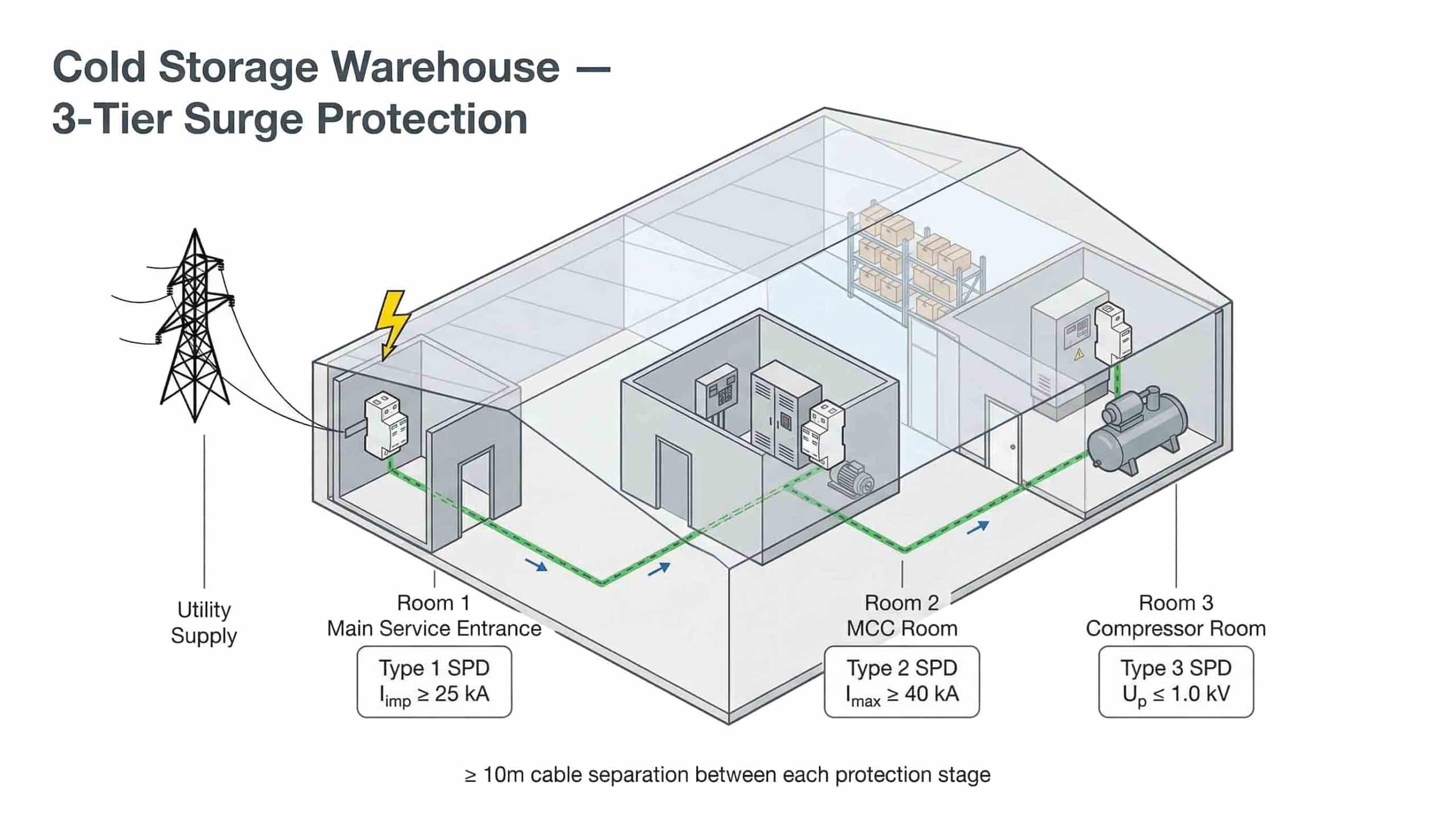
The correct commercial surge protection design scales with facility size — a restaurant walk-in cooler needs a single Type 2 SPD, while a cold storage warehouse with external LPS needs a full three-tier cascade. The diagram below shows the coordinated cascade architecture used in large commercial refrigeration projects.
4.1 Restaurant and Walk-In Cooler Systems
System profile: 1–2 walk-in coolers, 4–6 reach-in refrigerators, ice machine. Single 3-phase panel, TT or TN-C grounding.
The minimum commercial surge protection for a restaurant application is a single Type 2 SPD at the refrigeration sub-panel:
- TN-C system: Type 2 SPD (Imax = 40kA, Up ≤ 2.0kV), 3+0 configuration
- TT system: Type 2 SPD with 3+1 configuration (adds N-PE GDT protection module)
- Upstream protection: 125A gG fuse or C100 MCB
- Grounding wire: minimum 10mm² (6 AWG) copper, total path < 0.5m
Upgrade note: if the walk-in cooler uses an inverter-driven compressor (Copeland, Danfoss, or Emerson EVI models), add a Type 3 SPD at the unit disconnect for final Up ≤ 1.0kV VFD protection. This completes the two-stage commercial refrigeration surge protection design for restaurant applications.
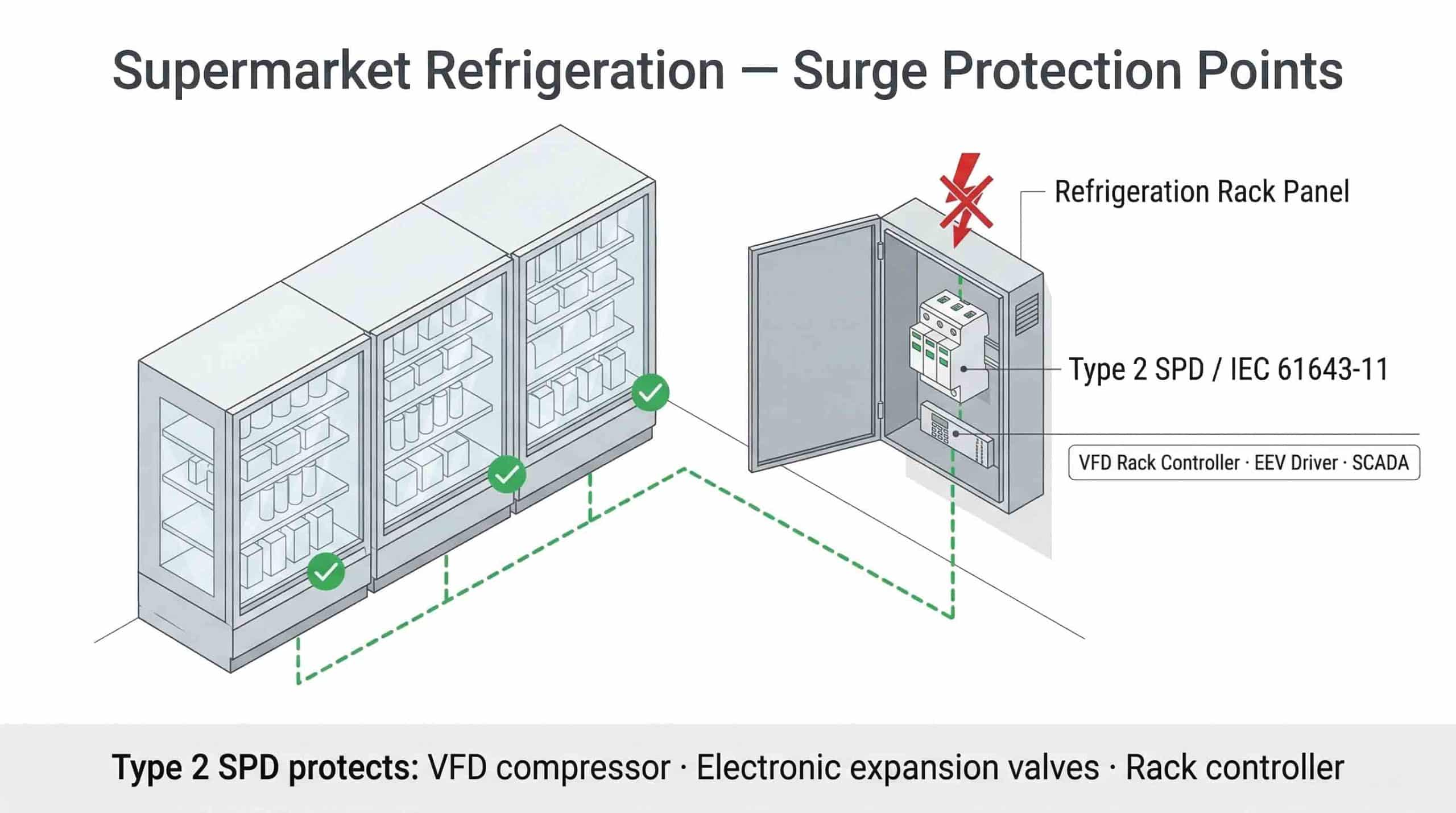
4.2 Supermarket Rack System: Two-Stage Coordination
System profile: Centralized rack (10–40 HP), 20–50 display cases, VFD rack controller, electronic expansion valves, SCADA/Building Management System (BMS) monitoring. TN-S grounding (modern construction).
Supermarket installations represent the most complex commercial refrigeration surge protection scenario, requiring a coordinated two-stage approach to bring transient voltage within safe limits for sensitive rack electronics.
Stage 1 – Main Distribution (400A service): Install a Type 2 SPD (Imax = 40kA, Up ≤ 2.0kV) in the main electrical room for bulk surge energy dissipation from the utility.
Stage 2 – Refrigeration Rack Panel: Install a Type 3 SPD (Imax = 10kA, Up ≤ 1.0kV) at the rack panel for fine protection of the rack controller, VFDs, and EEV assemblies.
Cascade coordination requirement. Maintain ≥ 10 meters of cable between Stage 1 and Stage 2 SPDs. This distance provides the impedance needed for proper energy sequencing — Type 2 clamps first at 2.0kV, Type 3 handles the residual down to 1.0kV. If both panels are physically adjacent, install a decoupling inductor between stages to enforce the correct firing sequence.
Protected assets in this design: VFD rack controller ($8,000–$25,000 replacement), head pressure control VFDs, EEVs (20–50 units at $600 each), SCADA/monitoring systems.
4.3 Cold Storage Warehouse: Three-Tier Lightning and Surge Protection
Facility profile: 50,000–500,000 sq ft, 1–5 MVA transformer, external lightning protection system (LPS) with roof-mounted lightning rods, ammonia or CO₂ industrial refrigeration.
Critical principle for LPS-equipped facilities: external LPS protects the structure from fire but routes massive current to ground. Ground Potential Rise (GPR) causes this current to back-feed into the electrical system. Without a Type 1 surge protector at the service entrance, the LPS creates a direct surge path into refrigeration equipment — making three-tier commercial surge protection mandatory for any LPS-equipped facility.
- Tier 1 – Service Entrance: Type 1 SPD (Iimp = 25kA/phase @ 10/350μs) — the only device class rated for direct lightning current waveform.
- Tier 2 – MCC Room: Type 2 SPD (4+0) at each motor control center distribution panel.
- Tier 3 – Ammonia Machine Room / Control Room: Type 3 SPD (Up ≤ 1.0kV) protecting Programmable Logic Controller (PLC) controllers, VFD-driven screw compressors, and SCADA systems.
Case study — cold storage VFD burnout: an ammonia cold storage facility lost two 250HP VFD-driven screw compressors during a thunderstorm despite having lightning rods on the roof. Investigation revealed the facility had external LPS but no Type 1 SPDs at the service entrance. Ground potential rise from the strike back-fed a massive surge through grounding conductors directly into both VFDs. After retrofitting Type 1 SPDs (Iimp = 25kA) at main switchgear and Type 2 SPDs at the MCC, the facility weathered three subsequent major storms without equipment loss.
If your facility has a similar profile — external lightning rods, VFD-driven compressors, no Type 1 SPD at the service entrance — it's worth having someone check. Send us your single-line diagram and we'll tell you honestly whether there's a gap.
Grounding coordination (IEC 62305 mandatory): bond LPS ground to electrical system ground. Implement equipotential bonding for all metal structures. Verify grounding resistance < 10Ω annually.
For external lightning protection context, see What Is a Lightning Protection System? and our guide on Lightning Arrester vs Surge Arrester terminology.
5. Installation Best Practices
Poor installation wiring — not incorrect SPD selection — is the most common cause of protection failure in commercial refrigeration systems. Two rules determine whether a correctly specified SPD actually delivers its rated protection: lead length and upstream overcurrent coordination.
5.1 The 0.5m Wiring Rule
Per IEC 60364-5-53, the total SPD connecting lead length (L1 + PE path) must not exceed 0.5 meters. Every meter of wire adds approximately 1μH of inductance. During a surge, voltage drop = L × di/dt, and that drop is added directly to the clamping voltage seen at the equipment terminals.
Calculation example, poor installation: SPD clamping voltage (Up): 1,500V. Connecting wire: 2 meters total loop path → 2μH inductance. Surge current rise rate: 10kA/μs (8/20μs waveform). Voltage drop = 2μH × 10,000V/μs = 2,000V. Total voltage at equipment = 1,500V + 2,000V = 3,500V. Result: a VFD rated for 1,200V sees 3,500V — failure occurs despite the surge protector being installed.
Correct installation per IEC 61643-11: mount the SPD as close as possible to the main busbar. Use shortest practical conductors with no loops or coils. Minimum conductor cross-section: 10mm² (6 AWG) copper. Do not share the PE conductor with other equipment.
5.2 Upstream Circuit Protection Coordination
Every commercial surge protection installation requires correctly sized upstream overcurrent protection for each SPD. The upstream breaker or fuse must permit the SPD to operate during surge events while clearing fault current if the SPD fails short-circuit. Undersized protection trips during surges; oversized protection cannot clear a failed SPD, creating a fire hazard. See our Circuit Breaker vs Surge Protector Coordination Guide for sizing rules.
6. Lifecycle Management and Maintenance
An SPD wears out based on cumulative surge energy absorbed, not calendar age — a low-exposure site may get 10-15 years from one, while a high-exposure site may need replacement in 3-5. The only way to know where a given SPD stands is scheduled inspection or remote monitoring, not assumption.
SPDs are sacrificial devices — their lifespan is measured in joules absorbed, not calendar years. Effective commercial refrigeration surge protection requires ongoing maintenance, not just initial installation. A properly maintained system requires scheduled inspection, because a failed SPD provides zero protection even though it remains physically in place. For full replacement criteria, see When to Replace a Surge Protector.
- Visual Inspection (Monthly): check the status indicator window. Green = SPD operational. Red = Metal Oxide Varistor (MOV) has failed; replace immediately.
- Remote Monitoring (Continuous): TrilPeak SPDs with /S suffix include a NO/NC remote signaling contact. Wire to BMS digital input for automated maintenance alerts and event logging — essential for multi-site supermarket chains and 24/7 cold storage operations.
- Thermal Imaging (Annual): scan SPD connections during annual electrical audits. An SPD running significantly hotter than ambient without a surge event indicates internal MOV leakage current degradation — signaling imminent failure before the indicator turns red.
- Post-Event Inspection: after confirmed nearby lightning strikes or major utility faults, inspect all SPDs precautionarily, even if indicators still show green.
7. IEC 61643-11 vs UL 1449: Certification Standards for International Projects
Two standards govern SPD testing and compliance worldwide — IEC 61643-11 for international markets and UL 1449 for North America — and specifying the wrong one creates compliance risk on export projects. Understanding which applies to your project is essential for correct specification.
| Standard | Jurisdiction | SPD Classification | Required For |
|---|---|---|---|
| IEC 61643-11 | International (Europe, Middle East, Asia, Africa, South America) | Type 1 / Type 2 / Type 3 by test waveform energy | CE marking; international export projects; EU, GCC, ASEAN specifications |
| UL 1449 | North America (USA, Canada) | SPD by nominal discharge current | USA/Canada domestic installations |
Table 3: IEC 61643-11 vs UL 1449
For global supply chains and export-oriented commercial refrigeration surge protection projects, IEC 61643-11 is the universal benchmark. Its granular classification by test waveform energy is particularly important in industrial applications where the type of surge — not just peak voltage — determines whether equipment survives.
TrilPeak SPD certifications: IEC 61643-11 — type tested by independent accredited laboratories. CE Marked — Low Voltage Directive 2014/35/EU compliance.
For a full breakdown of IEC 61643-11 testing protocols and Temporary Overvoltage (TOV) requirements, see Understanding IEC 61643-11 Standards. For authoritative standard documentation, see the International Electrotechnical Commission (IEC), ASHRAE, and IEEE.
Sourcing components for your own refrigeration equipment line? If you're an OEM building surge protection into your own refrigeration hardware rather than retrofitting an existing site, TrilPeak also supplies IEC 61643-11 certified SPD modules for integration into panel builds — contact our engineering team for OEM component datasheets and volume pricing.
8. Conclusion
Effective commercial surge protection for refrigeration is not a single device — it is a coordinated cascade matched to your facility type, grounding system, and equipment sensitivity. The hardware cost of a complete Type 1+2+3 system is $500–$5,000 installed. A single prevented VFD or rack controller failure returns that investment within days.
Match the SPD type to the installation point. Verify grounding topology before specifying 3+0 vs 3+1. Enforce the 0.5m lead rule during installation. Monitor status indicators monthly and integrate remote signaling into BMS for 24/7 operations. When properly specified and installed, commercial refrigeration surge protection delivers measurable ROI within the first avoided failure event.
For the complete IEC classification framework, see our IEC 61643-11 Standards Guide. For product selection, browse our full surge protective device range.
9. Frequently Asked Questions: Commercial Surge Protection for Refrigeration
9.1 What type of surge protector does a commercial refrigeration system need?
All commercial refrigeration systems require panel-mounted industrial SPDs for proper commercial surge protection, not consumer plug-in strips. At minimum, a Type 2 SPD (IEC 61643-11, 8/20μs, Imax ≥ 40kA) is needed at the main distribution panel. Facilities with external lightning protection systems (LPS) also require a Type 1 SPD at the service entrance. VFD-driven compressors need additional Type 3 fine protection (Up ≤ 1.0kV) at the equipment panel to stay below the IGBT damage threshold.
9.2 Do I need a surge protector for my cold storage facility if it already has lightning rods?
Yes — lightning rods make SPDs mandatory, not optional. Lightning rods protect the structure from fire and direct lightning current into the ground. Ground Potential Rise (GPR) causes this current to back-feed into the electrical system through grounding conductors. IEC 62305 explicitly mandates a Type 1 SPD at the service entrance for all facilities with external LPS. Without it, the LPS creates a direct surge pathway into your refrigeration equipment.
9.3 Why are modern VFD refrigeration compressors more vulnerable to surge damage than older equipment?
Legacy compressor contactors tolerated approximately 2,500V surges. Modern IGBT-based VFDs have a semiconductor breakdown voltage of ~1,200V — a 70% reduction in surge tolerance. A 2,000V lightning-induced surge causes avalanche breakdown in the IGBT PN junction within microseconds, resulting in a permanent short circuit. This is the inherent physics of high-efficiency power electronics, not a product defect. Equipment manufacturers routinely deny warranty claims for this type of surge damage.
9.4 What SPD configuration does a TT grounding system require for commercial refrigeration?
TT systems require a 3+1 SPD configuration (3 MOVs for L1/L2/L3-to-Earth + 1 Gas Discharge Tube for Neutral-to-Earth). In TT systems, the neutral is not bonded to ground at the service entrance, meaning N-E voltage can surge to 2,000V+. A standard 3+0 configuration leaves this path completely unprotected. To identify your system: if N and PE bars are bonded at the main panel service entrance → TN system. If separate → TT system, 3+1 required.
9.5 Why is IEC 61643-11 certification important for international cold storage and refrigeration projects?
IEC 61643-11 is required for CE marking and is accepted across Europe, the Middle East, Asia, and Africa. For export-oriented projects and multinational facility specifications, IEC certification ensures global supply chain compliance. UL 1449 (North America only) does not satisfy project specifications in EU, GCC, or ASEAN markets. Specifying IEC-certified SPDs from the outset avoids costly substitutions during procurement.
9.6 What is the minimum cable distance between Type 2 and Type 3 surge protectors for cascade coordination?
A minimum of 10 meters of cable between a Type 2 (main panel) and Type 3 (equipment panel) SPD is required for proper energy coordination. This distance provides the impedance needed to ensure the Type 2 clamps first (2.0kV), with the Type 3 handling the residual down to 1.0kV. If panels are adjacent (< 10m), install a decoupling inductor between stages. Insufficient separation causes simultaneous triggering, eliminating the cascade benefit and potentially destroying the Type 3 device.
9.7 Why does poor wiring make a surge protector ineffective even when installed correctly?
Connecting wire adds inductance (~1μH/meter). Voltage drop = L × di/dt. With just 2 meters of wire and a 10kA/μs surge: Vdrop = 2μH × 10,000 = 2,000V added to the SPD's 1,500V clamping voltage. Equipment sees 3,500V — failure occurs despite the surge protector being present. IEC 60364-5-53 mandates total lead length under 0.5m. Mount SPDs directly to the busbar, no wire loops, minimum 10mm² (6 AWG) copper conductors.
9.8 What is the cost of a supermarket refrigeration rack failure without surge protection?
Industry estimates place the total cost of a centralized rack controller failure at over $50,000 per event: $8,000–$25,000 for rack controller replacement, emergency HVAC/R service labor ($150–$300/hour), and total loss of perishable dairy, meat, and frozen inventory. In pharmaceutical cold storage, a single temperature excursion can trigger millions in product loss and regulatory consequences. A Type 2+3 coordinated SPD system costs $500–$2,000 installed — a sub-one-week payback on the first prevented failure.
9.9 Does TrilPeak hold UL 1449 certification for their commercial refrigeration SPDs?
TrilPeak SPDs are certified to IEC 61643-11 and carry CE marking, which are the applicable standards for the international markets we serve: Europe, Middle East, Asia, Africa, and South America. UL 1449 is a North American regional standard. For projects in these international markets, our IEC/CE certified products meet all applicable requirements. Customers with North American domestic projects should confirm whether their specification requires UL listing.
9.10 How do I monitor surge protector status across multiple commercial refrigeration sites remotely?
TrilPeak SPDs with the remote signaling option (model suffix /S) include a NO/NC changeover contact that connects to your BMS or SCADA digital input. When an SPD fails, the contact state changes, triggering automated email/SMS alerts and logging the event timestamp. For multi-site supermarket chains or cold storage networks, integrate SPD status into your central SCADA platform. This enables predictive replacement scheduling before a subsequent surge event reaches an unprotected system.
Related Resources & Standards
Need IEC-certified surge protection for a commercial refrigeration project?
TrilPeak manufactures Type 1, Type 2, and Type 3 SPDs for VFD compressors, rack controllers, and cold storage distribution panels — IEC 61643-11 certified, CE marked, direct from manufacturer. Send your single-line diagram and we'll confirm the right SPD configuration for your facility.