DIN Rail Surge Protector: What It Is, How It Installs, and How to Source It
Quick Answer: What Is a DIN Rail Surge Protector?
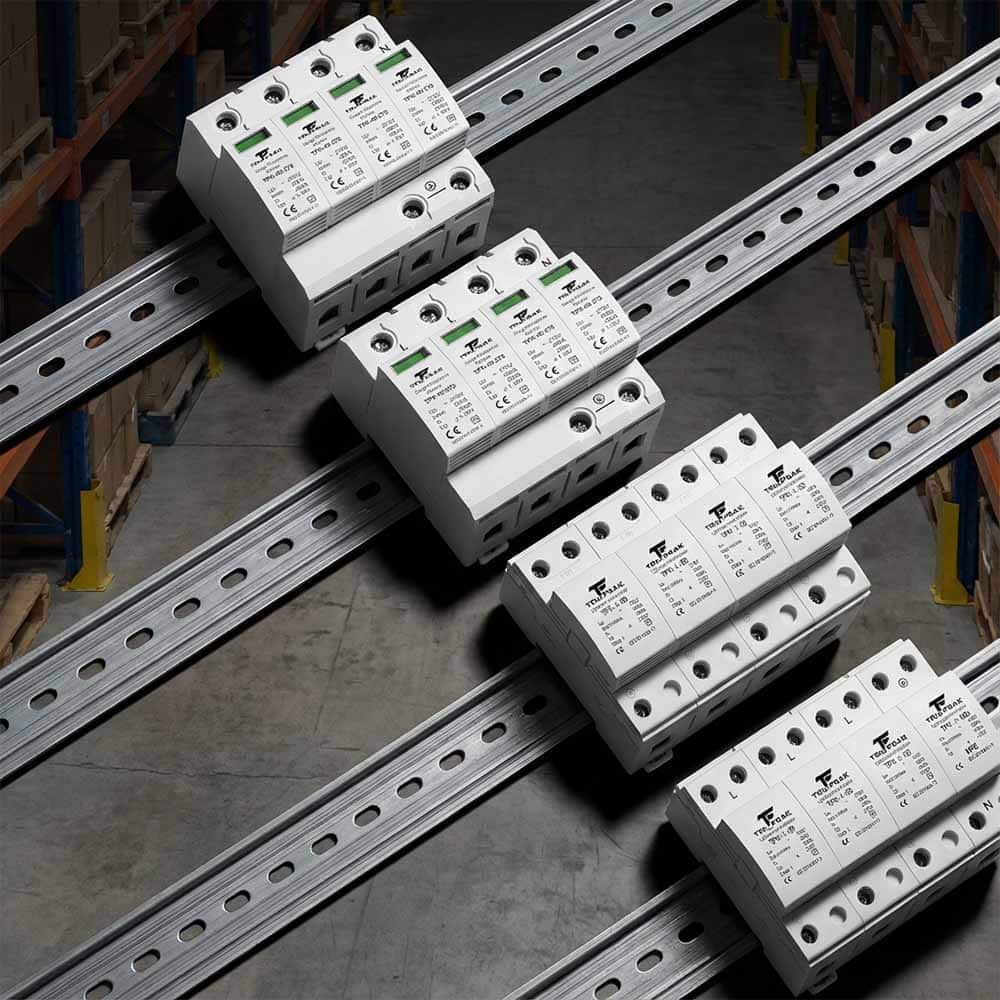
A DIN rail surge protector — also called a DIN rail mounted surge protection device, DIN rail SPD, or DIN rail surge suppressor — is a surge protective device (SPD) built in a modular housing that clips directly onto the standard 35mm metal rail already inside your distribution panel or control cabinet, the same rail your circuit breakers and terminal blocks sit on. No drilling, no separate enclosure. It snaps into place in seconds and can be replaced just as fast. This is the standard SPD mounting format for IEC 61643-11 compliant electrical installations worldwide, and the format every major SPD manufacturer builds around.
If you are a panel builder, system integrator, electrical contractor, or OEM sourcing manager specifying surge protection for a distribution board or control cabinet, this guide covers what a DIN rail surge protector is, how it installs, what specifications actually matter (pole configuration, module width, Uc rating), and what to ask a manufacturer before placing an order.
1. What Is a DIN Rail Surge Protector?
A DIN rail surge protector is an SPD housed in a modular plastic enclosure with a spring-loaded clip on its base, designed to mount on the same 35mm rail that holds every other modular component in an electrical panel. A DIN rail itself is a standardised 35mm wide metal mounting rail — defined by IEC 60715 — that runs horizontally inside electrical panels and control cabinets. It is the universal mounting platform for modular electrical components: circuit breakers, contactors, relays, terminal blocks, and SPDs all share the same rail system.
The name comes from DIN, the German standards body that originally defined the format. Today it is an international standard. If you open an industrial control cabinet or a commercial distribution board almost anywhere in the world, there is a DIN rail inside — and a DIN rail surge protector is the natural fit for surge protection in any such panel. In product literature and search results you will see this same device called a DIN rail mounted surge protection device, a DIN rail SPD, or a DIN rail surge suppressor — all four terms refer to the identical product category.
2. How a DIN Rail SPD Installs
A DIN rail surge protector clips onto the rail and connects to the line and earth terminals in under a minute, with no drilling and no extra hardware. To install: tilt the top of the device onto the rail, press the bottom in until the spring clip snaps, then connect the terminals. Removal is the reverse — press the clip release with a screwdriver, tilt, and lift off.
This clip-on mechanism is identical across all DIN rail components, which means a DIN rail surge protector integrates into any existing panel without modifying the rail or repositioning the surrounding components.

3. DIN Rail Surge Protector Specifications: Pole Configuration, Module Width & Uc Rating
Three specifications determine whether a DIN rail surge protector fits your panel and your earthing system: pole configuration, module width, and Uc (maximum continuous operating voltage). Getting any one of these wrong either leaves part of the system unprotected or means the device physically does not fit the rail space allocated.
3.1 Pole Configuration: 1+0, 1+1, 2+0, 3+0, 3+1, 4+0
Pole configuration must match your system's earthing arrangement, not just its phase count. A 3+0 mode device only protects the three line conductors to PE — if your system is TN-S or TT and needs a separate neutral-to-PE protection path, you need a 3+1 mode device instead. Using a 3+0 mode SPD on a TN-S panel leaves the N-PE path completely unprotected, a common and avoidable specification error in three-phase industrial panels.
| Mode | Poles | Protection Path(s) | Typical Use Case |
|---|---|---|---|
| 1+0 | 1 | L–PE | Single-phase TN-C (PEN conductor, no separate N) |
| 1+1 | 2 | L–PE, N–PE | Single-phase TN-S, TT (residential / light commercial) |
| 2+0 | 2 | 2 conductors–PE | Single-phase configuration without a dedicated N–PE path — confirm the exact application against your earthing system before specifying; see note below |
| 3+0 | 3 | L1/L2/L3–PE | Three-phase TN-C (PEN conductor, no separate N) |
| 3+1 | 4 | L1/L2/L3–PE, N–PE | Three-phase TN-S (most common industrial/commercial) |
| 4+0 | 4 | L1/L2/L3/N–PE | Three-phase TT (neutral clamped to PE on equal footing with the line conductors) |
The exact application boundary between 2+0 and 1+1 mode varies by manufacturer documentation and local wiring regulation — confirm against your specific project's earthing system and the manufacturer's datasheet rather than relying on mode notation alone.
3.2 Module Width and Rail Space
Most single-phase DIN rail SPDs occupy 1–2 module widths (18mm per module); three-phase 3+1 mode devices typically occupy 3–4 modules. Before specifying, measure the usable DIN rail length in the target panel — excluding sections blocked by busbars, structural supports, or existing equipment — and compare it against the SPD's module width. For panels with limited rail space, compact 2-module three-phase designs exist, but they generally trade discharge current capacity (e.g. 20kA instead of 40kA) for the reduced footprint.
3.3 Uc — Maximum Continuous Operating Voltage
Uc must be selected for the earthing system, not just the nominal voltage. This is the specification most frequently mis-selected in the field.
| System | Nominal Voltage | Minimum Uc (L–N) | Minimum Uc (L–L) |
|---|---|---|---|
| TN-S / TN-C | 230/400V | 275V | 440V |
| TT | 230/400V | 320V | 550V |
Specifying a Uc of 230V or 240V "to match the system voltage" is a common and incorrect assumption. Uc must exceed the highest voltage the line will see during normal operation, including tolerances and temporary overvoltages — for a 230V TN system, the standard minimum is 275V; for TT systems, 320V, because ground faults can raise the L-PE voltage to roughly 1.45× nominal before the upstream RCD trips.
The 275V and 320V figures above are the IEC 61643-11 minimum thresholds for standard 230/400V TN and TT systems — they are not the only Uc values available. Non-standard grid voltages, export markets with different nominal supply voltages, or projects requiring a specific safety margin above the standard threshold can be accommodated with a custom Uc rating; see Section 7 on confirming this directly with the manufacturer at the specification stage.
4. DIN Rail vs Other SPD Mounting Methods
DIN rail is the dominant SPD mounting format for panel-integrated surge protection, but it is not the only option. SPDs come in several mounting formats depending on the panel and application.
| Mounting Type | How It Installs | Best For | Limitation |
|---|---|---|---|
| DIN rail | Clips onto standard 35mm rail | Distribution panels, control cabinets, MCC — any panel with a DIN rail | Requires DIN rail in the panel |
| Screw / surface mount | Bolted to panel backplate or wall | Older panels without DIN rail, outdoor enclosures | Slower to install and replace |
| Plug-in / socket base | Plugs into a dedicated base unit | Applications requiring hot-swap without disconnecting wiring | Requires matching base; higher cost |
For panel builders, system integrators, and electrical contractors, a DIN rail surge protector is the default choice because it fits directly into the panel layout they are already building — no extra hardware, no layout redesign.
5. Why DIN Rail Is the Standard for Industrial and Commercial Panels
DIN rail dominates panel-integrated surge protection because it fits the layout panel builders are already using, replaces in seconds, and exposes device status without opening the panel. Four practical advantages explain why.
It fits what's already there. Industrial control panels, MCCs, and distribution boards are all laid out on DIN rails. Adding a DIN rail surge protector means slotting it into an existing rail section — typically 1 to 4 module widths — with no rethinking of the panel design.
Replacement is fast and clean. Many DIN rail surge protectors use a plug-in cartridge design: the wiring terminals stay fixed on the base, and only the protective element is swapped when the status indicator shows the device has tripped. In a plant environment where downtime is expensive, this is a significant advantage over surface-mounted alternatives that require rewiring to replace.
Status is visible without opening the panel. The green/red status indicator on the front face of a DIN rail surge protector is visible through the panel door during a walkthrough. A maintenance technician can check the status of every SPD in a panel in seconds.
Universal compatibility. Because the 35mm DIN rail is an international standard, any DIN rail surge protector from any manufacturer fits the same rail. No proprietary mounting systems, no vendor lock-in.
TrilPeak's entire industrial AC SPD range is DIN rail mounted. Every Type 1, Type 2, and Type 1+2 device clips onto a standard 35mm rail — built to integrate seamlessly into the panels you are already designing and building. See the full range on TrilPeak's SPD product pages.
6. Installation Best Practices: Lead Length, Positioning, and Backup Protection
Where you position the DIN rail surge protector on the rail directly determines how well it clamps surge voltage — this is not a preference, it is physics. Mount it as close as possible to the panel's incoming busbar, with the connecting leads kept short. The longer the leads between the SPD terminals and the busbar, the higher the voltage that reaches your equipment during a surge event, regardless of the device's rated Up.
In practice: put the DIN rail surge protector on the same rail section as the incoming protective devices, close to the busbar, with total lead length (line terminal to busbar, plus PE terminal to ground bar) kept under 0.5 metres. For a full explanation of how this affects protection level, see the IEC 61643-11 standard or TrilPeak's guide on how surge protection devices work.
A DIN rail SPD also needs a dedicated upstream protective device — either a Type B/C MCB sized per the manufacturer's datasheet, or a purpose-built Surge Backup Protector (SCB). After a surge is clamped, an SPD can draw follow current or develop elevated leakage; the SCB isolates the SPD branch selectively before that fault reaches the upstream main breaker, so a routine SPD replacement doesn't take down the entire panel. SCB units share the same 18mm-per-pole DIN rail footprint as the SPD itself, so adding backup protection does not change the rail space planning from Section 3.2.
7. Sourcing DIN Rail Surge Protectors: A B2B Buyer's Checklist
For panel builders and OEM buyers, the right DIN rail surge protector specification is only half the job — verifying the manufacturer can actually deliver to that specification, consistently, across every unit in an order, is the other half. These are the points worth confirming before placing an order.
7.1 Request the Type Test Report, Not Just a Compliance Claim
"IEC 61643-11 compliant" on a datasheet without a traceable test report number is self-declared and unverifiable. Ask for the full type test report from an accredited laboratory, covering discharge capacity testing, Up measurement at L-N/L-L/N-PE, temporary overvoltage (TOV) withstand, and DIN rail mounting cycle testing. See TrilPeak's IEC 61643-11 standards guide for the full list of what a complete test report should include.
7.2 Confirm MOQ, Lead Time, and OEM/Private Label Options
For panel builders and distributors buying in volume, confirm minimum order quantity, standard lead time, and whether the manufacturer offers OEM custom branding or ODM full custom design — this matters for project margins and for distributors building their own product line. This is also the stage to raise any non-standard requirement, such as a custom Uc rating for a non-standard grid voltage or export market, rather than assuming only the catalog-standard 275V/320V options are available. A manufacturer that produces its own MOV chips in-house (rather than assembling from third-party components) can typically support lower MOQs, faster customization, and non-standard voltage ratings, since they are not constrained by a separate supplier's minimums. See TrilPeak's OEM custom branding program for reference.
7.3 Ask How Quality Is Controlled Across the Production Batch
Two manufacturing questions separate a reliable DIN rail SPD supplier from a commodity assembler: do they manufacture their own MOV chips, and do they perform 100% routine testing on every finished unit, or only batch sampling? Vertically integrated manufacturers who control the ZnO ceramic formulation and test every unit before shipment can guarantee consistent clamping performance across a full production order — an assembler sourcing MOVs from open-market suppliers cannot make the same guarantee. TrilPeak's factory and manufacturing page documents this process for project due diligence, and the supplier profile covers certifications, export markets, and company background for procurement review.
Sourcing for a 3-phase panel build? Confirm pole configuration and Uc against your project's earthing system using TrilPeak's 3-phase surge protector range, or use the SPD Selector Tool to match a model to your panel voltage and system type in under a minute.
8. Frequently Asked Questions
8.1 What size DIN rail do surge protectors use?
Standard DIN rail SPDs mount on a 35mm top-hat (TS 35) rail, as defined by IEC 60715 — the same rail used for circuit breakers and terminal blocks in IEC-compliant panels worldwide.
8.2 Can I add a DIN rail SPD to an existing panel?
Yes, as long as the panel has a DIN rail with space available. The SPD clips onto the rail and connects to the phase, neutral, and PE terminals — no modifications to the panel required. If the panel has no DIN rail, a surface-mount variant is the alternative.
8.3 What is the difference between a DIN rail surge protector and a DIN rail surge suppressor?
None — these are the same product under different naming conventions. "Surge protector," "surge protective device (SPD)," and "surge suppressor" are used interchangeably across regions and manufacturer datasheets to describe the same IEC 61643-11 classified device. North American literature uses "TVSS" (Transient Voltage Surge Suppressor) under the equivalent UL 1449 standard. When comparing products, confirm the underlying test standard and Type classification rather than relying on the naming convention alone.
8.4 What pole configuration do I need for a 3-phase panel?
Most TN-S and TT three-phase distribution boards require a 3+1 mode configuration, protecting all three line conductors and the neutral to PE. TN-C systems, which combine neutral and PE into a single PEN conductor, use a 3+0 mode device instead — adding N-PE protection on a TN-C system creates an unintended fault path. Confirm your earthing system before ordering; this is the single most common DIN rail SPD specification error in three-phase panel builds.
8.5 How do I know when a DIN rail SPD needs replacing?
Check the status indicator on the front of the device. Green means the protective element is intact. Red or absent means the internal disconnector has tripped and the device must be replaced — it is no longer providing protection even though the panel still has power.
8.6 Do all DIN rail SPDs fit the same rail?
Yes. The 35mm DIN rail is an international standard (IEC 60715), so any DIN rail SPD from any manufacturer fits the same rail. The clip mechanism is universal, which is also why mixing brands within one panel build creates no mounting compatibility issue.
8.7 Can I get OEM or private-label DIN rail surge protectors?
Yes, from manufacturers that offer OEM custom branding or ODM full custom design programs. Vertically integrated manufacturers that produce their own MOV chips can typically support smaller minimum order quantities and faster turnaround on private-label runs than assemblers sourcing components from third parties. Confirm MOQ, standard lead time, and whether full IEC 61643-11 type-test documentation is included under your own brand name before committing to an order.
8.8 What should I ask a DIN rail SPD supplier for before ordering?
Four documents: the IEC 61643-11 type test report from an accredited laboratory (not a self-declared compliance statement), the CE Declaration of Conformity, the product datasheet confirming Uc, In, Imax, and Up for your specific system, and confirmation of routine testing coverage — ideally 100% of finished units rather than batch sampling only. A supplier unable to produce a traceable test report number for any of these should be treated as a specification risk for project submittals.
9. Conclusion: Specifying and Sourcing the Right DIN Rail Surge Protector
A DIN rail surge protector is the standard SPD format for any panel already built around the 35mm rail system — the specification question is rarely whether to use DIN rail, but which pole configuration, Uc rating, and module width fit your panel's earthing system and available rail space. Get the pole configuration wrong and part of the system stays unprotected; get Uc wrong and the device either nuisance-trips or fails to clamp correctly during a real surge event.
For B2B buyers and panel builders, the device specification is only half the decision — confirming the manufacturer can back its datasheet with a traceable accredited test report, consistent routine testing across the full order, and realistic MOQ and lead times is what separates a reliable supplier relationship from a recurring sourcing risk. TrilPeak manufactures its own MOV chips in-house, tests 100% of finished DIN rail SPD units before shipment, and provides full IEC 61643-11:2025 documentation with every order.
Related Resources & Standards
Sourcing DIN Rail SPDs for Your Panel Build or OEM Project?
Tell TrilPeak's engineering team your panel voltage, system type, and installation zone. You'll get the right device confirmed and full IEC 61643-11 type-test documentation within 24 hours.