Coaxial Cable Surge Protector: Essential Installer Guide
Quick Answer: Coaxial Cable Surge Protector
A coaxial cable surge protector is an inline device installed in series on a coax cable run to divert transient overvoltages — from lightning, switching transients, or ground potential differences — to protective earth before they reach connected equipment. During normal signal transmission it is electrically transparent. During a surge it responds in nanoseconds, clamping the line voltage and shunting energy to ground through a GDT, MOV, or hybrid protection circuit.
Key selection criteria: impedance match (75Ω for CATV/satellite, 50Ω for RF/antenna) · connector type (F, BNC, or N) · frequency range (must cover your signal band) · discharge current rating (5–20kA per IEC 61643-21) · grounding connection (mandatory — ungrounded coax SPDs are ineffective)
1. What Is a Coaxial Cable Surge Protector and Why Do You Need One?
A coaxial cable surge protector is a passive inline device that protects TV receivers, cable modems, satellite receivers, CCTV systems, and RF equipment from voltage transients travelling along the coax cable — threats that a power surge protector on the mains supply cannot address because they enter through a completely separate signal path.
Coaxial cables act as efficient antennas for lightning-induced electromagnetic fields. A lightning strike within 1–2 km of an outdoor antenna, rooftop satellite dish, or aerial cable run induces a transient voltage that travels along the coax shield and centre conductor directly into connected equipment. This surge path is entirely separate from the power supply — a mains power SPD provides zero protection against it.
1.1 Why Do Surge Protectors Have Coaxial Cable Ports?
Surge protectors include coaxial ports because lightning and switching transients travel through coax cables just as effectively as through power cords — and because coax-connected equipment is frequently the most surge-vulnerable device in a system. A cable modem, satellite receiver, or TV tuner card connects to both the mains power supply and an outdoor coax run. Without protection on both entry paths, a surge on the coax line destroys the tuner or modem input regardless of how well the power side is protected.
Consumer power strip surge protectors with coaxial ports typically provide only basic single-stage protection adequate for low-surge environments. For outdoor antenna systems, long aerial runs, inter-building cable links, or any installation in a high-lightning area, a dedicated coaxial cable surge protector with a proper grounding connection is required.
1.2 Three Surge Entry Paths in Coax-Connected Systems
Direct induction on the outer shield: Lightning electromagnetic fields induce voltage on the coax shield, which is conducted directly to the equipment's RF input connector and ground reference. This is the most common cause of cable modem and satellite LNB failures after storms.
Ground potential rise (GPR): When a lightning strike or fault raises the earth potential at the antenna mast or dish mounting point relative to the equipment's earth reference inside the building, the difference appears as a surge voltage on the coax shield. GPR events can damage equipment even with no direct strike nearby.
Centre conductor transients: Switching transients from nearby equipment, power line interference coupled through satellite dish electronics, or LNB power supply faults can inject transient voltages onto the coax centre conductor. A two-stage coaxial surge protector protects both conductors independently.
2. GDT vs MOV Protection Technology in Coaxial Surge Protectors
Coaxial cable surge protectors use one of three protection technologies — GDT (Gas Discharge Tube), MOV (Metal Oxide Varistor), or a hybrid two-stage design combining both — and the choice significantly affects response time, insertion loss, and signal frequency range.

2.1 GDT (Gas Discharge Tube) Coaxial Protectors
A GDT is a sealed ceramic tube filled with inert gas. Under normal signal voltages it presents very high impedance and is transparent to RF signals. When a surge exceeds the GDT's spark-over voltage (typically 75–230V), the gas ionizes and conducts heavily, diverting surge current to the ground terminal. GDT coaxial protectors offer very low insertion loss and handle high discharge currents (up to 20kA per IEC 61643-21), making them the preferred choice for high-frequency RF applications and broadband CATV systems where signal integrity is critical.
2.2 MOV (Metal Oxide Varistor) Coaxial Protectors
MOV-based coaxial protectors use a voltage-dependent resistor that clamps surges more precisely than a GDT but with somewhat higher capacitance — which limits their use to lower frequency applications. MOV coaxial protectors are suitable for CCTV baseband video signals and low-frequency data signals, but their higher capacitance makes them unsuitable for high-frequency satellite IF bands or broadband cable TV above 1 GHz.
2.3 Two-Stage Hybrid (GDT + MOV) Coaxial Protectors
The most effective coaxial surge protectors combine a GDT first stage with a series resistor and TVS or MOV second stage. The GDT handles the bulk energy of the initial surge; the second stage clamps the residual voltage to a safe level. Two-stage hybrid designs provide the lowest residual protection level (Up) — important for protecting sensitive tuner input stages with absolute maximum ratings of ±15V or less.
| Technology | Response Time | Discharge Current | Insertion Loss | Capacitance | Best For |
|---|---|---|---|---|---|
| GDT (single stage) | 100–300 ns | Up to 20 kA | Very low (<0.3dB) | Very low (<2pF) | Broadband CATV, RF/antenna, satellite |
| MOV (single stage) | 1–25 ns | Up to 10 kA | Low–medium | Medium (50–500pF) | CCTV baseband, low-frequency data |
| GDT + TVS/MOV (two stage) | <1 ns | Up to 20 kA | Low (<0.5dB) | Low (<5pF) | High-value equipment, all applications |
3. Coaxial Surge Protector Impedance and Connector Selection
Every coaxial cable surge protector must match the impedance of the coax system it protects — a 75Ω protector in a 50Ω RF system creates an impedance mismatch that degrades signal quality independently of any surge event.
3.1 75Ω vs 50Ω: Which Do You Need?
| Impedance | Applications | Connector Types | Frequency Range |
|---|---|---|---|
| 75Ω | Cable TV (CATV), satellite TV, free-to-air antenna, cable modem, CCTV video | F-type (most common), BNC-75Ω | 5 MHz – 3 GHz (CATV/satellite) |
| 50Ω | Amateur radio, commercial RF, cellular antenna, WiFi, GPS, broadcast antenna | N-type, BNC-50Ω, SMA, TNC | DC – 6 GHz+ depending on model |
Installing a 75Ω coaxial surge protector in a 50Ω RF system introduces a return loss of approximately 14dB at the mismatch point — significant signal degradation at high frequencies. Always verify impedance matching before installing any coaxial cable surge protector.
3.2 Connector Types: F, BNC, and N
F-type connectors are the standard for residential cable TV, satellite, and cable modem coax in the Americas and many European markets. F-type coaxial surge protectors are the most widely available and lowest-cost option for CATV and satellite applications.
BNC connectors are common in CCTV systems, professional video, and test equipment. BNC coaxial surge protectors are the standard choice for CCTV and security camera installations. Verify whether your BNC system is 75Ω (video/CCTV) or 50Ω (RF/test equipment) — both use the same BNC connector physically but require different impedance protectors.
N-type connectors are used in commercial RF applications — cellular repeaters, DAS (Distributed Antenna Systems), commercial broadcast, and high-power amateur radio. N-type coaxial surge protectors are available in both 50Ω and 75Ω configurations and typically have higher power handling and wider frequency range than F or BNC designs.
4. Frequency Range: Matching the Coaxial Surge Protector to Your Signal Band
A coaxial cable surge protector must maintain adequate signal transparency across the full frequency range of the signal it is protecting — a protector rated only to 1 GHz installed on a satellite intermediate frequency (IF) line running at 950–2150 MHz will attenuate the signal.
| Application | Signal Frequency Range | Min. Protector Bandwidth | Connector | Impedance |
|---|---|---|---|---|
| Cable TV (CATV) | 5–1000 MHz | 5–1000 MHz | F-type | 75Ω |
| Satellite TV (LNB IF) | 950–2150 MHz | 950–2200 MHz minimum | F-type | 75Ω |
| Free-to-air antenna (UHF/VHF) | 50–900 MHz | 50–1000 MHz | F-type or IEC 169-2 | 75Ω |
| CCTV / security camera video | Baseband to 8 MHz | DC–100 MHz | BNC | 75Ω |
| Amateur radio HF | 1.8–30 MHz | DC–30 MHz | N or PL-259 | 50Ω |
| Amateur radio VHF/UHF | 144–1296 MHz | DC–1500 MHz | N-type | 50Ω |
| Cellular/DAS repeater | 700–2700 MHz | DC–3000 MHz | N-type | 50Ω |
| WiFi 2.4/5 GHz | 2400–5800 MHz | DC–6000 MHz | N or SMA | 50Ω |
Satellite IF band protectors: verify the protector's upper frequency limit is at least 2200 MHz to cover the full 950–2150 MHz LNB IF output band including margins. Many inexpensive satellite inline protectors are only rated to 1800 MHz and will roll off at the top of the band, degrading reception on the highest transponder frequencies.
5. Coaxial Surge Protector Installation and Grounding
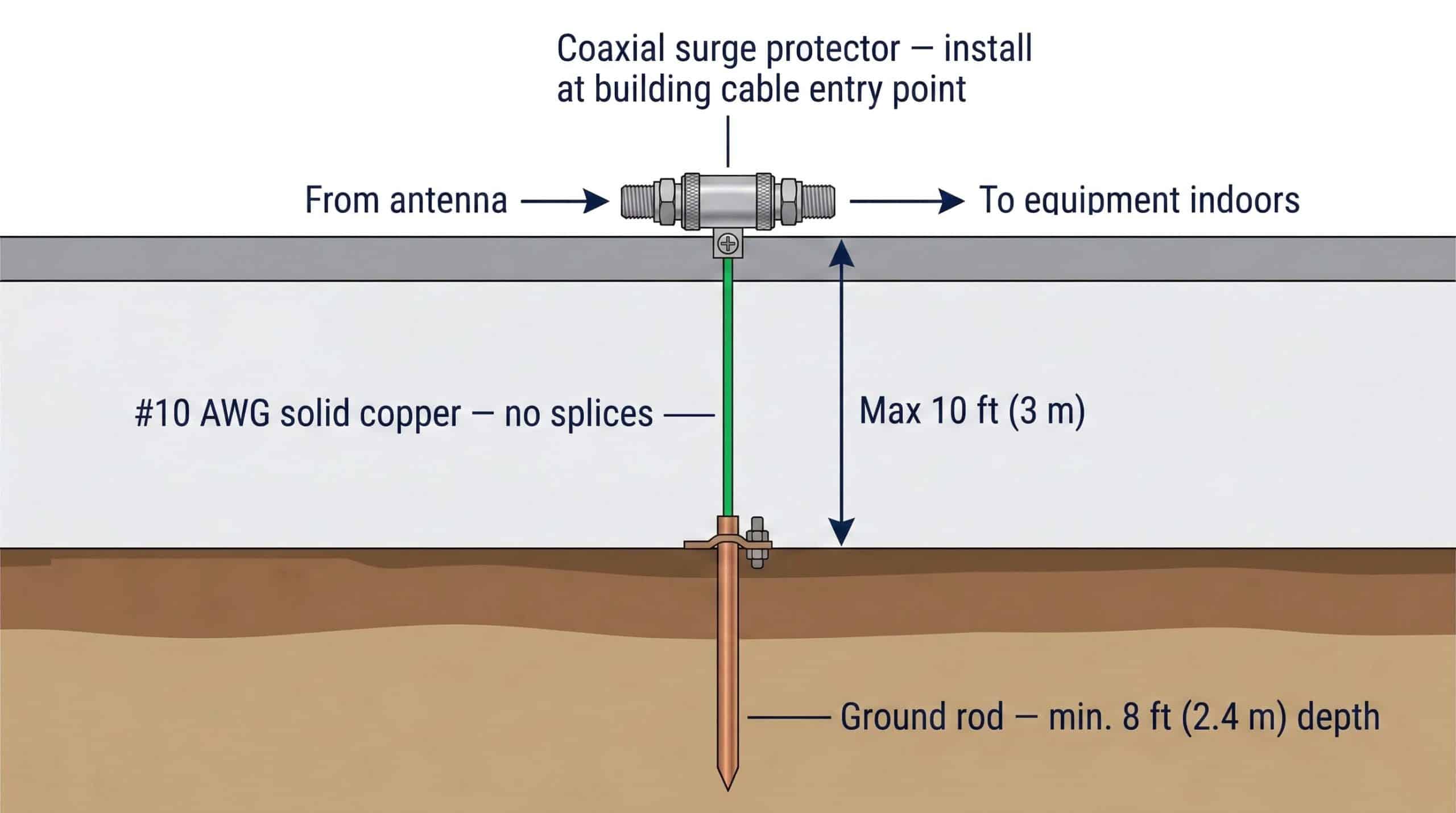
A coaxial cable surge protector without a low-impedance ground connection provides little or no surge protection — the ground terminal is not optional, it is the surge discharge path.
5.1 Where to Install the Coaxial Surge Protector
Install the coaxial cable surge protector at the point where the coax cable enters the building — at the wall penetration, cable entry gland, or entry panel. This is the highest-energy point on the cable run; protection installed here intercepts the surge before it travels through the building wiring to connected equipment.
For long cable runs with multiple connected devices, install a protector at the building entry point (highest protection level, highest discharge current rating) and optionally at each sensitive device (lower discharge current, lower residual protection level Up).
5.2 Grounding the Coaxial Surge Protector
The coaxial surge protector's ground terminal must be connected to the building's main earth terminal or the nearest accessible protective earth point. Critical requirements per IEC 61643-21:
- Lead length: Maximum 50 cm — every centimetre of ground lead adds inductance that increases the let-through voltage during a fast surge event
- Conductor cross-section: Minimum 4mm² copper for residential, 6mm² for commercial/industrial installations
- Connection point: Direct to the building main earth terminal or equipotential bonding bar — not to a water pipe, structural steel, or floating local ground
- Coax shield bonding: The coax outer shield should be bonded to the same earth point as the SPD ground terminal to eliminate ground potential differences between shield and equipment earth
An ungrounded coaxial surge protector is not a surge protector — it is a signal coupler with no surge discharge path. If you cannot install a proper ground connection at the mounting location, relocate the protector to a point where a short ground lead is achievable. Inserting an ungrounded coaxial SPD on a cable run provides no meaningful protection and may create a false sense of security.
5.3 Outdoor vs Indoor Installation
For outdoor-mounted coaxial surge protectors (at antenna masts, satellite dish mounting points, or building exterior entry conduits), select a model with IP65 or higher enclosure rating per IEC 60529. The protector should be bonded directly to the mast or dish grounding system at the highest practical point on the outdoor cable run, with a separate, independent ground conductor run down to the building earth terminal — not shared with the coax shield ground path.
6. How to Select a Coaxial Cable Surge Protector
Selecting the correct coaxial cable surge protector requires matching five parameters to the installation: impedance, connector type, frequency range, discharge current rating, and grounding configuration. Matching all five ensures the protector is transparent to signals under normal conditions and provides rated protection during a surge event.
| Application | Protector Type | Impedance | Connector | Min. Imax | Key Specification |
|---|---|---|---|---|---|
| Cable TV + cable modem (residential) | F-type inline | 75Ω | F-type | 5 kA | Bandwidth ≥1000 MHz, DC pass for cable modem power |
| Satellite TV (single dish) | F-type inline with DC pass | 75Ω | F-type | 5 kA | Bandwidth 950–2200 MHz, DC pass for LNB power (18V/500mA) |
| Free-to-air antenna (outdoor) | F-type inline, outdoor IP65 | 75Ω | F-type | 10 kA | Bandwidth 50–1000 MHz, outdoor rated |
| CCTV / IP camera coax | BNC inline | 75Ω | BNC | 5–10 kA | Baseband video bandwidth, low capacitance |
| Amateur radio (HF–UHF) | N-type inline, high power | 50Ω | N-type | 10–20 kA | Rated for transmit power level, DC pass not required |
| Cellular / DAS repeater | N-type inline, broadband | 50Ω | N-type | 10–20 kA | Bandwidth DC–3000 MHz, low insertion loss (<0.3dB) |
For installations combining cable TV and cable modem on the same line, verify that the coaxial cable surge protector is rated as a DC pass design — cable modems require DC power to pass through the coax to the cable operator's equipment. A non-DC-pass protector will block this supply and prevent the modem from operating.
7. Conclusion
A coaxial cable surge protector is a necessary complement to mains power surge protection in any installation where coaxial cables run outdoors, between buildings, or connect to equipment with exposure to lightning-induced transients. Power-side SPDs provide zero protection against surges entering through the coax signal path — a separate coaxial inline protector is required at every cable entry point.
The five selection criteria — impedance match, connector type, frequency range, discharge current rating, and grounding configuration — must all be satisfied for the protector to be transparent to signals and effective during surge events. The grounding connection is not optional: a coaxial surge protector without a low-impedance ground path provides no meaningful protection regardless of its specification.
8. Frequently Asked Questions: Coaxial Cable Surge Protector
8.1 Why do surge protectors have coaxial cable ports?
Because lightning and switching transients travel through coaxial cables just as effectively as through power cords, entering equipment through the RF input rather than the power supply. A cable modem, TV receiver, or satellite tuner connects to both the mains and an outdoor coax run — without protection on both paths, a surge on the coax destroys the tuner or modem input regardless of how well the power side is protected. Consumer power strips with coaxial ports provide basic protection for low-surge environments; dedicated inline coaxial cable surge protectors with grounded housings are required for outdoor antenna systems, long cable runs, or high-lightning-exposure locations.
8.2 Do I need a coaxial cable surge protector if I already have a power surge protector?
Yes — a mains power surge protector protects only the power supply path. Lightning-induced surges on a coaxial cable enter through the RF connector and travel directly to the equipment's tuner, demodulator, or input stage. The power supply and its protector are on a completely separate circuit path. You need a dedicated coaxial cable surge protector installed inline on the coax cable, with a grounding connection, at the point where the cable enters the building.
8.3 What is the difference between a 75Ω and 50Ω coaxial surge protector?
Impedance must match the coax system. 75Ω is standard for cable TV (CATV), satellite TV, free-to-air antenna, and cable modems — F-type or BNC connectors. 50Ω is standard for amateur radio, commercial RF, cellular antennas, and professional broadcast — N-type, BNC-50Ω, or SMA connectors. Installing the wrong impedance protector creates a mismatch that degrades signal quality at the mismatch point, adding return loss proportional to the impedance difference. Physically, F-type connectors are always 75Ω; N-type and BNC connectors can be either, so verify impedance on the label rather than assuming from connector type alone.
8.4 Can I use a coaxial surge protector on a satellite dish?
Yes, but you must select a model that covers the satellite IF frequency band (950–2150 MHz) and passes DC power for the LNB. A DC-pass coaxial surge protector allows the receiver to power the LNB through the coax while providing surge protection on both the signal and DC supply paths. Verify the protector's upper frequency limit is at least 2200 MHz — models rated only to 1800 MHz will attenuate the top satellite transponder frequencies. For multi-switch (DiSEqC) systems, also verify the protector passes the DiSEqC 22kHz tone used for satellite selection.
8.5 How do I ground a coaxial cable surge protector?
Connect the protector's ground terminal to the building's main earth terminal using a copper conductor with a minimum cross-section of 4mm² for residential or 6mm² for commercial installations. Keep the ground lead as short as possible — under 50 cm — and route it directly without coils or sharp bends. The connection must go to a proper earth terminal, not to a water pipe, structural steel, or floating local earth point. Bond the coax outer shield to the same earth point to eliminate ground potential differences. An ungrounded coaxial surge protector provides no meaningful protection — the ground terminal is the surge discharge path, not an optional connection.
8.6 How often should a coaxial surge protector be replaced?
Replace immediately after any confirmed lightning event near the installation, if signal quality degrades and the protector is the suspected cause, or if the protector shows physical damage (discoloration, cracking, burn marks). For outdoor-mounted protectors in high-lightning areas, scheduled replacement every 3–5 years is reasonable practice even without visible damage, since cumulative surge exposure degrades GDT spark-over voltage and MOV clamping characteristics over time. Indoor protectors in low-surge environments typically last 10+ years without degradation.
Related Resources & Standards
Need a Coaxial Cable Surge Protector for Your Installation?
TrilPeak supplies IEC 61643-21 certified signal line surge protectors for coaxial, RS485, Ethernet, and data line applications — with engineering support to confirm the right model for your frequency range, impedance, and discharge current requirements.