When to Replace Surge Protector: 5 IEC-Based Criteria for Industrial SPDs
Quick Answer: Yes — and the failure is silent. Industrial SPDs don't burn out visibly; their MOVs degrade incrementally with every surge event until protection capacity drops to zero — while the status indicator stays green. Knowing when to replace surge protector devices requires leakage current testing and standards-based decision criteria, not visual inspection. Type 2 SPDs: replace every 5–8 years or when leakage exceeds 3 mA. Type 1 SPDs: replace every 7–12 years or after any confirmed direct lightning strike.
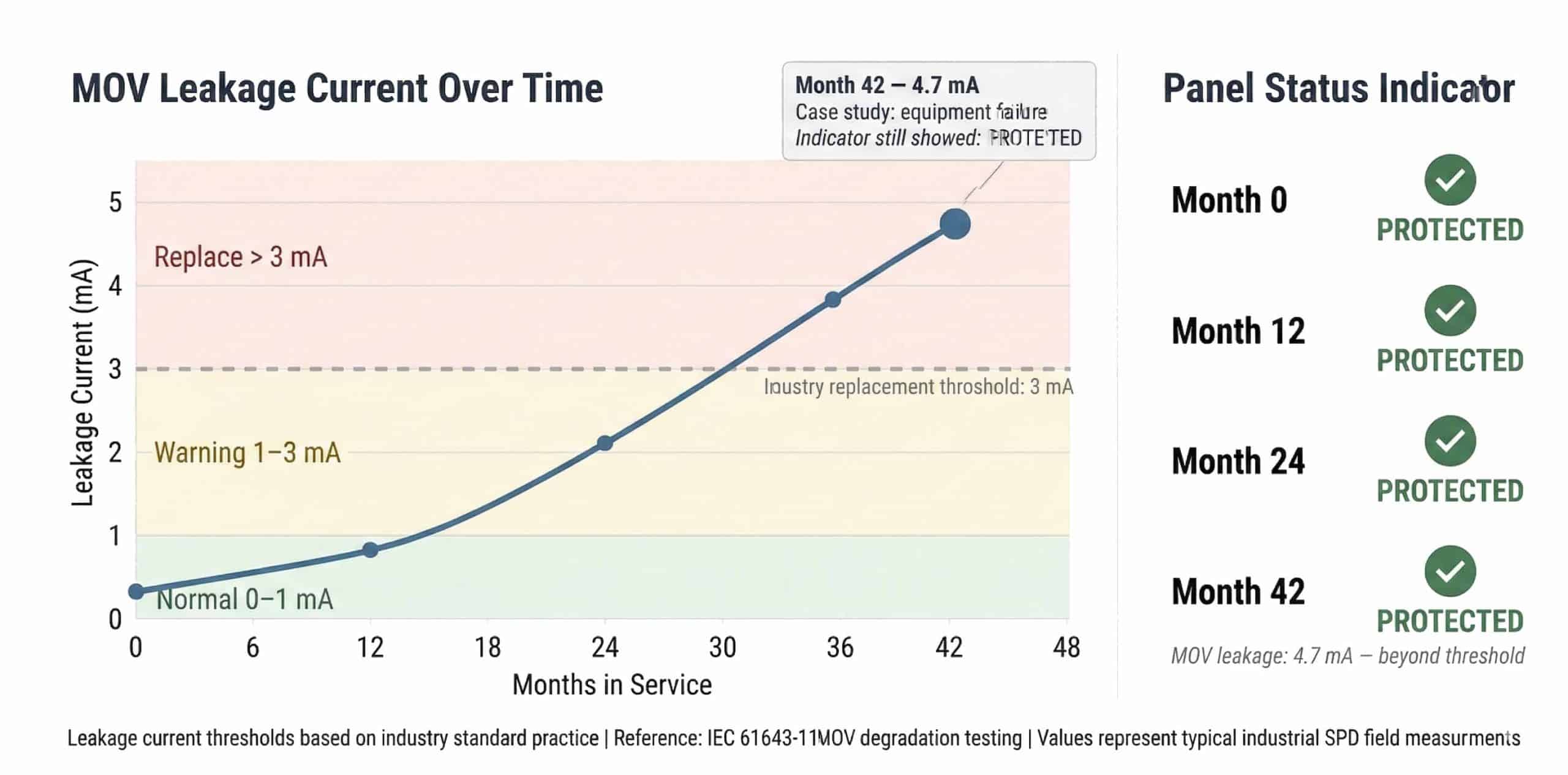
An automotive manufacturer lost $800,000 when a thunderstorm disabled critical injection molding equipment. The switchboard SPD had passed inspection two weeks prior — green indicator, no visible damage, terminals tight. Post-failure testing revealed MOV leakage current had climbed from 0.4 mA to 4.7 mA. The indicator showed "protected." The equipment was not.
This is the defining characteristic of industrial SPD failure: the green light lies. Status indicators detect thermal disconnector trips — they cannot detect MOV degradation, which is the primary failure mode in 80%+ of industrial SPD failures. The five replacement criteria below are drawn directly from IEC 61643-11, IEC 62305-3, and NFPA 70B — the same standards used by electrical engineers managing power panel surge protection in mission-critical facilities.
Why Industrial SPD Lifespan Is Not a Calendar Question
Consumer guides talk about "3–5 year replacement cycles." That framing is wrong for industrial applications — and following it will leave you either replacing SPDs too early or, far more dangerously, too late. A more precise question is: do surge protectors expire on a predictable schedule? No — they expire when their MOV degradation crosses a measurable threshold.
How long do surge protectors last in industrial environments depends on three variables, not one:
| SPD Type | Nominal Lifespan | High-Surge Environment | Primary Aging Mechanism |
|---|---|---|---|
| Type 1 (service entrance) | 7–12 years | 3–5 years | 10/350 µs lightning impulse accumulation |
| Type 2 (distribution board) | 5–8 years | 2–4 years | VFD switching transients (8/20 µs, repetitive) |
| Type 3 (point-of-use) | 3–5 years | 1–3 years | Low-energy repetitive surges from connected loads |
Table 1: Industrial SPD service life by type and exposure environment
A Type 2 SPD protecting a VFD-heavy MCC in a steel plant may accumulate 500+ transient events per year — the equivalent of 5+ years of "calendar life" consumed in 12 months. The only way to know actual remaining life is to measure it. For facilities running PLC and VFD circuits, leakage current testing is non-negotiable.
5 Criteria for Determining When to Replace Surge Protector Units
These criteria are ranked by diagnostic reliability — Criterion 1 is the only direct measurement of remaining MOV capacity. Criteria 2–5 are confirmatory. Trigger on any single Criterion 1 threshold, or on any two of Criteria 2–5 occurring together.
Criterion 1 — Leakage Current >3 mA: The Only Direct MOV Test
MOV leakage current is the single most reliable indicator for when to replace surge protector devices. As ZnO grain boundaries accumulate micro-crack damage from surge events, electrical resistance falls — causing more current to flow through the MOV at normal operating voltage. This is irreversible and cumulative.
| Leakage Current | MOV Condition | Action Required | IEC 61643-11 Reference |
|---|---|---|---|
| < 1 mA | Normal (70–100% capacity) | Continue service; test quarterly | Within tolerance |
| 1–3 mA | Warning (30–70% capacity) | Increase to monthly testing; plan replacement | Degradation threshold |
| > 3 mA | Critical — replace immediately | Take offline; install replacement | Cl. 7.3 failure criterion |
Table 2: Leakage current thresholds per IEC 61643-11
Testing frequency: Critical facilities (data centers, hospitals, semiconductor fabs) — monthly. General industrial — quarterly. The green indicator light has no relationship to these values. An SPD can show green at 4.7 mA — as the $800,000 failure case above demonstrated.
Note on temperature correction: Leakage current increases ~2% per °C above 25°C. Always record ambient temperature alongside measurements and apply correction for trend analysis. Inconsistent temperature at time of testing is the most common source of false-positive replacement triggers.
Criterion 2 — Status Indicator Fault: Confirm, Don't Assume
When the indicator changes from green to red, the thermal disconnector has tripped — but this is a lagging indicator, not a leading one. By the time it trips (at 130–140°C internal), the MOV has already been critically degraded for weeks or months.
What a red indicator confirms: thermal disconnector has activated. What it does not confirm: the SPD was providing effective protection before the trip; the circuit is now fully isolated (verify with multimeter, should read >10 MΩ between input and PE terminals).
What a green indicator does not confirm: anything about MOV protection capacity. The indicator is a single-point mechanical or electronic switch. It is not a protection level meter.
Criterion 3 — Thermal Anomaly on Infrared Scan
Annual IR thermography is standard practice for switchboard maintenance under NFPA 70B. For SPDs specifically, temperature thresholds are:
- 5–10°C above ambient: Normal operating range
- 20–40°C above ambient: Warning — elevated MOV leakage current; schedule leakage testing within 30 days
- >40°C above ambient, or absolute >80°C: Critical — immediate replacement required; thermal runaway risk
Single-phase anomalies (one pole hotter than the others in a 3-phase unit) are particularly significant — they indicate asymmetric MOV degradation that will cause the healthy phases to absorb disproportionate energy in the next surge event, accelerating cascade failure.
Criterion 4 — Post-Lightning Protocol (Mandatory for Type 1)
After any confirmed direct lightning event — defined by surge counter spike of 10+ events, simultaneous multi-breaker trip, or local meteorological confirmation — apply the following protocol:
Type 1 SPD (service entrance): Mandatory replacement regardless of test results. IEC 62305-3 Clause 5.3 is explicit — direct lightning current at the LPZ 0B→1 boundary causes structural MOV damage not detectable by field testing. See our lightning protection system guide for full LPZ boundary methodology.
Type 2 SPD (distribution board): Test leakage current and insulation resistance (>100 MΩ required) within 24 hours. If either fails — replace immediately. If both pass — schedule replacement within 6 months regardless; a post-lightning Type 2 that passed testing has a statistically elevated failure rate on the next event.
Criterion 5 — Visual Physical Damage
The five physical conditions that require immediate surge protector replacement regardless of other test results:
- Housing discoloration progression: yellow-brown → dark brown → black indicates cumulative internal overheating
- Visible carbonization or burn marks on housing or terminal area
- Housing cracks — even hairline — indicate thermal stress fracture from high-energy events
- Terminal corrosion (green copper oxidation) — increases contact resistance, adds inductive impedance that degrades effective Up
- Fastener torque below 8 N·m — loose terminals at panel SPDs are a common cause of installation-level Up degradation independent of MOV condition
Eighty percent of catastrophic SPD failures exhibit at least one of these signs beforehand. Monthly visual inspection during routine panel checks costs nothing and catches the remaining fast-degradation cases that leakage testing misses between quarterly intervals.
Industrial vs. Consumer SPD Replacement: Why the Standards Differ
Consumer surge protector guides use joule ratings and "3–5 year rules." Neither applies to industrial SPDs — and the difference matters for how you specify when to replace surge protector devices in a B2B procurement or maintenance context.
| Consumer Power Strip SPD | Industrial Type 1+2 SPD | |
|---|---|---|
| Standard | UL 1449 (joule rating) | IEC 61643-11 Class I/II test |
| Rated capacity | 200–3,000 J (marketing metric) | Iimp 12.5–50 kA (10/350 µs, engineering metric) |
| Replacement trigger | Calendar age / indicator light | Leakage current (>3 mA) + 4 confirmatory criteria |
| Post-lightning action | "Check the light" | Mandatory Type 1 replacement; Type 2 testing protocol |
| Failure consequence | Lost laptop | $50,000–$500,000+ production loss + downtime |
| Monitoring | None | Remote alarm contact → BMS/SCADA integration |
Table 3: Consumer vs. industrial SPD replacement framework comparison
This distinction is also why generic "surge protector lifespan" content online is not applicable to industrial procurement decisions. The IEC framework is test-driven and event-driven — not time-driven. A Type 1+2 industrial SPD with clean quarterly leakage tests at year 6 has more remaining useful life than a year-2 unit that absorbed a major lightning event without subsequent testing.
SPD Replacement Decision Matrix
Apply this matrix as the standard decision framework for determining when to replace surge protector units at each scheduled maintenance interval. A single red-column result requires immediate action regardless of other criteria.
| Condition | Immediate Replacement | Plan Within 3 Months | Continue — Retest |
|---|---|---|---|
| Leakage current | >3 mA | 1–3 mA + rising trend | <1 mA, stable |
| Status indicator | Red + surface >80°C | Red (verify circuit isolation) | Green (confirm with leakage test) |
| IR thermography | >40°C above ambient | 20–40°C above ambient | <20°C above ambient |
| Lightning event | Type 1 — always | Type 2 — if leakage/IR pass | No confirmed event |
| Physical damage | Any of 5 criteria above | — | No visible damage |
| Age (no test data) | Type 2 >8 yr / Type 1 >12 yr | Type 2 5–8 yr / Type 1 7–12 yr | Within nominal range |
Table 4: SPD replacement decision matrix — apply at each maintenance interval
Single-parameter decisions carry approximately 60% diagnostic confidence. Multi-criterion validation (two or more indicators aligning) raises confidence to >90%. Never act on indicator light alone — it is the lowest-confidence criterion in this framework. For coordination of SPD replacement with upstream overcurrent protection, see our circuit breaker vs surge protector coordination guide.
Maintenance Schedule by Facility Type
| Facility Type | Leakage Current | Visual Inspection | IR Thermography | Full Replacement Review |
|---|---|---|---|---|
| Data center / hospital / semiconductor | Monthly | Monthly | Quarterly | At 60% of rated service life |
| Industrial manufacturing (VFD-heavy) | Quarterly | Monthly | Semi-annual | At 70% of rated service life |
| Commercial / light industrial | Semi-annual | Quarterly | Annual | At 80% of rated service life |
Table 5: Industrial SPD maintenance schedule by facility criticality
For data center surge protection and other mission-critical applications, proactive replacement at 60% of rated service life is standard practice — the cost of one unplanned failure in a Tier III/IV facility exceeds the cost of 10 years of planned replacements.
Conclusion: Measure First, Replace on Data
Do surge protectors expire? Yes — but expiration is not a date on a calendar. It is a threshold on a leakage current meter. The five criteria above — led by IEC 61643-11 leakage measurement and followed by thermal imaging, indicator verification, post-lightning protocol, and visual inspection — give industrial facility managers and procurement engineers the objective, defensible basis for surge protector replacement decisions.
The alternative — replacing on calendar age or waiting for the red light — leaves your facility operating with unknown protection levels between scheduled inspections. At $50,000–$500,000 per unprotected surge event, the cost of that uncertainty far exceeds the cost of quarterly leakage testing.
For the complete when to replace surge protector picture: begin with a leakage current baseline on your current Type 1 and Type 2 SPDs. If you don't have test data, assume the worst and inspect. If leakage is below 1 mA and no lightning events have occurred, establish your testing cadence and document it. If leakage is above 1 mA — plan replacement now, not at the next annual review.
TrilPeak engineers provide SPD replacement specifications, IEC 62305 risk assessments, and cascade coordination studies for industrial and data center projects.
Frequently Asked Questions
Yes. Do surge protectors expire? Functionally, yes — MOV degradation is cumulative and irreversible. The SPD "expires" when leakage current exceeds 3 mA (IEC 61643-11 criterion), even if the status indicator still shows green. For industrial Type 1 SPDs, calendar expiry is 7–12 years; for Type 2, 5–8 years — but high-surge environments cut these figures in half. The only reliable way to know is leakage current testing. If you have no test baseline, assume the SPD is approaching end of life and test immediately.
How long do surge protectors last depends on type and environment. Type 1 service entrance SPDs: 7–12 years nominal, 3–5 years in high lightning-density regions. Type 2 distribution SPDs: 5–8 years nominal, 2–4 years in VFD-heavy manufacturing environments. Type 3 point-of-use: 3–5 years. These figures assume normal surge exposure — facilities with frequent utility switching events, high VFD density, or overhead supply in Ng >3/km²/year zones should apply the shorter end of each range and test quarterly.
Surge protector lifespan for service entrance (Type 1) devices is 7–12 years under IEC standards, with mandatory replacement after any confirmed direct lightning strike regardless of remaining calendar life. Industrial Type 1+2 combined units — such as those used in MDB and main switchboard applications — should be tested with leakage current measurement every 2–3 years and replaced at 60–70% of rated service life for critical facilities. For residential "whole house" units (UL 1449 Type 2), the 5–8 year range applies, with the same post-lightning mandatory replacement rule.
Partially. A green status indicator confirms only that the thermal disconnector has not tripped — it says nothing about MOV protection capacity. Visual inspection can identify housing damage, discoloration, and terminal corrosion. A multimeter can confirm complete isolation after a disconnector trip (>10 MΩ between input and PE). What visual inspection and multimeters cannot determine: MOV leakage current, reference voltage drift, or cumulative energy absorbed. For critical equipment, there is no substitute for quarterly leakage current testing — anything less is operating on assumption, not data.
Immediately and unconditionally, per IEC 62305-3. Type 1 SPDs at the LPZ 0B→1 boundary (service entrance) are designed to absorb direct lightning impulse current (10/350 µs waveform). After doing so, MOV grain boundaries sustain structural micro-fractures that field testing cannot detect. The device may pass leakage testing and still fail catastrophically on the next event. This is why IEC 62305-3 mandates replacement — not testing — after confirmed direct strikes. Maintain 1–2 spare Type 1 SPDs on-site for immediate replacement. For Type 2 downstream units, apply the post-lightning testing protocol in Criterion 4 above.
Significant. A Type 1+2 industrial SPD costs $200–$2,000 in hardware plus $500–$5,000 for installation. A single unprotected surge event in a manufacturing facility typically causes $15,000–$400,000 in VFD, PLC, and motor control equipment damage plus production downtime. At quarterly testing cost of approximately $200–$500 per panel per year, the break-even on preventing a single medium-severity event (>$50,000) is achieved within the first year of a proactive maintenance program. For data centers and semiconductor fabs, the ROI calculation is even more decisive — a single unprotected event can exceed $1M in equipment and data loss.
ISO 55001 (Asset Management Systems) requires documented degradation criteria, maintenance intervals, and replacement triggers for critical infrastructure assets. SPD replacement programs that use the IEC 61643-11 leakage current threshold (>3 mA = replace), combined with event-based triggers (post-lightning, post-fault) and documented quarterly test records, satisfy ISO 55001 Clause 6.2 (asset management objectives) and Clause 8.3 (management of change) requirements. TrilPeak can provide IEC-compliant test documentation templates and SPD lifecycle records on request — contact our engineering team for asset management integration support.
TrilPeak's Type 1+2 combined SPD range includes models with surge event counters, remote alarm contacts (SPDT, 250V AC) for BMS/SCADA integration, and optional Modbus RTU interfaces for timestamped surge logging. These features enable the predictive maintenance approach described in this guide — replacing based on accumulated event data rather than calendar assumptions. Contact our engineering team or visit the Type 1+2 SPD product page for specific model specifications and monitoring interface options.
Related Resources
- Type 1 vs Type 2 vs Type 3 SPD: Complete Selection Guide
- IEC 61643-11 SPD Standards Reference
- Power Panel Surge Protection: 5-Step Engineering Guide
- Industrial Surge Protector Selection Guide
- Circuit Breaker vs Surge Protector Coordination Guide
- What Is a Lightning Protection System?
- Lightning Arrester vs Surge Arrester: Key Differences
- Data Center Surge Protection Guide