Air Terminal: Complete Guide to Critical Types, Heights & NFPA 780 Rules
Quick Answer: An air terminal (also called a lightning rod or strike termination device) is a metal rod installed at the highest point of a building to intercept lightning and direct current safely to ground. Per NFPA 780, the tip of an air terminal shall not be less than 10 inches (254mm) above the protected surface; air terminals exceeding 24 inches require additional bracing. The 4 main types are Franklin rod, blunt tip, ESE, and mesh network — made from copper, aluminum, or stainless steel. Note: NFPA 780 and IEC 62305 do not recognize ESE air terminals.
An air terminal serves as the critical entry point in a complete lightning protection system. According to NFPA 780 and IEC 62305 international standards, air terminals must be installed at the highest points of structures to provide preferential strike points for lightning. When integrated with down conductors and grounding electrode systems, air terminals create a safe pathway that protects buildings, equipment, and occupants from the destructive effects of lightning strikes reaching billions of volts and temperatures exceeding 30,000°C.
Common terminology: The terms "air terminal," "lightning rod," and "Franklin rod" all refer to the same device. "Air terminal" is the modern technical term used in engineering specifications, while "lightning rod" remains the popular term. Benjamin Franklin invented the first lightning rod in 1752, which is why they're sometimes called "Franklin rods."
What Is an Air Terminal and How Does It Protect Buildings?
Air Terminal Definition and Core Function
An air terminal (also called a lightning rod or air termination system) is a metal device installed at the highest point of a building or structure. According to international standards NFPA 780 and IEC 62305, an air terminal provides a preferential strike point for lightning, safely directing the electrical current through the lightning protection system to the ground.
Key physical characteristics of air terminals:
- Material: Copper, aluminum, or stainless steel for optimal conductivity
- Shape: Pointed or rounded metal rod designed for lightning interception
- Height: Typically 254mm to 600mm (10 to 24 inches) above the protected surface
- Location: Must be positioned higher than all objects requiring lightning protection
An lightning rod cannot work alone. It must be integrated with down conductors and a proper grounding system to form a complete air termination network that effectively protects buildings from lightning strikes.
Air Terminal vs Lightning Rod vs Franklin Rod: Understanding the Terminology
| Term | Description | Usage Context |
|---|---|---|
| Air Terminal | Modern technical standard term for lightning rod systems | Engineering specifications, international standards (IEC 62305, NFPA 780) |
| Lightning Rod | Traditional common name for air terminal device | Daily communication, commercial product descriptions |
| Franklin Rod | Historical term named after inventor Benjamin Franklin (1752) | Historical literature and traditional lightning protection references |
All three terms refer to the same device with identical functions in a lightning protection system. This guide uses these terms interchangeably, with "air terminal" as the primary technical term.
Air Terminal Role in Complete Lightning Protection Systems
A complete lightning protection system (LPS) integrates air terminals with two other essential components:
1. Air Terminal (Strike Termination Device)
- Function: Intercepts direct lightning strikes at preferred points
- Location: Installed at highest points and vulnerable areas of buildings
- Common configurations: Single rods, multiple air terminals, or mesh conductor networks
2. Down Conductor System
- Function: Safely conducts lightning current from air terminals to ground
- Composition: Metal cables or copper strips connecting terminals to grounding electrodes
3. Grounding Electrode System
- Function: Dissipates lightning current safely into the earth
- Composition: Metal rods, plates, or copper ground ring buried underground
The strike termination device serves as the critical "entry point" of the lightning protection system, the down conductor provides the "safe pathway," and the grounding system acts as the "discharge point." All three components must be properly bonded and installed according to lightning protection standards for effective building protection.

Figure 1: Complete lightning protection system with air terminal, down conductor, and grounding components
How Do Air Terminals Work to Intercept Lightning Strikes?
Lightning Interception Principle Behind Air Terminal Systems
Understanding lightning formation:
Lightning occurs when electrical charges accumulate in storm clouds. The cloud base develops negative charges, while ground objects develop positive charges through electromagnetic induction. When the voltage difference reaches millions of volts, an electrical discharge (lightning strike) occurs between cloud and ground.
How air terminals intercept lightning strikes:
- As a thunderstorm cloud approaches, a stepped leader (downward electrical channel) extends from the cloud toward the ground surface
- The air terminal's pointed tip generates a concentrated electric field and launches an upward streamer toward the descending leader
- When the upward and downward channels meet in mid-air, a conductive pathway forms
- Lightning current flows through the air terminal, down conductor, and into the grounding system
Why lightning preferentially strikes air terminals:
- Height advantage: Air terminals are positioned at the highest points, providing the shortest path to ground
- Superior conductivity: Metal construction conducts electricity far better than building materials
- Electric field enhancement: The pointed geometry of air terminal tips concentrates the electric field, facilitating upward streamer formation
Air Terminal Protection Zone and Rolling Sphere Method
Each air terminal creates a defined protection zone around its installation point. Objects and building areas within this zone receive protection from direct lightning strikes according to lightning protection standards.
Rolling Sphere Method for Air Terminal Placement:
The rolling sphere method (also called striking distance method) is the internationally recognized standard for determining air terminal protection zones per IEC 62305 and NFPA 780. Engineers visualize a sphere of a specific radius rolling over the building surface. Any area the sphere cannot touch (because it rests on air terminals or protected surfaces) is considered within the lightning protection zone.
| Lightning Protection Level | Rolling Sphere Radius | Typical Air Terminal Applications |
|---|---|---|
| Class I (LPL I) | 20m (66 ft) | High-risk facilities: explosives storage, ammunition depots, critical infrastructure |
| Class II (LPL II) | 30m (98 ft) | Important commercial buildings, data centers, hospitals |
| Class III (LPL III) | 45m (148 ft) | General industrial facilities, warehouses, manufacturing plants |
| Class IV (LPL IV) | 60m (197 ft) | Ordinary residential and commercial buildings |
The height and placement of lightning rods directly determine the size of the lightning protection zone. Larger buildings typically require multiple rods or a mesh conductor network to achieve complete lightning protection coverage according to the rolling sphere method calculations.

Figure 2: Rolling sphere method for determining air terminal protection zones according to IEC 62305
Types of Air Terminals for Lightning Protection
Franklin Rod Air Terminal (Solid Point Design)
The Franklin rod air terminal is the most widely used and globally accepted type of lightning rod, featuring a sharp pointed tip for optimal lightning interception.
Key characteristics of Franklin rod air terminals:
- Design: Solid metal rod with conical or needle-shaped pointed tip
- Proven history: Invented by Benjamin Franklin in 1752, providing reliable lightning protection for over 270 years
- Universal standard recognition: Accepted by NFPA 780, IEC 62305, UL 96A, and all major international lightning protection standards
Ideal applications: Franklin rod air terminals are suitable for residential buildings, commercial structures, industrial facilities, and all general-purpose lightning protection applications.
Franklin rods remain the most widely specified lightning rod type globally due to proven reliability, universal code acceptance, and cost-effectiveness for lightning protection systems.
Blunt Tip Air Terminal
Blunt tip air terminals feature a rounded or hemispherical end instead of a sharp point, representing an alternative design philosophy in lightning protection.
Key characteristics of blunt tip air terminals:
- Design: Rounded tip geometry instead of pointed end
- Technical theory: Some research suggests blunt tips may reduce localized thermal damage at the lightning strike point
- Acceptance status: Still debated in academic circles; most international standards continue to favor traditional pointed air terminal designs
Ideal applications: Specialized projects with specific requirements for blunt tip air terminal configurations.
Early Streamer Emission (ESE) Air Terminal
ESE air terminals (Early Streamer Emission devices) incorporate electronic components that manufacturers claim emit upward streamers earlier than conventional air terminals, theoretically extending the protection radius.
Key characteristics of ESE air terminals:
- Design: Built-in electronic trigger or discharge device within the rod housing
- Manufacturer claims: Protection radius allegedly 2-4 times larger than standard Franklin rod air terminals
International standard recognition of ESE air terminals:
| Standard/Region | ESE Air Terminal Recognition Status |
|---|---|
| France NF C 17-102 | ✅ Recognized and regulated |
| Spain UNE 21186 | ✅ Recognized and regulated |
| USA NFPA 780 | ❌ Not recognized or approved |
| International IEC 62305 | ❌ Not recognized or approved |
Why NFPA 780 and IEC 62305 Do Not Recognize ESE Air Terminals
NFPA 780 explicitly does not recognize Early Streamer Emission (ESE) air terminals as valid lightning protection. IEC 62305 holds the same position internationally. Reasons cited:
- No independent verification: The claimed extended protection radius has not been replicated under controlled natural lightning conditions by independent labs.
- No proven superiority: No peer-reviewed evidence shows ESE air terminals outperform conventional Franklin rods in real-world conditions.
- Standards bodies: The Lightning Protection Institute (LPI), Underwriters Laboratories (UL), and NFPA all maintain that conventional air terminals meet all verified protection requirements.
For US projects (NFPA 780) or international projects (IEC 62305), ESE air terminals cannot be specified as the primary lightning protection solution. Franklin rod air terminals remain the universally accepted, code-compliant standard.
Ideal applications: Large open areas in France, Spain, and other regions where ESE air terminal standards are officially recognized.
Mesh System Air Termination Network
A mesh system air termination network uses a grid of horizontal conductors across the roof surface instead of individual vertical lightning rods, providing distributed lightning strike points.
Key characteristics of mesh air termination systems:
- Design: Horizontal conductor grid covering the entire roof area
- Lightning protection principle: Multiple potential strike points distribute lightning risk across the air termination network
- Grid spacing: Typically 5m × 5m to 20m × 20m mesh size depending on lightning protection level requirements
Advantages of mesh air termination systems:
- Complete, uniform lightning protection coverage with no gaps in the protection zone
- Can be concealed beneath roofing materials for aesthetic considerations
- Eliminates visible lightning rods for architecturally sensitive projects
Ideal applications: Flat roof buildings, large industrial warehouses, solar photovoltaic farms, and structures requiring comprehensive lightning rod coverage.
Air Terminal Type Comparison
| Air Terminal Type | Design Features | Global Standard Acceptance | Cost Range | Best Use Cases |
|---|---|---|---|---|
| Franklin Rod | Pointed rod design | ⭐⭐⭐⭐⭐ Universal | $ Low | General buildings and lightning protection applications |
| Blunt Tip | Rounded rod design | ⭐⭐⭐⭐ High | $ Low | Specific project requirements |
| ESE | Active electronic device | ⭐⭐⭐ Regional | $$$ High | Large open areas in approved regions |
| Mesh Network | Horizontal conductor grid | ⭐⭐⭐⭐⭐ Universal | $$ Medium | Flat roofs and comprehensive coverage needs |
Our engineers provide free system design consultation — IEC 62305 compliant, for residential, commercial, and industrial projects worldwide.
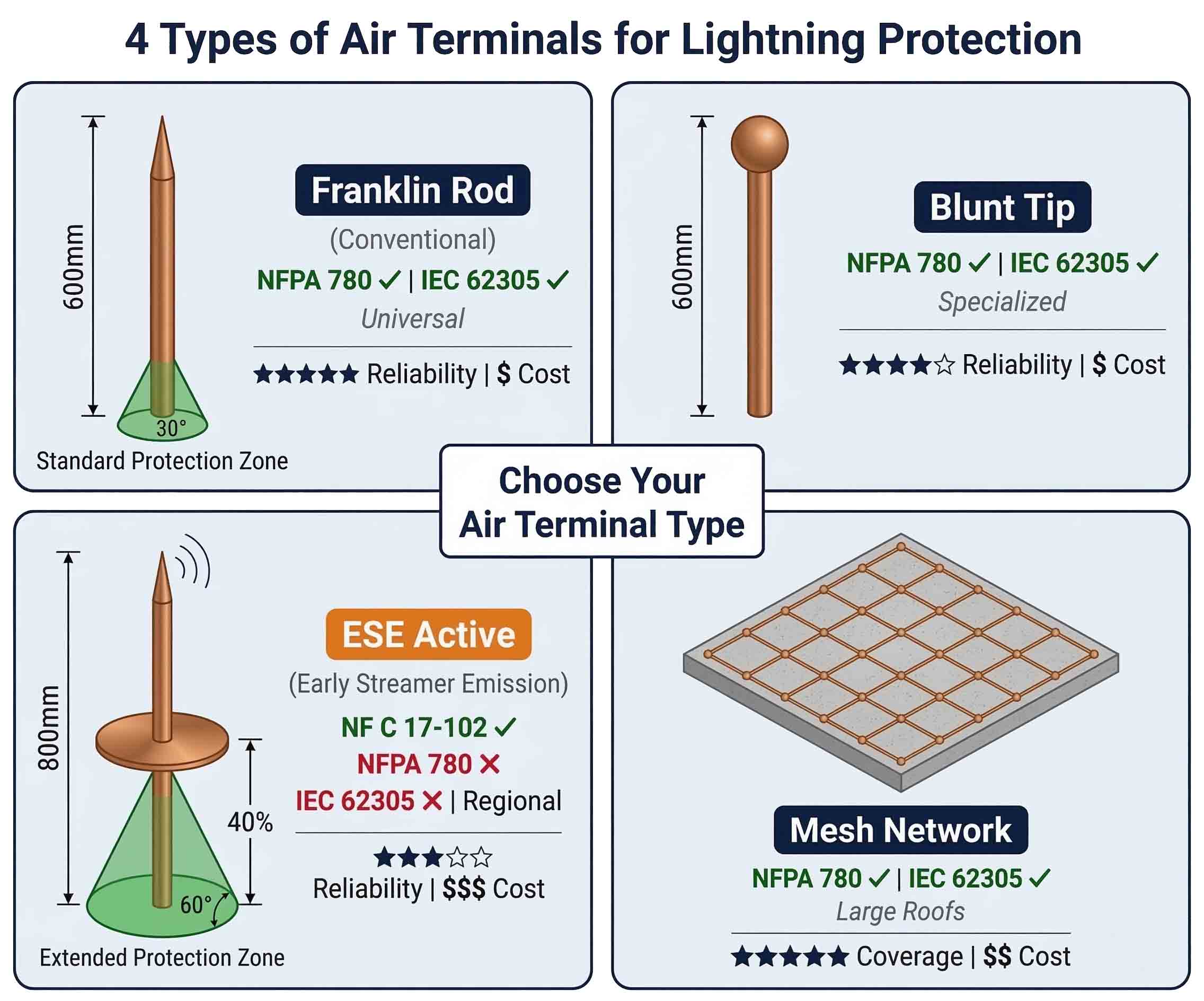
Figure 3: Four main types of lightning protection systems - Franklin Rod, Blunt Tip, ESE, and Mesh Network
Air Terminal Height Requirements and Spacing Specifications
Air terminal height and spacing specifications are governed by NFPA 780 (US standard) and IEC 62305 (international standard). Meeting these requirements is critical for ensuring valid lightning protection coverage and code compliance.
Air Terminal Height Requirements per NFPA 780
NFPA 780 specifies the following air terminal height rules:
- Minimum tip height: The tip of an air terminal shall not be less than 10 inches (254mm) above the surface or object being protected — this is the absolute minimum per NFPA 780 Section 4.6.
- Standard height range: Air terminals exceeding 24 inches (610mm) in height above the roofline are considered "tall air terminals" and require additional mechanical support or bracing per NFPA 780.
- Practical range: Most commercial air terminal products are supplied in heights from 254mm to 600mm (10–24 inches), covering the majority of standard installations.
- Tall structures: For roof protrusions such as antennas, HVAC equipment, or parapets, taller lightning rods or elevated mounting bases must ensure the terminal tip extends above the highest point requiring protection.
NFPA 780 Key Rule: "The tip of an air terminal shall not be less than 10 inches (254mm) above the object it protects." Air terminals of 24 inches (610mm) or less are classified as standard; those exceeding 24 inches require additional bracing.
What is the minimum height of an air terminal tip per NFPA 780?
Per NFPA 780 Section 4.6, the tip of an air terminal shall not be less than 10 inches (254mm) above the object or area it is to protect. Air terminals of 24 inches (610mm) or less in height are classified as standard installations requiring no additional bracing.
Where shall air terminals exceeding 24 inches in height be supported?
Per NFPA 780, air terminals exceeding 24 inches (610mm) in height shall be supported by a brace or attachment secured to the structure at a point not less than one-half the height of the air terminal above the roof surface. This bracing ensures mechanical stability during high-wind conditions.
What is the maximum allowed distance between 24-inch air terminals?
Per NFPA 780, the maximum allowed distance between standard 24-inch (610mm) air terminals is 20 feet (6.1m) along roof ridges, and no point on a flat roof shall be more than 50 feet (15.2m) from the nearest air terminal. These spacings are calculated using the rolling sphere method to ensure complete lightning protection coverage.
What are the basic components of a lightning protection system?
The basic components of a lightning protection system are: air terminals (strike termination devices), ground rods (grounding electrodes), down conductors connecting them, bonding conductors for equipotential bonding, and surge protective devices (SPD) for internal protection — per NFPA 780 and IEC 62305.
UL 96A vs NFPA 780 vs IEC 62305: Which Lightning Protection Standard Applies?
Selecting the correct lightning protection standard is critical for regulatory compliance and product approval. The three most referenced standards differ significantly by region and application:
| Standard | Region | Scope | Certification Body |
|---|---|---|---|
| NFPA 780 | United States | Installation requirements for lightning protection systems | NFPA (National Fire Protection Association) |
| UL 96A | United States | Product listing standard for air terminals and components (UL Listed label) | Underwriters Laboratories (UL) |
| IEC 62305 | International (Europe, Asia, Middle East, Africa) | Full system design and component standards for lightning protection | International Electrotechnical Commission (IEC) |
| NF C 17-102 | France / ESE-accepting countries | ESE air terminal design and installation | French Standards Association (AFNOR) |
Air Terminal Spacing Requirements and Maximum Allowed Distance
The maximum allowed distance between air terminals is determined by the protection zone of each terminal, calculated using the rolling sphere method per IEC 62305 and NFPA 780:
| Lightning Protection Level | Rolling Sphere Radius | Max Distance Between 24-inch Air Terminals | Applicable Standard |
|---|---|---|---|
| LPL I (Highest) | 20 m (66 ft) | ~6 m (20 ft) on roof edges | IEC 62305 / NFPA 780 |
| LPL II | 30 m (98 ft) | ~9 m (30 ft) on roof edges | IEC 62305 |
| LPL III | 45 m (148 ft) | ~14 m (46 ft) on roof edges | IEC 62305 |
| LPL IV (Standard) | 60 m (197 ft) | ~18 m (59 ft) on roof edges | IEC 62305 |
| NFPA 780 Standard | N/A (uses fixed spacing) | Max 6 ft (1.8 m) on roof ridges; 20 ft (6.1 m) on flat roofs | NFPA 780 Table 4.6 |
Under NFPA 780, standard 24-inch air terminal spacing rules for residential and light commercial buildings are:
- Along roof ridges: air terminals spaced no more than 20 feet (6.1m) apart
- Within 2 feet of all roof edges, ridges, and hips
- On flat roofs: no point on the roof shall be more than 50 feet (15.2m) from the nearest air terminal
Basic Components of a Lightning Protection System
An air termination network is only one part of a complete system. The basic components of a lightning protection system are:
- Air terminals (air termination network) — strike termination devices at the highest points
- Down conductors — cables connecting air terminals to the grounding electrode system
- Grounding electrode system — buried electrodes that safely dissipate lightning current into the earth
- Equipotential bonding — connections between all metallic building systems to prevent dangerous potential differences
- Surge protection devices (SPD) — internal protection against conducted and induced surges
Air Terminal Materials: Copper, Aluminum, and Stainless Steel
Copper Air Terminals
Copper air terminals are the most recommended material choice for professional lightning protection systems due to superior electrical and physical properties.
Characteristics of copper lightning rods:
- Electrical conductivity: Excellent - highest among common air terminal materials (100% IACS reference standard)
- Corrosion resistance: Excellent performance in coastal, industrial, and all environmental conditions
- Service lifespan: 50+ years with minimal maintenance for copper lightning protection systems
- Material cost: Higher initial investment than aluminum air terminals
TrilPeak copper air terminals: Manufactured from 99.9% pure copper meeting UL 96A material standards, available in custom lengths and configurations for all lightning protection applications.
Ideal applications: Coastal environments, industrial facilities with corrosive atmospheres, high-standard lightning protection projects, and long-term infrastructure investments requiring reliable air terminal performance.
Aluminum Air Terminals
Aluminum rods provide a lightweight and economical alternative to copper for many lightning protection applications.
Characteristics of aluminum lightning rods:
- Electrical conductivity: Good - approximately 61% of copper conductivity
- Weight advantage: 70% lighter than copper air terminals, reducing structural load
- Corrosion resistance: Good performance in dry inland environments; poor performance in coastal salt-spray conditions
- Service lifespan: 30-40 years for aluminum terminal installations
- Material cost: 30-50% lower than copper air terminals
Ideal applications: Inland areas with low humidity, budget-constrained lightning protection projects, and large-scale terminal installations where weight reduction is beneficial.
Stainless Steel Air Terminals
Stainless steel lightning rods offer superior mechanical strength and aesthetic appearance for specialized lightning protection applications.
Characteristics of stainless steel lightning rods:
- Electrical conductivity: Lower than copper and aluminum - approximately 2.4% of copper conductivity
- Mechanical strength: Highest tensile and impact resistance among air terminal materials
- Corrosion resistance: Excellent performance in all environmental conditions
- Aesthetic appearance: Attractive polished silver finish for visible terminal installations
Due to lower electrical conductivity, stainless steel rods typically require larger cross-sectional areas to meet lightning current-carrying capacity requirements per international standards.
Ideal applications: Architectural projects with high aesthetic standards, corrosive industrial environments, and applications requiring maximum air terminal durability.
Air Terminal Material Comparison
| Air Terminal Material | Electrical Conductivity | Corrosion Resistance | Expected Lifespan | Material Cost |
|---|---|---|---|---|
| Copper | ⭐⭐⭐⭐⭐ Excellent | ⭐⭐⭐⭐⭐ Excellent | 50+ years | High |
| Aluminum | ⭐⭐⭐⭐ Good | ⭐⭐⭐ Good (inland only) | 30-40 years | Low |
| Stainless Steel | ⭐⭐ Fair | ⭐⭐⭐⭐⭐ Excellent | 40+ years | Medium |
Air terminal material selection guidance:
- Choose copper rods: Most professional applications, coastal and industrial environments, projects requiring maximum reliability
- Choose aluminum rods: Inland locations, budget-limited projects, large installations where weight matters
- Choose stainless steel rods: Architecturally sensitive projects with high aesthetic requirements
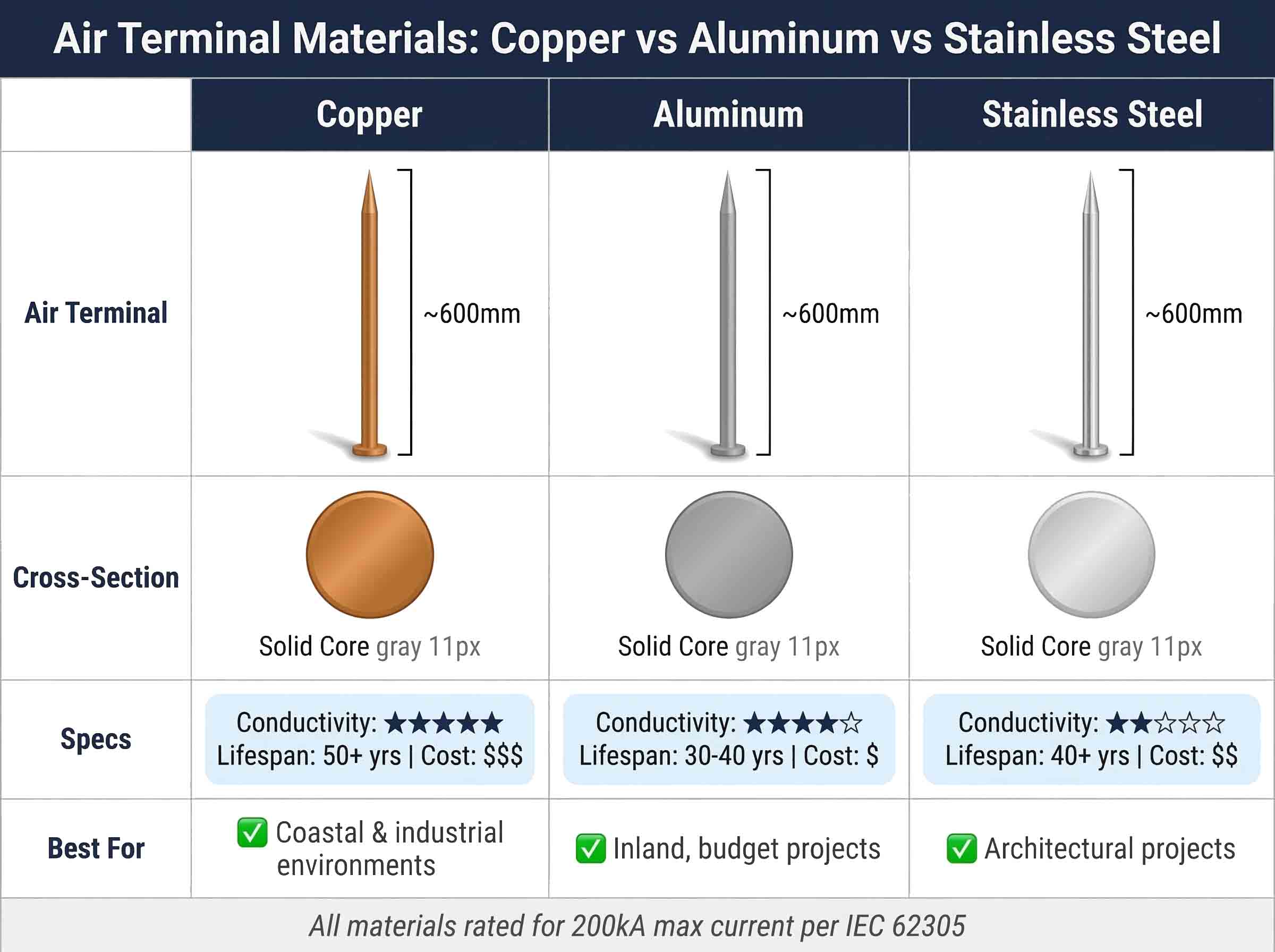
Figure 4: Comparison of air terminal materials - Copper, Aluminum, and Stainless Steel
Air Terminal Applications Across Industries
Residential Building Lightning Rod Systems
Typical residential lightning rod configuration:
- Number of air terminals: 2-6 units depending on house size, roof complexity, and protection zone calculations
- Installation locations: Roof ridge lines, chimneys, gable ends, and roof corners
- Material selection: Aluminum or copper lightning rods based on budget and environmental conditions
Lightning protection goals: Personal safety for occupants, fire prevention from lightning strikes, and protection of household electrical systems and appliances.
Commercial and Industrial Facility Air Terminals
Typical commercial/industrial air terminal configuration:
- Multiple individual strike termination devices or complete mesh conductor networks for large roof areas
- Material selection: Primarily copper lightning rods for maximum reliability and longevity
- Integration with building management systems and lightning monitoring equipment
Lightning protection goals: Critical equipment protection, business continuity assurance, employee safety, and insurance premium reduction.
Common applications: Manufacturing plants, warehouses and distribution centers, shopping malls, office buildings, and educational facilities.
Telecommunications Tower and Data Center Air Terminals
Lightning protection challenges: Telecommunications towers present extremely high lightning strike risk due to height and exposed locations. Data centers house sensitive electronic equipment vulnerable to lightning-induced surges.
Typical air terminal system configuration:
- Tower-mounted strike termination devices at the highest point with multi-layer grounding electrode systems
- High lightning protection level classification (typically Class I or Class II per IEC 62305)
- Comprehensive integration with surge protection devices (SPD) on all power and data circuits
Lightning protection goals: Server and network equipment protection, continuous uptime maintenance, and prevention of data loss from lightning-related power disturbances.
Oil, Gas, and Chemical Facility Air Terminals
Lightning risks: Petroleum and chemical facilities contain flammable and explosive materials where lightning strikes can trigger catastrophic fires or explosions.
Air terminal system requirements:
- Enhanced lightning protection levels beyond standard building requirements
- Explosion-proof and intrinsically safe air terminal components and connections
- More frequent inspection intervals and rigorous maintenance protocols for all lightning protection equipment
Lightning protection goals: Storage tank and pipeline protection, control room and critical infrastructure safety, and prevention of ignition sources in hazardous classified areas.
Solar Farm and Wind Turbine Air Terminal Systems
Lightning protection challenges: Renewable energy installations occupy large open areas with equipment continuously exposed to weather conditions, making them prime targets for lightning strikes.
Solar photovoltaic farm strike termination devices:
- Mesh conductor networks or strategically placed rods covering photovoltaic arrays
- Surge protective devices on both DC solar circuits and AC grid interconnection equipment
Wind turbine lightning protection:
- Built-in lightning receptors integrated into turbine blade tips and nacelle housing
- Tower structure serves as down conductor pathway to foundation grounding system
Frequently Asked Questions About Air Terminals
Air terminal and lightning rod refer to exactly the same lightning protection device. "Air terminal" is the modern technical term used in international engineering standards like NFPA 780 and IEC 62305. "Lightning rod" is the traditional common name that most people recognize. "Franklin rod" is the historical term honoring inventor Benjamin Franklin. All three terms describe identical devices that intercept lightning strikes and direct current safely to the grounding system.
No, air terminals do not "attract" additional lightning strikes to a building. Whether lightning strikes a particular location depends entirely on storm cloud electrical conditions and ground topography, not on the presence of lightning protection systems.
The air terminal's critical function is to provide a controlled, safe strike point when a lightning discharge is already targeting the vicinity. By offering the path of least resistance, air terminals ensure lightning current flows through engineered conductors to ground rather than through building structure, wiring, or occupants.
The required number depends on building dimensions, roof geometry, and lightning protection level requirements:
- Small residential buildings: Typically 2–4 air terminals for complete coverage
- Medium commercial buildings: Generally 6–12 air terminals depending on roof area
- Large industrial facilities: May require dozens of individual air terminals or a complete mesh conductor network
Each strike termination device creates a limited protection zone calculated using the rolling sphere method. All roof protrusions — chimneys, antennas, HVAC equipment, and skylights — must fall within protected zones. Professional system design per NFPA 780 or IEC 62305 standards is strongly recommended for accurate placement and quantity determination.
According to NFPA 780, the minimum air terminal height is 254mm (10 inches) above the surface being protected. Standard commercial products typically range from 254mm to 600mm (10 to 24 inches) in length.
The critical design requirement is that air terminals must extend above all objects requiring lightning protection. For buildings with tall roof protrusions like communication antennas or equipment enclosures, taller rods or elevated mounting bases may be necessary to maintain proper protection zone coverage per rolling sphere method calculations.
Self-installation of lightning protection systems is strongly discouraged for multiple important reasons:
- Safety concerns: Working at roof heights presents serious fall hazards requiring proper safety equipment and training
- Technical complexity: Proper protection zone calculations, bonding techniques, and grounding system integration require specialized knowledge
- System effectiveness: Incorrect rod placement, inadequate connections, or improper grounding can result in complete system failure
- Insurance requirements: Many property insurance policies require professional installation certification and may deny lightning damage claims for non-compliant systems
Hiring a certified lightning protection professional who follows NFPA 780 or IEC 62305 standards is strongly recommended for safe, effective installation.
Copper air terminals are the most universally recommended material because they offer superior electrical conductivity, excellent corrosion resistance in all environments including coastal and industrial atmospheres, and the longest service lifespan exceeding 50 years.
- Aluminum air terminals: Appropriate for inland dry environments and budget-constrained projects
- Stainless steel air terminals: Best for architecturally sensitive projects where appearance is critical
Material selection should consider environmental corrosion factors (coastal salt exposure, industrial pollution), project budget, and required service life expectations.
Yes, absolutely. Air terminals and surge protection devices (SPD) defend against different threats and both are essential:
- Air terminals (external protection): Protect building structure from direct lightning strikes by safely conducting current to ground
- SPDs (internal protection): Protect sensitive electrical equipment from induced voltage surges entering through power lines, data cables, and telecommunications circuits
A complete lightning protection system per IEC 62305 requires both. Neither substitutes for the other.
| Air Terminal Material | Expected Lifespan |
|---|---|
| Copper air terminals | 50+ years |
| Aluminum air terminals | 30–40 years |
| Stainless steel air terminals | 40+ years |
Factors significantly affecting lifespan include environmental conditions (coastal salt spray, industrial pollution), physical damage from severe weather, and quality of regular maintenance. Annual professional inspections can identify issues early and substantially extend system service life.
Lightning strikes on unprotected buildings can cause catastrophic damage:
- Structural damage: Moisture in concrete, masonry, or wood can instantly vaporize, causing violent cracking, spalling, and structural failure
- Fire ignition: Lightning channel temperatures exceeding 30,000°C — five times hotter than the sun's surface — can instantly ignite combustible roofing materials and structural components
- Electrical system destruction: Massive voltage surges destroy all connected equipment including HVAC systems, appliances, computers, and telecommunications equipment
- Personal injury and fatality: Direct lightning current or side flash discharges can cause severe injuries or death to building occupants
A properly installed lightning protection system eliminates these risks by providing a controlled, safe pathway for lightning current that bypasses building structure and electrical systems entirely.
This remains a controversial technical debate in the lightning protection industry:
ESE manufacturers claim: Protection radius 2–4 times larger than Franklin rod systems; fewer units required; recognized by French NF C 17-102 and Spanish UNE 21186 standards.
Independent experts and major standards bodies counter: ESE terminals are explicitly not recognized by NFPA 780 or IEC 62305; claimed performance advantages have not been independently verified under natural lightning conditions; ESE device costs are 3–5 times higher than Franklin rod systems.
Practical conclusion: Franklin rod systems have delivered proven, reliable protection for over 270 years with universal standards recognition. ESE devices are accepted in specific regions — selection must carefully consider applicable local code requirements and project specifications.
Browse our complete IEC 62305-compliant ESE and Franklin rod catalog, or request a custom quote for your project.
Conclusion: Selecting the Right Air Terminal System
The air terminal serves as the critical first component of any effective lightning protection system. When selecting lightning protection equipment for your project, carefully consider building type and height, local environmental conditions including corrosion factors, applicable lightning protection standards (NFPA 780 or IEC 62305), and overall budget constraints.
Key air terminal selection guidelines:
- Material choice: Copper air terminals are the most recommended option for the majority of professional lightning protection applications due to superior conductivity, corrosion resistance, and longevity
- Type selection: Franklin rod systems remain the most reliable, universally accepted, and cost-effective lightning rod type with over 270 years of proven field performance
- System integration: Strike termination devices must be properly integrated with down conductors, grounding electrode systems, and surge protection devices to create complete, effective lightning protection per international standards
For detailed technical specifications, product information, or project-specific air terminal system design assistance, explore our complete lightning protection system solutions or contact the TrilPeak engineering team directly.
Related Lightning Protection Resources
- What is a Lightning Protection System? Complete Technical Guide
- Lightning Arrester vs Surge Arrester: Key Differences Explained
- Lightning Protection System Products and Solutions
References and Standards
- NFPA 780: Standard for the Installation of Lightning Protection Systems. National Fire Protection Association. https://www.nfpa.org/codes-and-standards/all-codes-and-standards/list-of-codes-and-standards/detail?code=780
- IEC 62305: Protection Against Lightning (Parts 1-4). International Electrotechnical Commission. https://webstore.iec.ch/publication/6793
- UL 96A: Installation Requirements for Lightning Protection Systems. Underwriters Laboratories.
- Lightning Protection Institute (LPI). Design Guide for Lightning Protection Systems. https://www.lightning.org/